Which States Have the Most Dollar General Stores?
Texas leads in store count. Mississippi leads per capita. Compare all 50 states using Dollar General’s February 2026 store counts and Census population estimates.

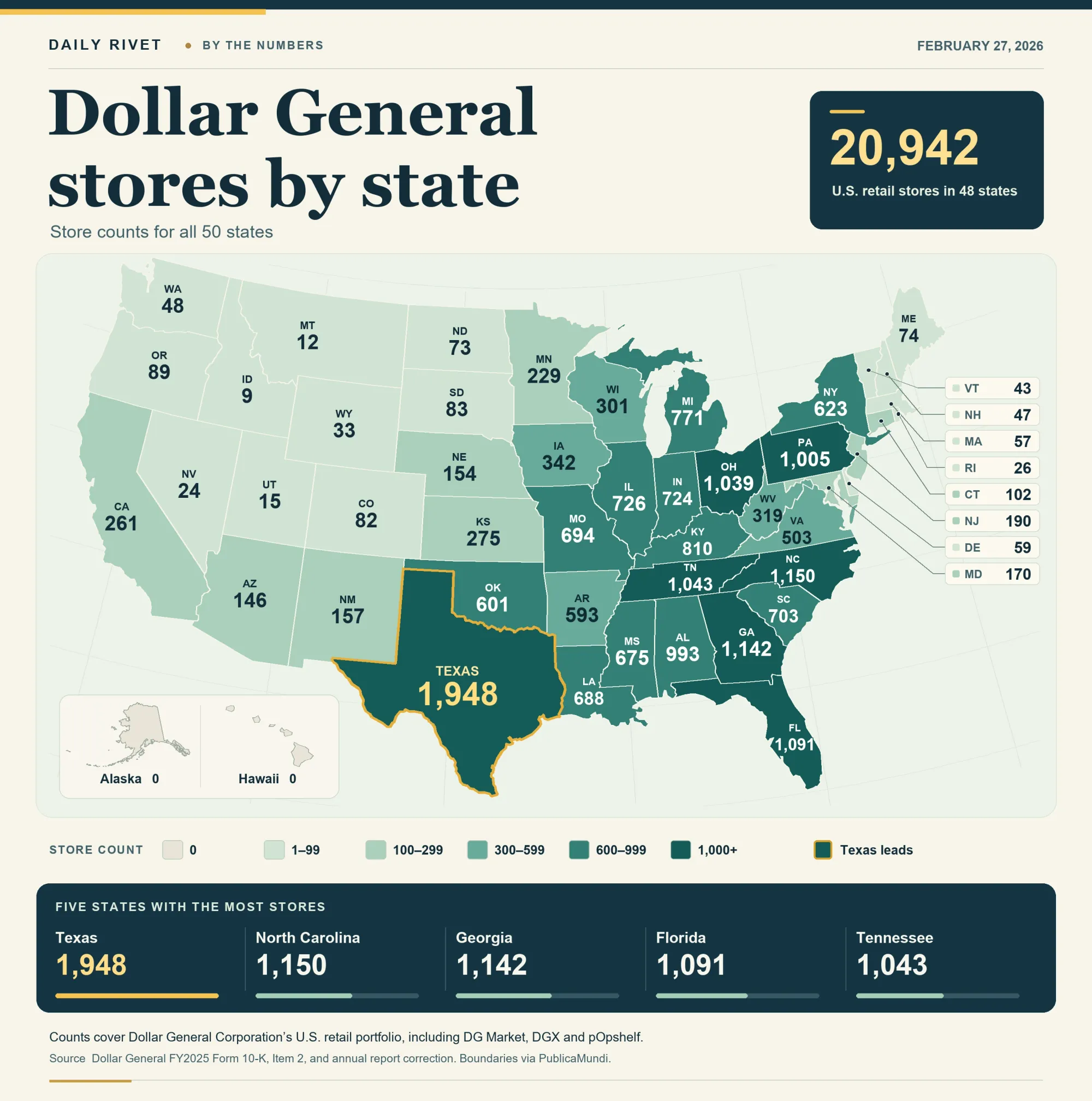
Texas has the most Dollar General Corporation stores, with 1,948 in the company’s February 27, 2026 state count. But relative to population, Mississippi leads: its 675 stores work out to 22.85 for every 100,000 residents.
The counts include the company’s U.S. stores across Dollar General, DG Market, DGX and pOpshelf.
Mississippi leads when population enters the picture
Adjust for population and the order changes. Mississippi has about one store for every 4,400 residents, making its network the most concentrated of any state.
- Mississippi — 22.85 stores per 100,000 residents
- Alabama — 19.12 stores per 100,000 residents
- Arkansas — 19.04 stores per 100,000 residents
- West Virginia — 18.06 stores per 100,000 residents
- Kentucky — 17.58 stores per 100,000 residents
- Louisiana — 14.90 stores per 100,000 residents
- Oklahoma — 14.58 stores per 100,000 residents
- Tennessee — 14.26 stores per 100,000 residents
- South Carolina — 12.62 stores per 100,000 residents
- Missouri — 11.07 stores per 100,000 residents
Mississippi’s rate is roughly 3.7 times Texas’s 6.14 stores per 100,000 residents. Arkansas is another clear example of the difference: 593 stores put it 19th by total, but third by the population-adjusted rate.
Why small towns matter to the map
The concentration makes more sense when you look at the store Dollar General is trying to build. In its 2025 annual report, the company says about 80% of its stores are in towns of 20,000 people or fewer. Its stores average roughly 7,500 square feet of selling space, with simple buildings and a deliberately limited selection within each merchandise category.
The logic is to keep the cost of opening and running a store low while making everyday purchases quick. Dollar General says that combination lets it compete in small markets with fewer shopping alternatives as well as in bigger markets. That helps explain why a national chain's footprint need not follow population alone.
These statewide rates show concentration, not how close a store is to any particular home. A rural household may still face a long drive even in a state with a high store count.
The complete 50-state list
Alphabetical for easy lookup. Each line gives the store count, then stores per 100,000 residents.
- Alabama: 993 stores · 19.12 per 100,000
- Alaska: 0 stores · 0.00 per 100,000
- Arizona: 146 stores · 1.92 per 100,000
- Arkansas: 593 stores · 19.04 per 100,000
- California: 261 stores · 0.66 per 100,000
- Colorado: 82 stores · 1.36 per 100,000
- Connecticut: 102 stores · 2.77 per 100,000
- Delaware: 59 stores · 5.57 per 100,000
- Florida: 1,091 stores · 4.65 per 100,000
- Georgia: 1,142 stores · 10.10 per 100,000
- Hawaii: 0 stores · 0.00 per 100,000
- Idaho: 9 stores · 0.44 per 100,000
- Illinois: 726 stores · 5.71 per 100,000
- Indiana: 724 stores · 10.38 per 100,000
- Iowa: 342 stores · 10.56 per 100,000
- Kansas: 275 stores · 9.24 per 100,000
- Kentucky: 810 stores · 17.58 per 100,000
- Louisiana: 688 stores · 14.90 per 100,000
- Maine: 74 stores · 5.23 per 100,000
- Maryland: 170 stores · 2.71 per 100,000
- Massachusetts: 57 stores · 0.80 per 100,000
- Michigan: 771 stores · 7.61 per 100,000
- Minnesota: 229 stores · 3.93 per 100,000
- Mississippi: 675 stores · 22.85 per 100,000
- Missouri: 694 stores · 11.07 per 100,000
- Montana: 12 stores · 1.05 per 100,000
- Nebraska: 154 stores · 7.63 per 100,000
- Nevada: 24 stores · 0.73 per 100,000
- New Hampshire: 47 stores · 3.32 per 100,000
- New Jersey: 190 stores · 1.99 per 100,000
- New Mexico: 157 stores · 7.39 per 100,000
- New York: 623 stores · 3.11 per 100,000
- North Carolina: 1,150 stores · 10.27 per 100,000
- North Dakota: 73 stores · 9.13 per 100,000
- Ohio: 1,039 stores · 8.73 per 100,000
- Oklahoma: 601 stores · 14.58 per 100,000
- Oregon: 89 stores · 2.08 per 100,000
- Pennsylvania: 1,005 stores · 7.70 per 100,000
- Rhode Island: 26 stores · 2.33 per 100,000
- South Carolina: 703 stores · 12.62 per 100,000
- South Dakota: 83 stores · 8.88 per 100,000
- Tennessee: 1,043 stores · 14.26 per 100,000
- Texas: 1,948 stores · 6.14 per 100,000
- Utah: 15 stores · 0.42 per 100,000
- Vermont: 43 stores · 6.67 per 100,000
- Virginia: 503 stores · 5.66 per 100,000
- Washington: 48 stores · 0.60 per 100,000
- West Virginia: 319 stores · 18.06 per 100,000
- Wisconsin: 301 stores · 5.04 per 100,000
- Wyoming: 33 stores · 5.61 per 100,000
Dollar General operates in 48 states, with no stores in Alaska or Hawaii.
How the figures were calculated
Store counts come from Dollar General’s 2025 annual report and cover its U.S. locations on February 27, 2026.
Rates use the Census Bureau’s July 1, 2025 population estimates. For each state, the store count is divided by its population and multiplied by 100,000.
For the national picture, compare America’s largest retail chains by store count.
Recommended