How Music Formats Changed From 1970 to 2025
Vinyl → cassette → CD → downloads → streaming: more than six decades of change in how Americans bought and listened to music.
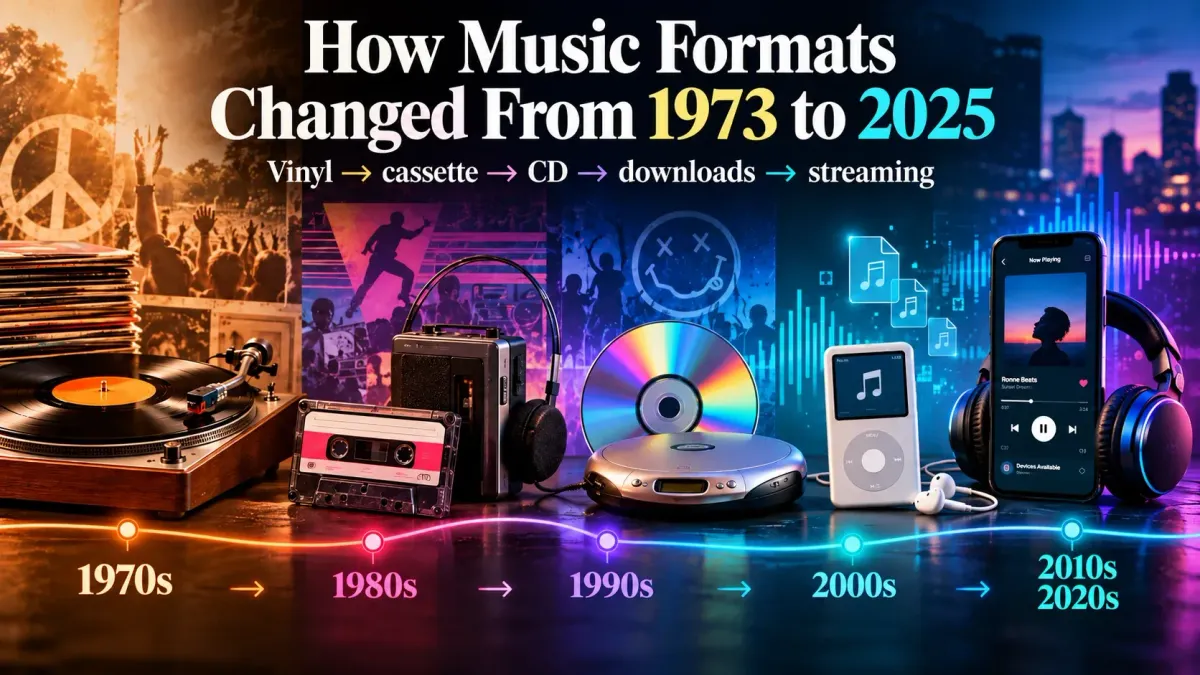
Vinyl → cassette → CD → downloads → streaming: more than six decades of change in how Americans bought and listened to music.
For most of the history of recorded music, listening to a new album meant buying something you could physically hold. In the 1960s and 1970s, that usually meant a vinyl record. By the 1980s, millions of Americans were carrying music around on cassette tapes. CDs transformed the market again in the 1990s, followed by digital downloads in the 2000s. Then streaming changed the relationship between listeners and music more fundamentally than any format before it.
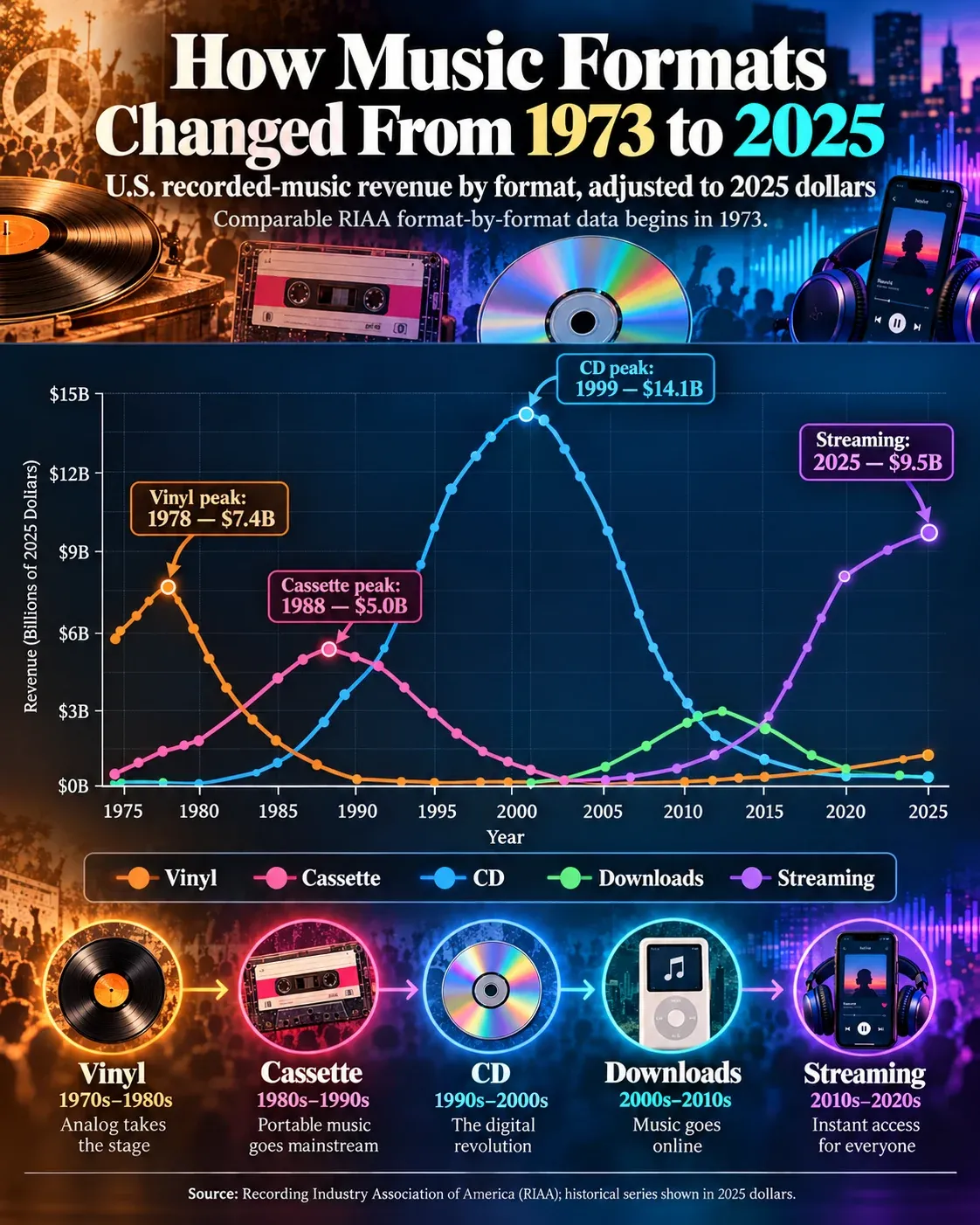
Each new format seemed dominant in its moment, but most eventually gave way to something newer. More than 50 years of U.S. recorded-music revenue data from the Recording Industry Association of America shows that transition clearly. Vinyl rises and falls, cassettes surge and then disappear, CDs grow into an enormous business before collapsing, and downloads enjoy a relatively brief period of dominance before streaming overwhelms the market. Then, in one of the more unexpected turns in the story, vinyl begins to grow again.
Note: Comparable RIAA format-by-format revenue data begins in 1973, so the detailed visualization for this article starts there. The years before 1973 are included as historical context for the vinyl era.
The vinyl era
At the beginning of this story, there was little doubt about which format defined recorded music. Vinyl had become deeply embedded in popular culture by the 1960s, and the entire music business was built around the record itself. Albums were sold through record stores, played on home stereo systems, and presented as complete physical packages with artwork, liner notes, and carefully sequenced tracks.
That business continued to grow through the 1970s. Adjusted for inflation, U.S. LP and EP revenue reached roughly $7.4 billion in 2025 dollars in 1978, making vinyl the clear center of the recorded-music market.
Even at that peak, however, another format was gaining ground. The cassette offered something vinyl could not: portability. It could be played in a car, carried in a portable player, copied onto blank tape, and used in ways that records simply could not match. As music listening became more mobile, the cassette began to move from a secondary format into the mainstream.
Cassettes take over the 1980s
The transition from vinyl to cassette happened gradually rather than all at once. In 1980, inflation-adjusted vinyl revenue was still roughly $5.2 billion, compared with about $1.5 billion for cassettes. Five years later, however, the balance had shifted. By 1985, cassette revenue had climbed to approximately $3.9 billion, while vinyl had fallen to about $2.3 billion.
Cassettes reached their inflation-adjusted peak around 1988, at roughly $5.0 billion in 2025 dollars. By then, they had become the dominant physical format for many listeners.
The appeal was easy to understand. Cassettes worked in home stereos, boom boxes, cars, and portable players. Sony's Walkman helped turn music into a personal, mobile experience, while blank tapes made it possible to build mixtapes, record radio broadcasts, and create customized collections long before digital playlists existed.
Yet even as cassettes reached their commercial high point, the next major format had already arrived.
CDs changed the scale of the music business
Compact discs began appearing in RIAA revenue data in the early 1980s. At first, they were expensive and relatively uncommon, but as CD players became cheaper and more widely available, adoption accelerated quickly.
The transition becomes especially clear around 1990. Adjusted to 2025 dollars, U.S. cassette revenue that year was approximately $4.7 billion, while CD revenue had reached about $4.9 billion. It was almost a perfect handoff from one dominant format to the next.
From there, the CD business exploded. By 1995, inflation-adjusted CD revenue had climbed above $11 billion, while cassette revenue had fallen below $3 billion. The format reached its peak in 1999, when CDs generated the equivalent of approximately $14.1 billion in 2025 dollars.
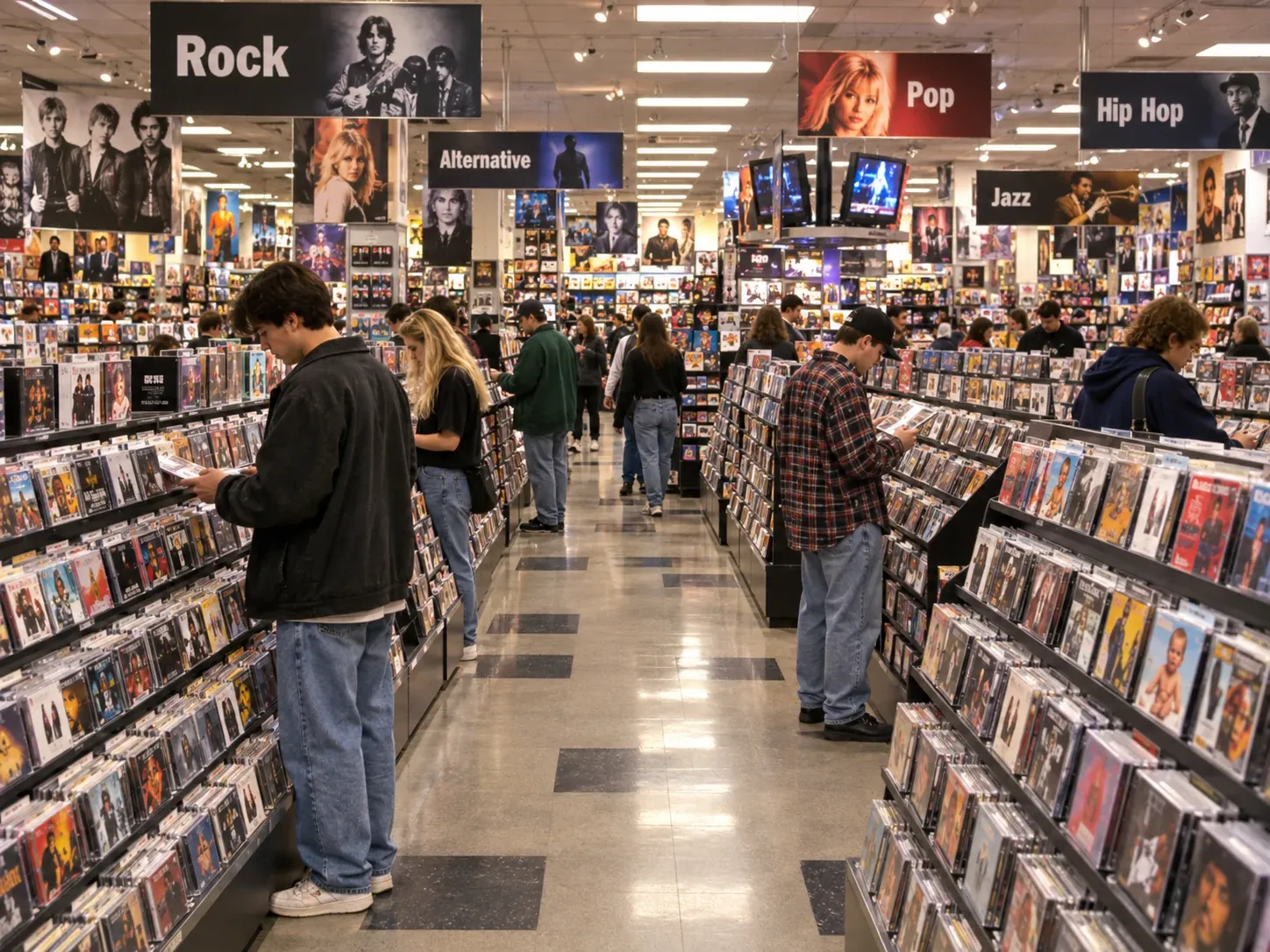
That scale matters because CDs were not simply replacing cassettes. They helped create one of the most lucrative periods the recorded-music industry had ever seen. Consumers bought new releases on CD, but many also repurchased albums they already owned on vinyl or cassette. The transition created a powerful combination of new demand and replacement demand.
For a time, it looked as though the compact disc might become the final physical format. Instead, its decline would prove much faster than its rise.
The CD empire begins to fall
CD revenue remained near its historic high around 2000, but within just a few years the market had clearly started to change. By 2005, inflation-adjusted U.S. CD revenue had fallen to roughly $9.9 billion. That was still a huge business, but digital distribution was beginning to reshape what consumers expected from recorded music.
The important shift was not simply from one format to another. Music itself was becoming a file.
As broadband internet expanded and portable digital players became more common, consumers gained the ability to buy individual songs without purchasing an entire album. Apple's iTunes Store helped normalize that behavior and made the idea of paying for a single track feel completely ordinary.
That represented a major break from the structure of the previous several decades. Vinyl, cassettes, and CDs had all preserved the idea of music as a packaged product. Downloads began to separate the song from the physical object, and increasingly from the album as well.
Downloads briefly become the future

The digital-download era was important, but surprisingly short when viewed across the full timeline.
In 2005, inflation-adjusted album and single download revenue was only about $600 million. By 2010, downloads had climbed to approximately $2.4 billion, putting them close to CDs, which had fallen to around $2.9 billion.
Two years later, the positions had reversed. In 2012, downloads generated roughly $2.9 billion in inflation-adjusted revenue, compared with about $2.0 billion from CDs. RIAA data shows downloads reaching about 43% of U.S. recorded-music revenue in 2012, their high-water mark as a share of the market.
For a brief period, buying music from iTunes or another digital store appeared to be the natural successor to buying a CD. Consumers could purchase exactly the songs they wanted, store them on a computer or portable player, and carry thousands of tracks in a pocket.
But while downloads seemed like the future, another model was already gaining traction. Instead of buying and owning individual files, listeners were increasingly paying for access to vast libraries of music.
Streaming ends the age of buying music
Streaming changed more than the delivery format. It changed the underlying transaction.
With vinyl, cassette, CDs, and downloads, consumers generally paid to acquire a specific recording. Streaming shifted the market toward recurring access instead. Rather than buying one album or song at a time, listeners could pay a monthly fee and gain access to millions of tracks.
That change happened quickly. By 2015, download revenue was still significant, but streaming had grown enough to challenge it. During the second half of the decade, the balance shifted decisively.
By 2020, the gap was enormous. Inflation-adjusted download revenue had fallen to around $560 million, while streaming generated more than $8 billion.
The decline of downloads continued from there. By 2024, downloads represented only about 2% of U.S. recorded-music revenue, down from their 43% peak in 2012.
In 2025, streaming was operating on a completely different scale. RIAA reported $9.47 billion in U.S. wholesale streaming revenue, compared with only about $273 million from total downloads.
For the first time in this timeline, the dominant format was not really a format at all. It was access.
But vinyl came back

One of the most interesting parts of the entire story is what happened to the format that started it.
Vinyl never returned to anything close to its 1970s dominance, but it did something few obsolete technologies manage to do: it became a meaningful business again.
After nearly disappearing from the mainstream during the CD era, vinyl sales began to climb steadily. By 2025, RIAA reported 46.8 million vinyl units and approximately $1.04 billion in wholesale vinyl revenue. CDs, by comparison, generated about $312 million from 29.5 million units.
Vinyl revenue increased 9.3% from 2024 to 2025 even as CD revenue declined 7.8%.
That does not mean consumers are abandoning streaming and returning to turntables. Instead, the modern market appears to have split into two very different kinds of music consumption. Streaming dominates everyday listening because it is fast, convenient, and nearly unlimited. Vinyl appeals to listeners who still value the physical object, the artwork, the ritual of playing a record, or the idea of owning something tangible.
In other words, streaming provides convenience, while vinyl provides ownership.
Five formats, five very different peaks
The scale of each era becomes easier to understand when the major formats are compared at or near their inflation-adjusted highs.
| Format | Approximate peak period | Inflation-adjusted revenue |
|---|---|---|
| Vinyl | 1978 | $7.4 billion |
| Cassette | 1988 | $5.0 billion |
| CD | 1999 | $14.1 billion |
| Downloads | 2012 | $2.9 billion |
| Streaming | 2025 | $9.5 billion* |
2025 streaming figure reflects RIAA wholesale revenue reported for that year rather than an inflation adjustment of an earlier year's figure.
The CD era stands out immediately. At its peak, CD revenue was nearly twice the inflation-adjusted peak of vinyl and almost three times the cassette peak. Downloads, despite fundamentally changing the way people bought music, never reached anything close to that scale. Streaming eventually did, but through a completely different business model.
The handoffs tell the story
Looking only at the peaks does not fully explain how quickly the market changed. The crossover points tell the story even more clearly.
During the middle of the 1980s, cassettes passed vinyl. Around 1990, CDs passed cassettes. In the early 2010s, downloads passed CDs. Only a few years later, streaming passed downloads.
Each transition happened faster than the one before it.
Vinyl remained commercially important for decades. Cassettes dominated for a shorter period. CDs reached extraordinary heights but began falling sharply once digital distribution became practical. Downloads barely had time to establish themselves as the new standard before streaming overtook them.
The technology was not just changing. The pace of change was accelerating.
From owning an album to accessing almost every album
There is an even larger story behind the numbers.
In 1975, the music industry depended on selling individual physical objects. A record was manufactured, shipped to a store, purchased by a customer, and added to a personal collection.
Cassettes preserved that model, as did CDs.
Downloads removed the physical object but kept much of the ownership model intact. Consumers still selected a song or album, paid for it, and added it to a digital library.
Streaming broke that relationship.
Today's listener can pay one subscription and gain access to a music library vastly larger than any personal collection most people could have imagined owning.
That is why the move from downloads to streaming feels more significant than the earlier transitions. Vinyl became cassette. Cassette became CD. CD became a digital file. Streaming did not simply replace the file. It replaced the need to own one.
And yet the record survived
More than six decades after vinyl helped define American music listening, records are still being sold by the tens of millions.
Cassettes have largely disappeared from the mainstream. CDs are only a fraction of the business they once were. Paid downloads, once presented as the future of music, have fallen into a small corner of the market.
Vinyl somehow remains.
Its survival does not change the larger picture. Streaming accounted for the overwhelming majority of U.S. recorded-music revenue in 2025, generating nearly $9.5 billion at wholesale.
But vinyl's revival gives this timeline an unusual ending. The oldest major format in the chart is no longer dominant, but it is the physical format that managed to survive nearly everything that was supposed to replace it.
Source: Recording Industry Association of America (RIAA) U.S. recorded-music revenue data and year-end reports. Historical comparisons are shown in inflation-adjusted 2025 dollars where noted. The detailed RIAA format series begins in 1973; 1960–1972 is included as historical context.
Recommended