The Artists Who Dominated the Billboard Charts the Longest

Rihanna sits just above the Beatles in this ranking, although the Beatles had more No. 1 singles. Boyz II Men are close behind with only five. Counting weeks at the top produces a different picture of pop success: the number of hits matters, but so does how long each one holds off the competition.
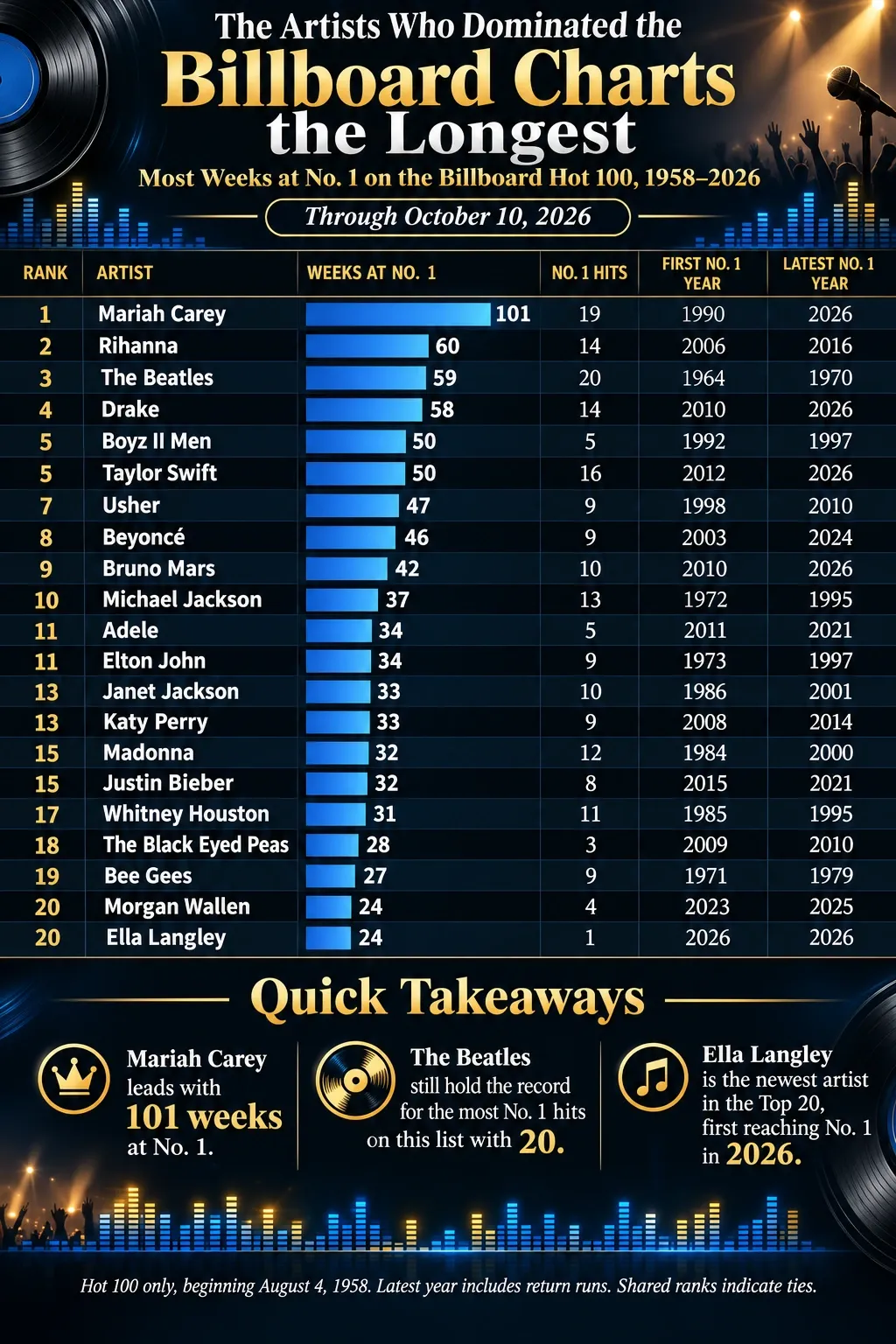
We ranked artists by their cumulative weeks at No. 1 on the Billboard Hot 100. The table brings together careers that unfolded very differently, from a succession of hits within a few years to returns to the top across decades.
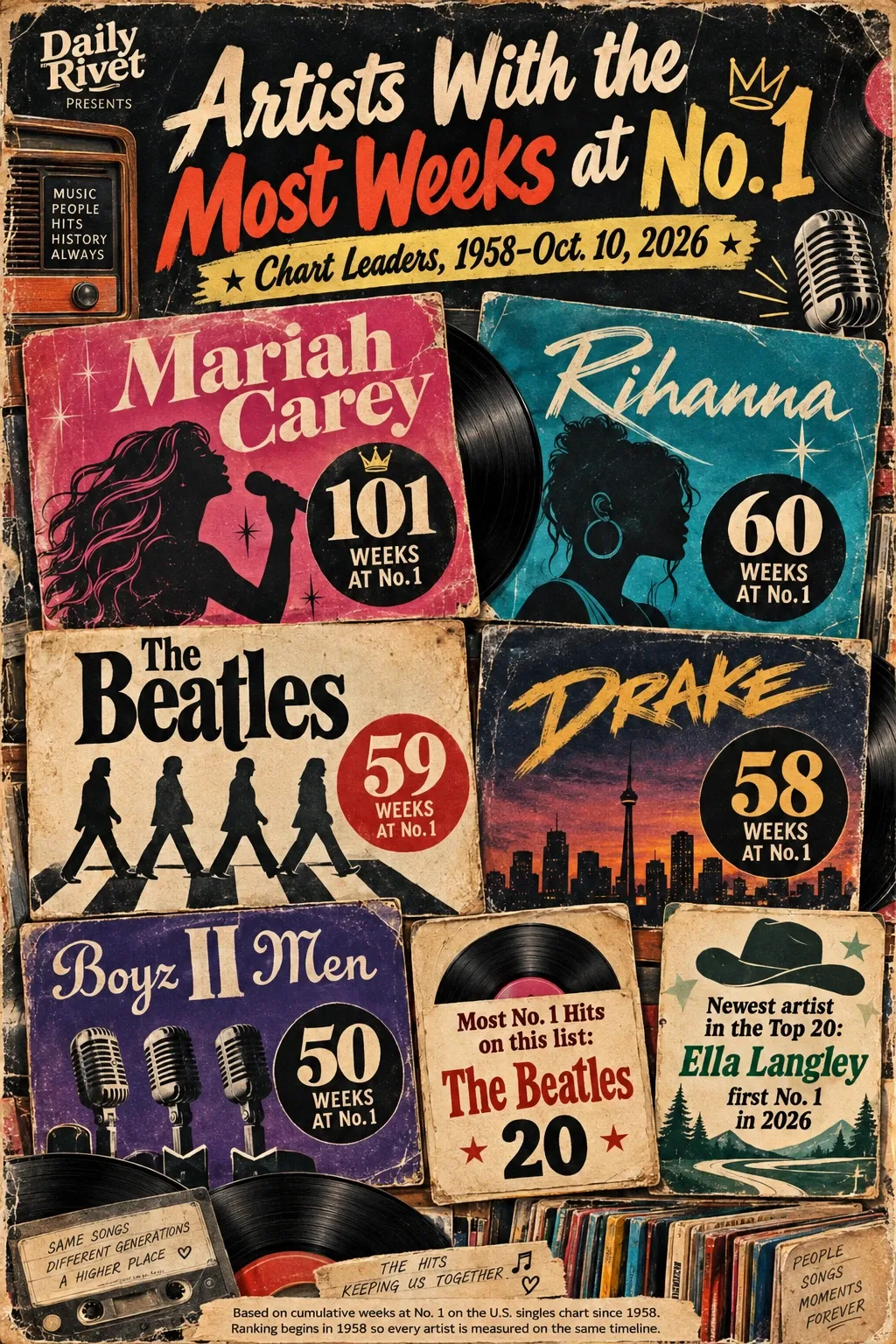
The Artists With the Most Weeks at No. 1 on the Billboard Hot 100
| Rank | Artist | Weeks at No. 1 | No. 1 Hits | First Hot 100 No. 1 | Latest Hot 100 No. 1 | Longest-Running No. 1 |
|---|---|---|---|---|---|---|
| 1 | Mariah Carey | 101 | 19 | “Vision of Love” — 1990 | “All I Want for Christmas Is You” — 2026* | “All I Want for Christmas Is You” — 22 weeks |
| 2 | Rihanna | 60 | 14 | “SOS” — 2006 | “Work” — 2016 | “We Found Love” — 10 weeks |
| 3 | The Beatles | 59 | 20 | “I Want to Hold Your Hand” — 1964 | “The Long and Winding Road” — 1970 | “Hey Jude” — 9 weeks |
| 4 | Drake | 58 | 14 | “What’s My Name?” — 2010 | “Janice STFU” — 2026 | “God’s Plan” — 11 weeks |
| 5 | Boyz II Men | 50 | 5 | “End of the Road” — 1992 | “4 Seasons of Loneliness” — 1997 | “One Sweet Day” — 16 weeks |
| 5 | Taylor Swift | 50 | 16 | “We Are Never Ever Getting Back Together” — 2012 | “Patient Zero” — 2026 | “The Fate of Ophelia” — 10 weeks |
| 7 | Usher | 47 | 9 | “Nice & Slow” — 1998 | “OMG” — 2010 | “Yeah!” — 12 weeks |
| 8 | Beyoncé | 46 | 9 | “Crazy in Love” — 2003 | “Texas Hold ’Em” — 2024 | “Irreplaceable” — 10 weeks |
| 9 | Bruno Mars | 42 | 10 | “Nothin’ on You” — 2010 | “I Just Might” — 2026 | “Uptown Funk!” — 14 weeks |
| 10 | Michael Jackson | 37 | 13 | “Ben” — 1972 | “You Are Not Alone” — 1995 | “Billie Jean” / “Black or White” — 7 weeks |
| 11 | Adele | 34 | 5 | “Rolling in the Deep” — 2011 | “Easy on Me” — 2021 | “Hello” / “Easy on Me” — 10 weeks |
| 11 | Elton John | 34 | 9 | “Crocodile Rock” — 1973 | “Candle in the Wind 1997” / “Something About the Way You Look Tonight” — 1997 | “Candle in the Wind 1997” — 14 weeks |
| 13 | Janet Jackson | 33 | 10 | “When I Think of You” — 1986 | “All for You” — 2001 | “That’s the Way Love Goes” — 8 weeks |
| 13 | Katy Perry | 33 | 9 | “I Kissed a Girl” — 2008 | “Dark Horse” — 2014 | “I Kissed a Girl” — 7 weeks |
| 15 | Madonna | 32 | 12 | “Like a Virgin” — 1984 | “Music” — 2000 | “Take a Bow” — 7 weeks |
| 15 | Justin Bieber | 32 | 8 | “What Do You Mean?” — 2015 | “Stay” — 2021 | “Despacito” — 16 weeks |
| 17 | Whitney Houston | 31 | 11 | “Saving All My Love for You” — 1985 | “Exhale (Shoop Shoop)” — 1995 | “I Will Always Love You” — 14 weeks |
| 18 | The Black Eyed Peas | 28 | 3 | “Boom Boom Pow” — 2009 | “Imma Be” — 2010 | “I Gotta Feeling” — 14 weeks |
| 19 | Bee Gees | 27 | 9 | “How Can You Mend a Broken Heart” — 1971 | “Love You Inside Out” — 1979 | “Night Fever” — 8 weeks |
| 20 | Morgan Wallen | 24 | 4 | “Last Night” — 2023 | “What I Want” — 2025 | “Last Night” — 16 weeks |
| 20 | Ella Langley | 24 | 1 | “Choosin’ Texas” — 2026 | “Choosin’ Texas” — 2026 | “Choosin’ Texas” — 24 weeks |
*The latest chart year reflects the most recent No. 1 appearance of a song, including return runs. Mariah Carey’s Christmas single first reached No. 1 in 2019 and its latest No. 1 chart date falls in January 2026.
How we counted: This comparison covers the Hot 100 from its launch on August 4, 1958, through the chart dated October 10, 2026. It counts cumulative weeks, including nonconsecutive returns, and includes individual artist credits on collaborations and featured appearances. Separately credited groups are kept separate from their members’ solo records. Shared No. 1 songs contribute to each credited artist’s total; ranks are tied where totals match.
The cutoff matters because active artists can add weeks with each new chart. The latest changes are documented in Billboard’s October report on Taylor Swift and its report on Ella Langley’s 24-week run. Earlier Billboard charts are excluded, a limitation particularly relevant to Elvis Presley.
1. Mariah Carey — 101 Weeks
Mariah Carey’s lead keeps growing in a way few pop careers could have been planned to do. “All I Want for Christmas Is You” was released in 1994, but did not reach No. 1 until 2019. Its annual returns now add to a record built long before streaming made a decades-old Christmas single a regular chart contender.
“Vision of Love,” “Fantasy” and “We Belong Together” established her place among the chart’s most successful artists; the holiday song gives her a recurring opportunity to extend it. A new December run can increase her career total without a new single being released.
2. Rihanna — 60 Weeks
Rihanna accumulated her No. 1 weeks between “SOS” in 2006 and “Work” in 2016. Her position above the Beatles is striking because it comes from fewer chart-topping singles, with “We Found Love” alone contributing ten weeks.
The succession of hits also crossed styles: “Umbrella,” “Disturbia,” “Only Girl (In the World)” and “Diamonds” sound quite different from one another. Taken together, they make this part of the table feel like a record of a particular decade, when a new Rihanna single was a frequent presence near the top of the chart.
3. The Beatles — 59 Weeks
The Beatles’ 20 No. 1 singles arrived between 1964 and 1970. That is a remarkably compressed period for a catalog that still feels so large: their first American chart-topper, “I Want to Hold Your Hand,” and their last, “The Long and Winding Road,” sit barely six years apart.
“Hey Jude” supplied their longest run, at nine weeks. But the shape of their success was a succession of chart-toppers rather than dependence on one unusually durable song. A ranking by number of No. 1 hits puts them ahead of everybody here; counting weeks changes the order.
4. Drake — 58 Weeks
Drake’s first No. 1 credit belongs to a Rihanna record. His appearance on “What’s My Name?” in 2010 counts toward his total, just as his own releases do. It is a useful reminder that this ranking follows the artist credits on the chart, including featured appearances.
Later hits such as “One Dance,” “God’s Plan” and “In My Feelings” gave him extended runs of his own. “God’s Plan” accounts for eleven weeks, while his more recent “Janice STFU” spent two weeks on top. That second week brought his career total to 58, as Billboard documented.
5. Boyz II Men — 50 Weeks
Three songs account for 43 of Boyz II Men’s 50 weeks at No. 1. “End of the Road” held the position for thirteen weeks, “I’ll Make Love to You” for fourteen, and the Mariah Carey collaboration “One Sweet Day” for sixteen.
With those ballads, the group could occupy the top of the chart for months at a time. Their five No. 1 singles place them alongside artists with far more hits, and the comparison captures something that a simple song count misses: once Boyz II Men reached the top, dislodging them could take a while.
5. Taylor Swift — 50 Weeks
Taylor Swift’s No. 1 history began with “We Are Never Ever Getting Back Together” in 2012, several albums into her career. It now includes successes from distinct phases of her songwriting, from “Shake It Off” and “Blank Space” to “Cardigan” and “Anti-Hero.”
Her latest move changes the ranking. “Patient Zero” debuted at No. 1 on the chart dated October 10, 2026, becoming her sixteenth chart-topper and bringing her to 50 career weeks. She now ties Boyz II Men, although their totals come from very different numbers of songs.
7. Usher — 47 Weeks
In 2004, Usher’s No. 1 singles accounted for 28 weeks at the top: twelve for “Yeah!,” eight for “Burn,” two for “Confessions Part II” and six for “My Boo,” his duet with Alicia Keys. More than half his career total comes from that one year.
There were hits on either side of it, beginning with “Nice & Slow” in 1998 and extending to “OMG” in 2010. But the Confessions period is the center of this story. The figures give some scale to how thoroughly those songs occupied the chart during 2004.
8. Beyoncé — 46 Weeks
Beyoncé’s entry starts with “Crazy in Love” in 2003. The No. 1 weeks she earned with Destiny’s Child belong to the group’s separate chart record, so this total covers only releases credited to her individually, including collaborations.
Within that span, “Irreplaceable” contributed ten weeks, while “Texas Hold ’Em” took her back to No. 1 in 2024. Those songs frame a career that kept finding new routes to the top across more than twenty years. The group-credit distinction also explains why this row does not capture her entire history as a performer.
9. Bruno Mars — 42 Weeks
Two collaborations help explain Bruno Mars’ place. B.o.B’s “Nothin’ on You” gave him his first No. 1 credit in 2010, and Mark Ronson’s “Uptown Funk!” supplied fourteen weeks at the top in 2015.
His own singles, including “Just the Way You Are,” “Grenade” and “That’s What I Like,” sit alongside those records. The total measures the chart success of releases on which he receives an individual artist credit. That is why his contribution to a collaborator’s single belongs here, while a separately credited group such as Silk Sonic is treated on its own.
10. Michael Jackson — 37 Weeks
Michael Jackson’s 37 weeks may look modest beside some of the artists above him. It is a useful place to pause before treating the table as a ranking of musical importance. Time at No. 1 captures one part of a career; album sales, videos, touring and influence fall outside it.
His individual chart record runs from “Ben” in 1972 to “You Are Not Alone” in 1995, with “Billie Jean” and “Black or White” each spending seven weeks on top. Like Beyoncé’s entry, his total leaves the group’s record separate: the Jackson 5’s No. 1 weeks are not added to his solo tally.
A Few No. 1 Hits Can Add Up Quickly
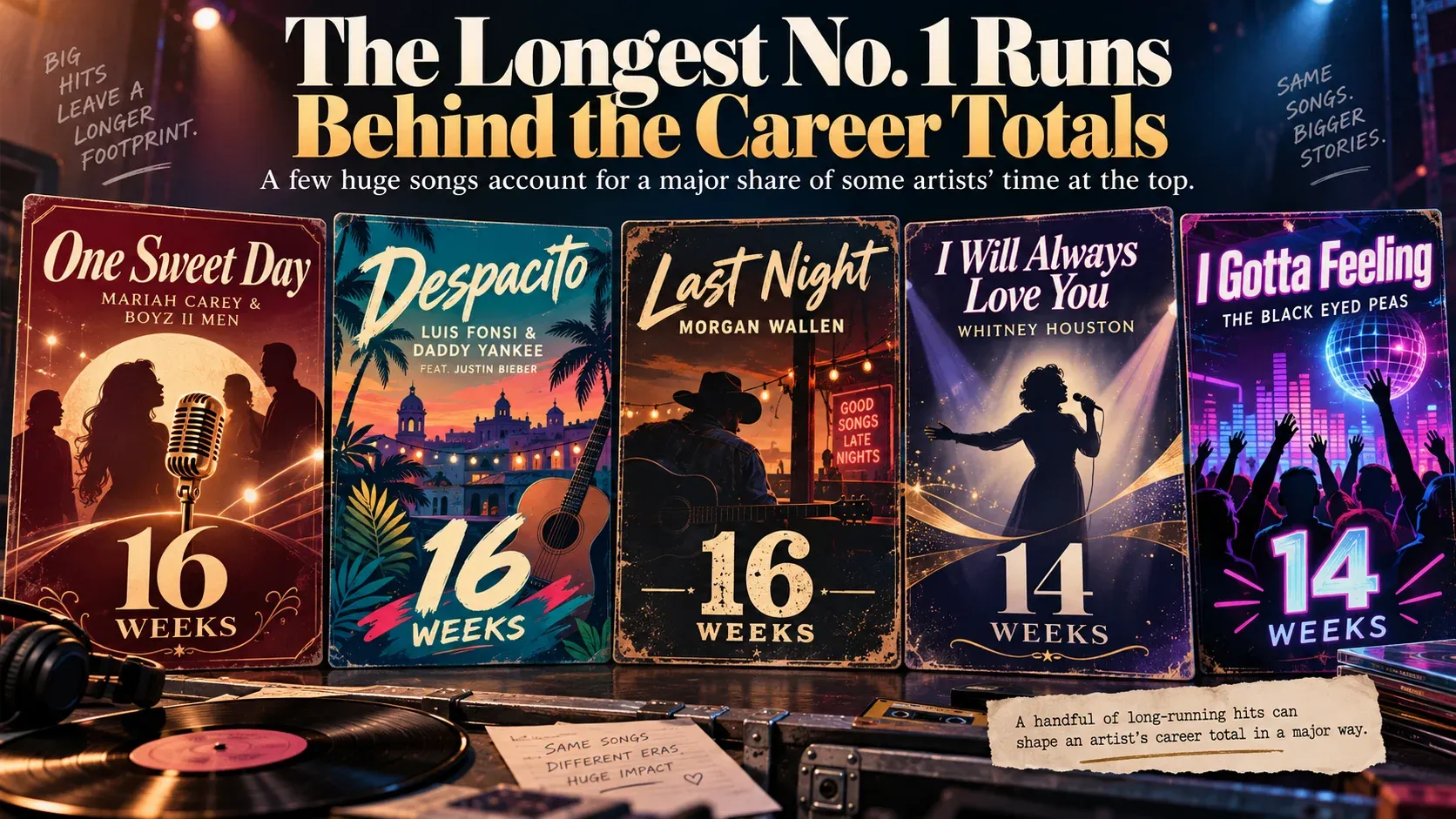
The Black Eyed Peas spent a combined 26 weeks at No. 1 with “Boom Boom Pow” and “I Gotta Feeling,” before “Imma Be” added another two. Almost their entire total comes from those first two singles. A relatively brief run of releases can therefore put an act high in a career ranking.
Collaborations can have a similar effect. Justin Bieber’s credit on “Despacito” contributes sixteen of his 32 weeks, while Morgan Wallen’s “Last Night” supplies sixteen of his 24. The table rewards these extended runs heavily, so it is worth looking at the longest-running song alongside the career total.
Ella Langley has now reached the same 24-week total as Wallen with “Choosin’ Texas” alone. That puts her in a tie at the table’s cutoff, which is why the first twenty ranks contain 21 artists.
What the Years and Credits Tell Us
A long span between the first and latest No. 1 does not mean an artist spent every intervening year near the top. Likewise, a short span can contain an enormous amount of success. Reading the dates alongside the weeks helps distinguish repeated comebacks from a concentrated run.
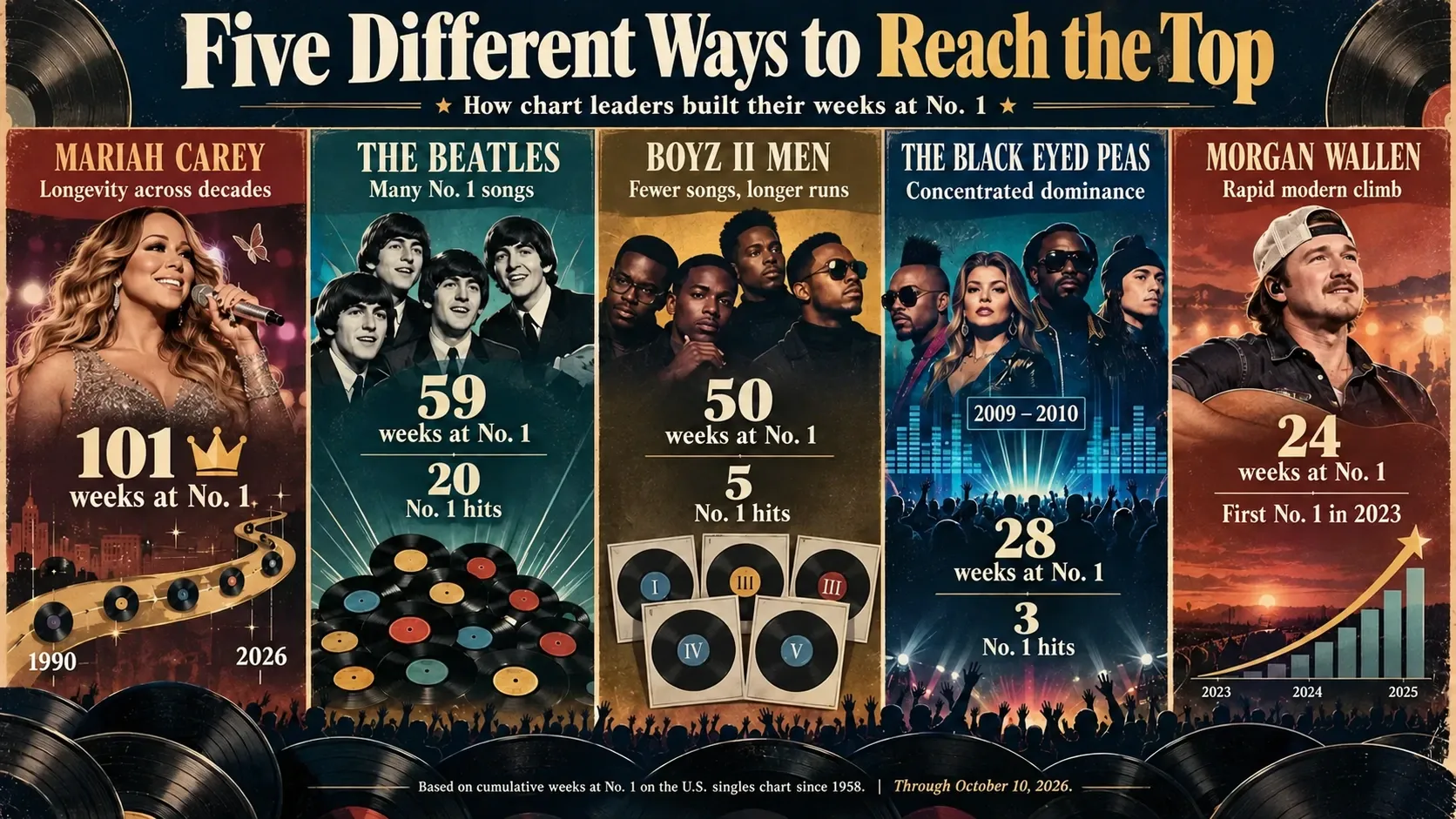
The Bee Gees’ nine No. 1 singles came between 1971 and 1979, while the Black Eyed Peas accumulated their total in 2009 and 2010. Beyoncé’s individual No. 1 credits stretch from 2003 to 2024. Each pattern tells us something different about how the artist fits into pop history.
Elton John’s entry also shows why the chart name matters. His latest Hot 100 No. 1 was the 1997 double-sided single “Candle in the Wind 1997” / “Something About the Way You Look Tonight.” “Cold Heart,” with Dua Lipa, reached No. 7 on the Hot 100, although it topped other charts. It is a later success, but it cannot extend a career span specifically measured by Hot 100 No. 1s.
Elvis Presley poses a different problem: some of his biggest hits predate the Hot 100. Beginning in August 1958 leaves those earlier weeks outside the comparison. The dates give the ranking a consistent starting point, but also limit what it can say about artists already established before then.
What Weeks at No. 1 Can’t Measure
A week at the top in the 1960s and a week at the top today are recorded in the same column, despite changes in how the chart is compiled. Sales, airplay, downloads and streaming have played different roles over its history. Our related look at how music formats changed follows the shifts in how audiences bought and listened to those records.

That makes the table useful for comparing chart records, with some care about what the comparison means. It does not measure who made the most influential music, sold the most albums or mattered most to a particular generation. A performer can leave a lasting mark without ever approaching these totals.
The most revealing differences are often between neighboring rows: fewer hits that stayed longer, many hits arriving in quick succession, or a familiar song returning years after its original release. Those are different kinds of success, and the number of weeks gives us a way to examine them.
Recommended