The Hottest Christmas Toy Every Year of the 1990s
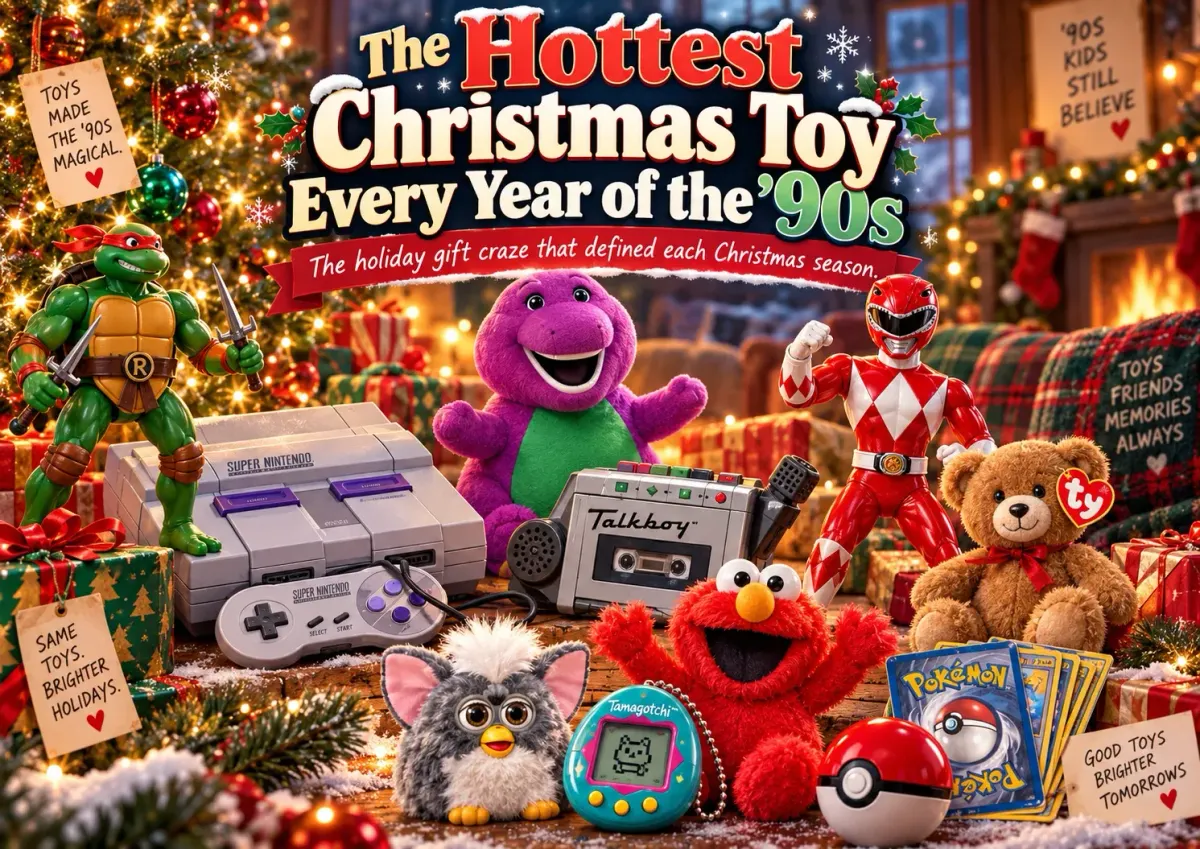
Before online shopping made almost anything obtainable with a few clicks, finding the hottest Christmas toy could become a holiday adventure all its own. During the 1990s, parents called stores, waited for delivery trucks, searched crowded malls and sometimes paid several times retail price just to put the right box under the tree.
Every Christmas seemed to have one toy that rose above everything else.
It was the gift kids circled in catalogs, talked about at school and added to their lists for Santa. By December, commercials had made it impossible to ignore, stores struggled to keep it on the shelves, and parents began wondering how many shopping centers they might have to visit before finally finding one.
The 1990s were particularly good at creating these holiday sensations. The decade began with Teenage Mutant Ninja Turtles filling toy aisles and ended with Pokémon seemingly taking over the world. In between came video game systems, talking dinosaurs, movie-inspired gadgets, virtual pets and a red furry monster that caused one of the most famous Christmas shopping frenzies ever.
There was no official organization that crowned a single “hottest Christmas toy” every year, and some holiday seasons had several products competing for that title. This list is not intended to be a strict ranking based solely on annual unit sales. Instead, we are looking at the toy or toy line that best captured the must-have Christmas energy of each season, combining popularity, cultural buzz, scarcity and the kind of childhood obsession that could send parents from store to store.
Here is a trip through Christmas morning in the 1990s.
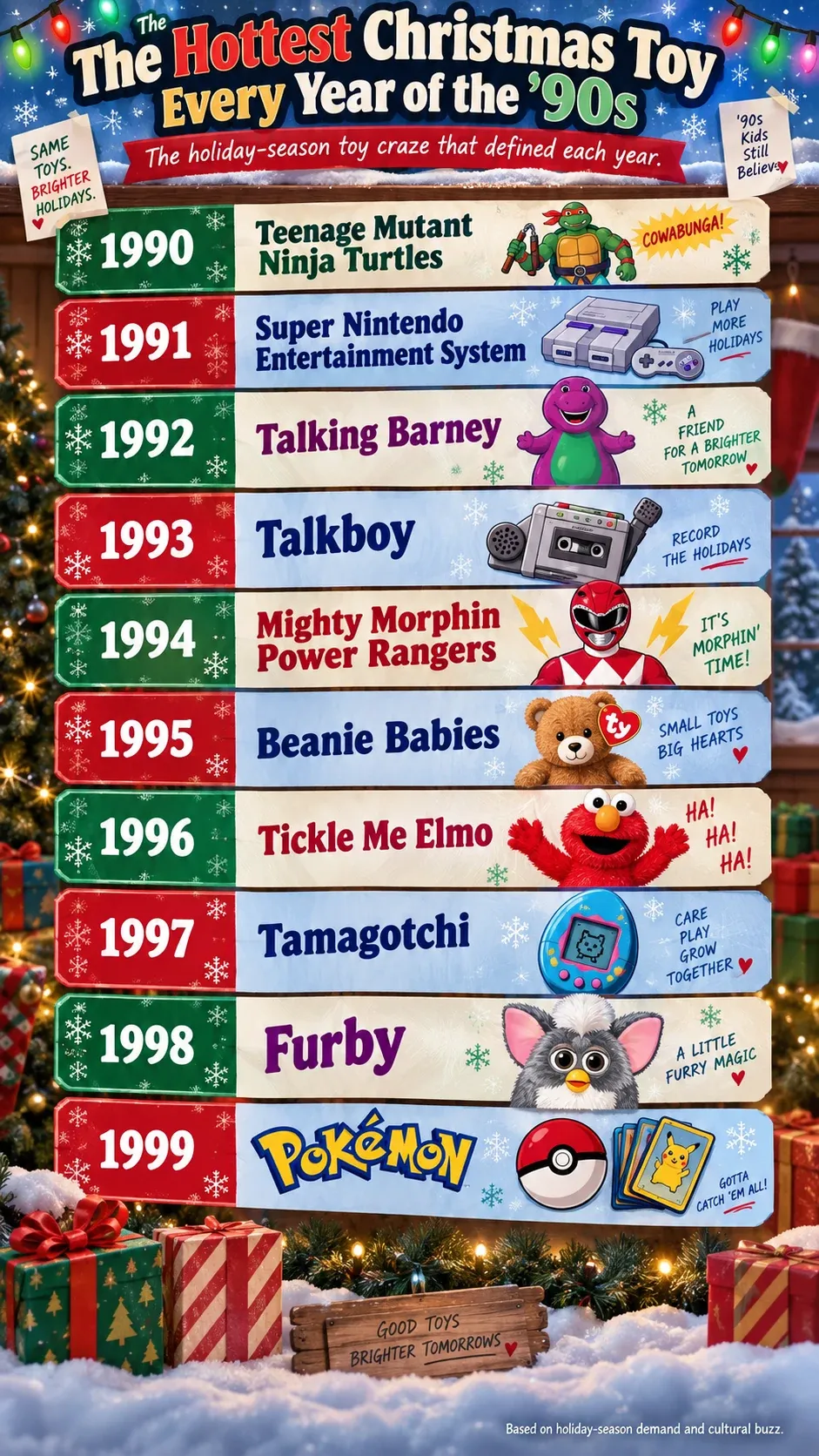
1990: Teenage Mutant Ninja Turtles
If you were a kid at the beginning of the decade, there was a good chance four pizza-loving turtles had already taken over some part of your bedroom.
Teenage Mutant Ninja Turtles had grown from an independent comic book into a full-scale children's entertainment phenomenon. The animated series was everywhere, the first live-action movie became a major box-office success in 1990, and Playmates Toys had built an enormous collection of action figures, vehicles and playsets around Leonardo, Donatello, Michelangelo and Raphael.
By the time Christmas arrived, the Turtles were not simply popular characters. They were dominating toy aisles. Contemporary reporting from the Los Angeles Times described Teenage Mutant Ninja Turtles as the nation's hottest-selling toy characters in late 1990, and retailers were devoting more space to the franchise as demand continued to grow.
Part of the appeal was that there was never just one Turtle toy to own. A child who already had Leonardo could still ask for the Party Wagon, the Technodrome, Shredder, Bebop, Rocksteady or one of the increasingly strange supporting characters that Playmates continued adding to the line.
That made Teenage Mutant Ninja Turtles almost perfectly designed for Christmas. One box under the tree could quickly turn into an entire universe of figures, vehicles and playsets.
The must-have: Teenage Mutant Ninja Turtles action figures and playsets
1991: Super Nintendo Entertainment System
Christmas 1991 marked the beginning of a new era for Nintendo.
The original Nintendo Entertainment System had already become one of the defining toys of the late 1980s, but video games were changing quickly. Sega's Genesis was pushing the industry toward faster, more colorful 16-bit games, and Nintendo responded with the Super Nintendo Entertainment System.
The American version arrived just months before Christmas, giving families a new candidate for the biggest gift under the tree. At around $199, the Super Nintendo was considerably more expensive than the average toy, but that was also part of what made it special. This was the kind of present that often sat at the very top of a child's Christmas list, the large box you hoped might still be hiding behind the tree after everything else had been opened.
A September 1991 Los Angeles Times report asked whether Super Nintendo might become “the hottest toy of the Christmas season,” while retailers reported strong early consumer interest. The system did not completely dominate the holiday season, as Barbie, Water Babies, Disney merchandise and other lower-priced toys remained extremely popular, but the Super Nintendo quickly established itself as one of the defining gifts of the era.
For kids lucky enough to open one, the experience was even better because Super Mario World came bundled with many systems. Christmas morning could go from opening presents to exploring Dinosaur Land within minutes.
The must-have: Super Nintendo Entertainment System
1992: Barney
Few children's characters arrived as quickly or as completely as Barney.
Barney & Friends made its PBS debut in April 1992, and before the year was over, the oversized purple dinosaur had become a genuine preschool phenomenon. Children watched Barney sing about friendship, imagination and learning on television, and it did not take long before they wanted a version of him sitting beside them at home.
By December, the Associated Press was describing Barney as a top-selling toy, with JCPenney reportedly expecting to sell around one million Barney dolls during the year, most of them during the holiday season. Contemporary reporting also described Barney merchandise as “red hot” as parents searched for products connected to the rapidly growing television franchise.
Unlike some later years, however, 1992 did not produce one completely dominant national Christmas toy craze. Troll dolls, Totally Hair Barbie, Crash Dummies, Super Soakers, Super Nintendo and G.I. Joe all had strong holiday seasons. Playthings magazine even ranked Troll dolls first in its 1992 best-selling toy survey.
Even so, Barney deserves the spot because of how quickly he became part of children's culture. Within months of the television show's national debut, the purple dinosaur had become one of the most recognizable characters in America and one of the toys preschoolers most wanted to see under the tree.
The must-have: Barney plush toys
1993: Talkboy
Sometimes a memorable Christmas toy begins as something that was never originally intended to be sold.
In Home Alone 2: Lost in New York, Kevin McCallister carried a Talkboy cassette recorder that allowed him to record his voice and then play it back at different speeds. It looked exactly like the kind of gadget children would want, yet when the movie was released in 1992, the Talkboy was essentially a prop created for the film.
That did not stop kids from asking for one.
The response eventually convinced Tiger Electronics to produce a real version, and the Deluxe Talkboy arrived in 1993 with the variable-speed recording feature children remembered from the movie. Suddenly, a fictional gadget from a Christmas film had become an actual Christmas present.
The toy was especially memorable because it encouraged kids to recreate what they had seen on screen. Voices could be slowed down, sped up and replayed endlessly, which meant almost every family member eventually became the subject of a Talkboy recording.
There is some competition for the 1993 spot. Contemporary reporting described Mighty Morphin Power Rangers as one of the season's hottest toys, and demand for Power Rangers merchandise was already beginning to outrun supply. Still, few products are as specifically tied to the experience of being a kid during an early-'90s Christmas as the Talkboy.
It was a rare case in which children watched a toy in a movie, demanded that somebody make it real and then actually got what they wanted.
The must-have: Deluxe Talkboy
1994: Mighty Morphin Power Rangers
By Christmas 1994, Power Rangers were almost impossible to escape.
The American television series had become a phenomenon shortly after debuting in 1993, combining martial arts, monsters, brightly colored superheroes and giant transforming robots into something children immediately understood and parents quickly learned they would be buying.
The toy line expanded just as quickly as the television audience. There were action figures, Morphers, weapons, vehicles and giant Megazords, but retailers struggled to keep the most popular products in stock. Parents were not necessarily searching for one specific Power Rangers toy so much as trying to find almost anything carrying the name.
That demand continued across more than one holiday season. The Los Angeles Times later included Mighty Morphin Power Rangers among the major Christmas toy hits of both 1993 and 1994, which helps explain just how large the franchise had become.
Most toy crazes burn brightly and disappear fairly quickly. Power Rangers managed something more difficult by surviving the first rush of excitement and remaining one of the defining children's brands of the decade.
For many kids, finding a Power Ranger action figure under the tree was exciting enough. Finding one of the large Megazord sets felt like winning Christmas.
The must-have: Mighty Morphin Power Rangers toys
1995: Beanie Babies
At first, Beanie Babies did not look like the beginning of one of the strangest collecting crazes in American history.
They were small, inexpensive and remarkably simple compared with the electronic toys and video game systems competing for children's attention. That simplicity, however, became part of their appeal.
Ty Warner's bean-filled animals began developing a following, particularly in the Midwest, and by 1995 interest was starting to accelerate. Certain animals became harder to find, retired designs suddenly seemed more desirable, and collectors began paying closer attention to which Beanies might disappear next.
Christmas 1995 was not yet the absolute peak of Beanie Baby mania. Contemporary retail reporting actually had Barbie among the season's strongest sellers, while Star Wars figures, construction toys and other traditional products were also doing extremely well.
What makes Beanie Babies important that year is that the mechanics of the craze were already taking shape. Children wanted them as toys, adults increasingly treated them as collectibles, and scarcity began to make certain animals feel much more valuable than their modest retail prices suggested.
Within another year or two, stores could receive shipments of Beanie Babies and watch customers empty the shelves almost immediately. Price guides appeared, retired animals attracted inflated resale prices and families began storing small plush toys as though they might someday fund a college education.
The frenzy had not fully peaked in 1995, but it was clearly underway.
The must-have: Beanie Babies
1996: Tickle Me Elmo
Then came Elmo.
There were popular toys, there were hard-to-find toys, and then there was Tickle Me Elmo.
The idea seemed simple enough. Squeeze or tickle the fuzzy red Sesame Street character and Elmo would laugh, shake and ask to be tickled again. When the toy first appeared during the summer of 1996, there was little indication that it was about to become one of the most famous Christmas shopping crazes in American history.
By the holiday season, everything had changed.
Television exposure helped demand explode at exactly the moment parents were beginning their Christmas shopping. Stores sold through shipments almost immediately, customers repeatedly called retailers asking when more would arrive, and resellers quickly realized they could charge several times the normal retail price.
CNN described Tickle Me Elmo as possibly the hottest toy of the U.S. holiday season, while reports across the country documented parents hunting for inventory and rushing to stores when new shipments appeared.
The toy normally sold for around $30, but desperate shoppers soon found themselves facing resale prices of hundreds of dollars. Roughly one million Elmos had reportedly been sold by Christmas, yet the perception was still that there were never enough to go around.
Nintendo 64 was also an enormous Christmas gift that year, particularly for older children, but no product captured the frantic side of holiday toy shopping quite like Elmo.
Tickle Me Elmo was not merely the hottest toy of 1996. It became one of the products people still mention when describing what a true Christmas toy craze looks like.
The must-have: Tickle Me Elmo
1997: Tamagotchi
The next major toy obsession was small enough to fit in a pocket.
Tamagotchi introduced millions of children to a new kind of responsibility: keeping a tiny digital creature alive. The egg-shaped electronic toy asked owners to feed their pets, play games with them, clean up after them and monitor their health. Ignore a Tamagotchi for too long and there could be consequences.
It was simple, inexpensive, portable and surprisingly difficult to put down.
By the 1997 holiday season, virtual pets were firmly established among the hottest toys in America. Tamagotchi appeared on holiday hot lists, retailers promoted electronic pets heavily, and children carried them almost everywhere.
That portability was a large part of the appeal. Unlike a traditional doll or action figure, a Tamagotchi could follow you to school, into the car or around the neighborhood. More importantly, the toy demanded attention throughout the day, which made it feel less like something you occasionally played with and more like something you were responsible for.
Teachers and parents soon discovered the downside.
Virtual pets started interrupting classrooms because children were worried that their digital creatures might become sick or die while they were supposed to be paying attention to math.
Years before smartphones made constant digital distraction an everyday reality, Tamagotchi had already given the 1990s a surprisingly accurate preview.
The must-have: Tamagotchi
1998: Furby
Imagine walking into a toy store in December 1998 and asking whether they had any Furbys.
There was a good chance you already knew the answer.
Tiger Electronics introduced the furry electronic creature earlier that year. Furby could move, respond to touch and speak its own fictional language, called Furbish, while gradually appearing to learn more English as children interacted with it.
For 1998, the technology felt remarkably advanced. Furby seemed less like an ordinary stuffed animal and more like a tiny electronic pet with a personality.
That novelty quickly turned into a shortage.
Contemporary reports show how intense the craze became. The Los Angeles Times described Furby as the hot toy of the holiday season and wrote about shoppers searching both physical stores and the still-young World Wide Web for inventory. A Furby normally cost around $30, but resale prices climbed rapidly, and rare versions could sell for astonishing amounts online.
The Washington Post was equally direct, calling Furby that year's hot toy before Christmas had even arrived.
Stores would receive a shipment, word would spread, customers would appear and the Furbys would disappear.
It was exactly the type of shopping frenzy the decade had become known for, except this time the hunt was beginning to spill onto the internet.
Christmas 1998 belonged to a strange furry creature that seemed determined to keep talking long after everyone else had gone to bed.
The must-have: Furby
1999: Pokémon
The decade ended with something much bigger than a single toy.
Pokémon was everywhere.
The Game Boy games had introduced American children to the idea of catching, training and trading dozens of creatures. Then came the animated television series, followed by trading cards, plush toys, figures, books, clothes, school supplies and nearly anything else that could accommodate a Pikachu.
By Christmas 1999, Pokémon had become less of a product line and more of an entire children's culture.
The Los Angeles Times reported in November that Pokémon trading cards and video games were among the hottest toys of the season, while parents searched stores as Christmas approached.
The trading cards were particularly well suited to creating obsession because every new pack carried the possibility of something rare. Kids compared collections at school, traded duplicates, memorized which cards were hardest to find and learned surprisingly sophisticated lessons about scarcity and perceived value.
For parents, Pokémon created a different kind of Christmas-shopping challenge because there was no single definitive item to buy.
Children wanted the Game Boy games, trading cards, figures, Pikachu plush toys, electronic Pokédexes and whatever else might have appeared on store shelves that week.
The decade that began with Turtlemania ended with Pokémania, and in many ways Pokémon offered a preview of how children's franchises would operate in the decades that followed: television, games, collectibles and merchandise all feeding one another at the same time.
The must-have: Pokémon cards, games and toys
The Christmas Toy Craze Was Different Before Online Shopping
Looking back at these toys today, it is easy to focus entirely on nostalgia. What is just as interesting, however, is the way people had to shop for them.
There were no smartphone notifications announcing that a Furby had returned to stock. There was no app showing inventory at five stores within 20 miles, and there were no same-day delivery services capable of bringing the season's hottest toy to your front door a few hours later.
Amazon existed by the second half of the decade, but online shopping was still in its infancy and played only a small role in the way most families bought Christmas gifts.
Finding a hot toy often required actual detective work.
Parents called Toys "R" Us and other retailers, checked newspaper advertisements, asked employees when the next delivery truck was expected and drove from one shopping center to another hoping someone had received a shipment.
When rumors spread that a store had Tickle Me Elmo or Furby in stock, shoppers could arrive quickly enough to create lines.
That scarcity was part of what transformed certain toys from popular products into cultural events. The toy itself mattered, but the chase became part of the story as well.
For children, that only added to the mystery of Christmas morning. You had no idea how difficult it might have been for someone to find the gift sitting under the tree.
A Decade of Christmas Morning Memories
Every generation remembers certain Christmas gifts, but the 1990s produced an unusually recognizable collection of them.
Teenage Mutant Ninja Turtles captured the action-figure boom that opened the decade, while Super Nintendo showed how quickly video games were becoming a centerpiece of children's entertainment. Barney demonstrated the enormous merchandising power of children's television, and Talkboy showed that a fictional movie gadget could become a real-world hit simply because kids demanded it.
Power Rangers followed with another massive action-figure craze, while Beanie Babies helped turn toy collecting into something adults pursued almost as enthusiastically as children.
Then the second half of the decade produced an extraordinary run of Christmas phenomena. Tickle Me Elmo dominated 1996, Tamagotchi made millions of children responsible for digital pets in 1997, Furby caused another nationwide shopping frenzy in 1998, and Pokémon closed out the decade by becoming something much larger than any individual toy.
Technology changed. Characters changed. The size of the boxes under the tree changed.
The basic Christmas-morning hope did not.
You went to sleep wondering whether the thing you wanted more than anything might somehow be waiting for you the next morning.
The Hottest Christmas Toy of Every Year in the '90s
| Year | Our Pick |
|---|---|
| 1990 | Teenage Mutant Ninja Turtles |
| 1991 | Super Nintendo Entertainment System |
| 1992 | Barney |
| 1993 | Deluxe Talkboy |
| 1994 | Mighty Morphin Power Rangers |
| 1995 | Beanie Babies |
| 1996 | Tickle Me Elmo |
| 1997 | Tamagotchi |
| 1998 | Furby |
| 1999 | Pokémon |
Which one of these did you want most for Christmas—and which one do you still have packed away somewhere today?
Recommended