
The Biggest Christmas Toy Every Year of the 1980s
Cabbage Patch Kids caused shopping chaos, Transformers took over toy aisles and Nintendo changed childhood forever. These were the toys that defined every Christmas of the 1980s.
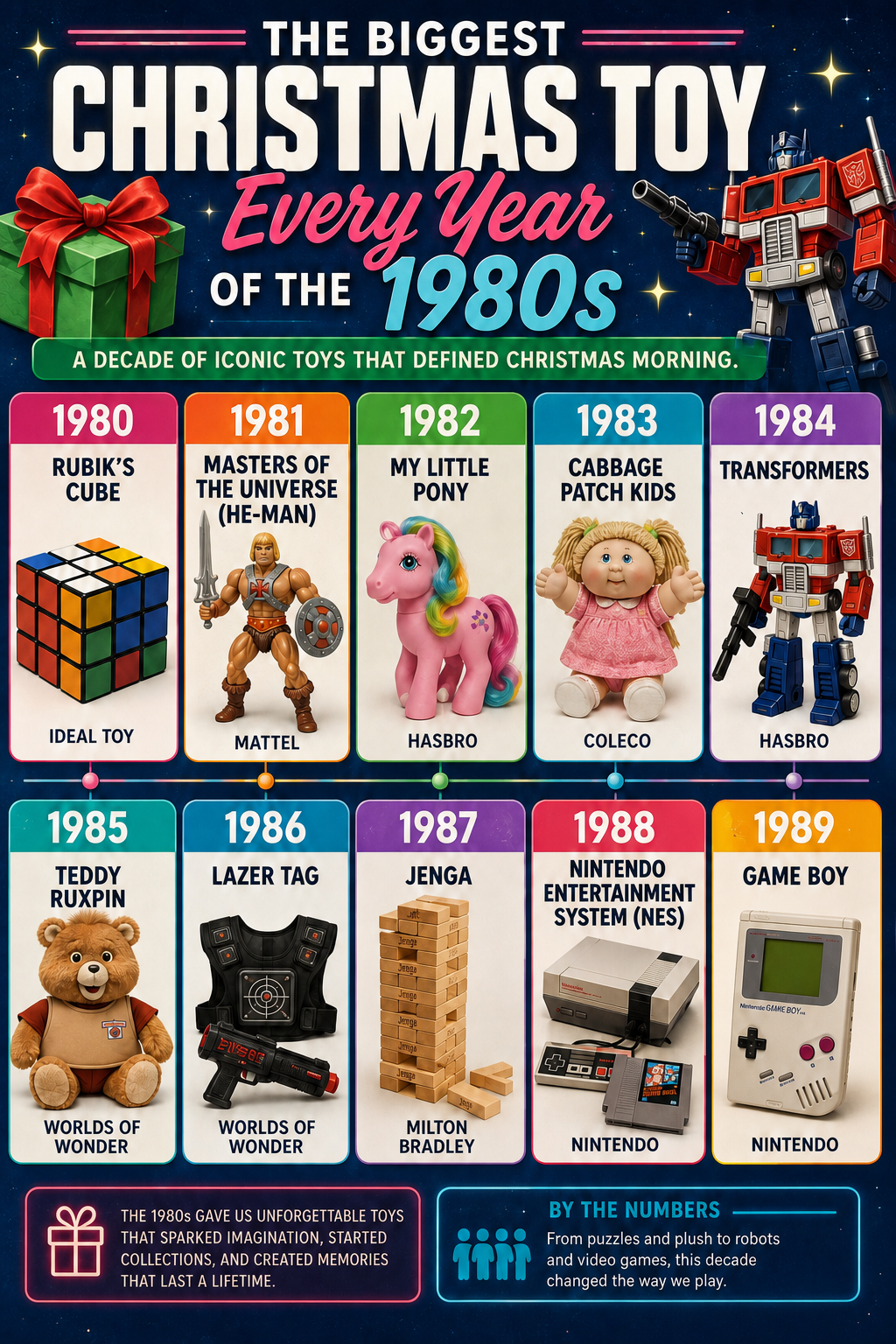
For anyone who grew up during the 1980s, these toys are more than products; they are memories. Maybe you twisted a Rubik’s Cube until peeling off the stickers seemed like the only solution. Perhaps your parents somehow found the Cabbage Patch Kid every store had sold out of, or you held a He-Man figure overhead and declared that you had the power.
The 1980s may have been the golden age of the Christmas toy craze. It was a decade of Saturday-morning cartoons, giant toy catalogs, crowded department stores and parents driving from one retailer to another in search of the one present their children absolutely had to have.
Some of those gifts became much more than popular products. Cabbage Patch Kids caused shopping chaos, Transformers helped perfect the toy-and-cartoon formula, Teddy Ruxpin seemed almost alive, and Nintendo changed what a Christmas present could be. Here is the toy that most clearly defined each holiday season of the decade.
The biggest Christmas toys of the 1980s
| Year | Toy or brand | Company |
|---|---|---|
| 1980 | Rubik’s Cube | Ideal Toy |
| 1981 | Masters of the Universe / He-Man | Mattel |
| 1982 | My Little Pony | Hasbro |
| 1983 | Cabbage Patch Kids | Coleco |
| 1984 | Transformers | Hasbro |
| 1985 | Teddy Ruxpin | Worlds of Wonder |
| 1986 | Lazer Tag | Worlds of Wonder |
| 1987 | Jenga | Milton Bradley |
| 1988 | Nintendo Entertainment System | Nintendo |
| 1989 | Game Boy | Nintendo |
A note about the selections: There is no single audited U.S. database naming the number-one Christmas toy for every year of the 1980s. These choices combine available sales figures with contemporary holiday coverage, documented shortages, media attention, cultural impact and retrospective toy-industry research. In years with several credible contenders, the selection represents the product that most clearly defined that holiday season.
1980 — Rubik’s Cube
Six colored sides, nine squares on each face and one deceptively simple goal turned Rubik’s Cube into a worldwide obsession. Hungarian professor Ernő Rubik developed the puzzle during the 1970s, and Ideal Toy later brought it to the American market just as the craze exploded. Historical accounts indicate that roughly 100 million cubes were sold worldwide during its first few years on the international market.
The cube appealed to children, teenagers and adults alike. It was affordable, portable, instantly recognizable and frustrating in exactly the right way. Once somebody solved it, everyone else wanted to know how. That universal appeal made Rubik’s Cube the defining Christmas toy of 1980.
1981 — Masters of the Universe
He-Man gave children more than an action figure; Masters of the Universe offered an entire fantasy world to collect. Mattel’s line combined muscular heroes, monsters, vehicles, weapons and the unforgettable Castle Grayskull playset. Mini-comics packaged with the toys introduced the characters and their conflicts, while animation helped turn He-Man, Skeletor and their allies into household names.
The franchise showed how powerful a toy could become when every figure was part of a larger story. Children did not simply want one hero—they wanted the world around him, making Masters of the Universe one of the decade’s defining toy properties.
1982 — My Little Pony
My Little Pony turned colorful vinyl figures into a collecting phenomenon. Bright bodies, flowing manes, individual names and distinctive symbols gave each pony its own identity, and that individuality meant there was always another character to discover.
The line quickly expanded into playsets, accessories, television specials, animated series and movies. Tens of millions of ponies were sold during the decade, proving that imaginative play and collectability could be an extraordinarily powerful combination.
1983 — Cabbage Patch Kids
No toy captures the frenzy of 1980s Christmas shopping quite like the Cabbage Patch Kid. Each doll came with a name, birth certificate and adoption papers, creating an emotional hook: children were not merely buying a doll; they were adopting one.
That idea collided with limited supply during the 1983 holiday season. Shoppers lined up for shipments, crowds rushed store displays, and arguments and physical confrontations made national news. At one Pennsylvania department store, roughly 1,000 shoppers reportedly converged on only 240 dolls. Coleco sold approximately 3 million Cabbage Patch Kids during the dolls’ first year, yet demand still seemed impossible to satisfy. The shortage transformed a popular toy into a national cultural event.
1984 — Transformers
Transformers arrived with one of the decade’s most irresistible concepts: a robot that could become something else. Cars, jets and trucks changed into action figures, making the transformation itself part mechanical puzzle and part imaginative play.
Hasbro’s larger achievement was giving those robots personalities, rivalries and an ongoing mythology through animated television and comic books. Optimus Prime and Megatron were not anonymous pieces of plastic; they were characters in a continuing story. That combination of ingenious engineering and powerful entertainment made Transformers a holiday force.
1985 — Teddy Ruxpin
Stuffed animals had been popular for generations, but Teddy Ruxpin felt different. A cassette mechanism inside the animatronic bear played recorded stories while synchronizing his mouth and facial movements with the audio. Today the technology may look simple, but in 1985 it felt remarkably advanced.
Teddy originally sold for around $70, making him a relatively expensive gift, yet demand remained strong. Children could sit him down, insert a cassette and watch him seemingly tell a story. By making a familiar teddy bear feel interactive and alive, Worlds of Wonder created one of the year’s most memorable presents.
1986 — Lazer Tag
Worlds of Wonder followed Teddy Ruxpin with a completely different kind of electronic hit. Lazer Tag equipped players with infrared toy weapons and wearable sensors, turning backyards, basements and neighborhoods into science-fiction battlefields.
The concept landed perfectly in a decade fascinated by lasers, computers, robots and space adventures. It also pointed toward a growing trend: electronics were no longer limited to games played in front of a screen. They could become part of active, physical play and make children feel as though they had stepped inside a futuristic video game.
1987 — Jenga
Jenga needed no batteries, television series or flashing lights—only wooden blocks and a rule set that could be explained in seconds. Remove one block, place it on top and do not knock over the tower.
That simplicity made the game almost universally accessible. Children and adults could understand it immediately, and families could play together on Christmas morning. More than 100 million Jenga games have since been sold worldwide, showing that a straightforward idea can be every bit as enduring as the most elaborate electronic toy.
1988 — Nintendo Entertainment System
By the late 1980s, Nintendo was changing the toy aisle. The Nintendo Entertainment System had reached the United States several years earlier, but by 1988 it had become one of the most desirable gifts in America. The widely recognized NES Action Set typically included the console, two controllers, the Zapper light gun and a cartridge featuring Super Mario Bros. and Duck Hunt.
Opening an NES created a whole new category of future presents. Games such as The Legend of Zelda, Mike Tyson’s Punch-Out!!, Mega Man, Contra and Castlevania kept the wish lists growing. The console was not simply another toy; for an entire generation, it became the center of the living room.
1989 — Game Boy
After taking over the television, Nintendo made gaming portable. The Game Boy’s monochrome screen, modest hardware and chunky design did little to diminish its appeal. It was durable, easy to carry and, in the United States, bundled with the extraordinarily addictive Tetris.
Children could now play Nintendo in the car, on an airplane or under the covers after bedtime. Holiday demand helped establish another enormous Nintendo success, and the Game Boy family would eventually sell well over 100 million systems worldwide. By the end of the decade, video games no longer needed to stay connected to the television.
Which toy craze was the decade’s biggest?
Three products stand above the rest. The Nintendo Entertainment System changed the market by turning every new game into a potential birthday or Christmas gift. The Rubik’s Cube crossed age groups and became one of the bestselling puzzles ever made without relying on batteries, characters or a media franchise.
The decade’s most intense Christmas craze, however, belonged to Cabbage Patch Kids. Nothing else generated the same combination of demand, scarcity, news coverage and shopping chaos. Christmas 1983 demonstrated a formula toy companies would spend decades trying to recreate: when enormous demand meets limited supply, the search for the gift can become nearly as famous as the gift itself.
Recommended

What Would Your Wizarding Career Be?
Answer 25 personality questions and discover whether you're destined to be an Auror, Healer, Professor, Curse-Breaker, Wandmaker or another wizarding professional.

10 of the Most Recognizable Careers in the Harry Potter Wizarding World
From Aurors and Healers to Hogwarts professors and Quidditch players, explore 10 of the most recognizable jobs in the Harry Potter Wizarding World.
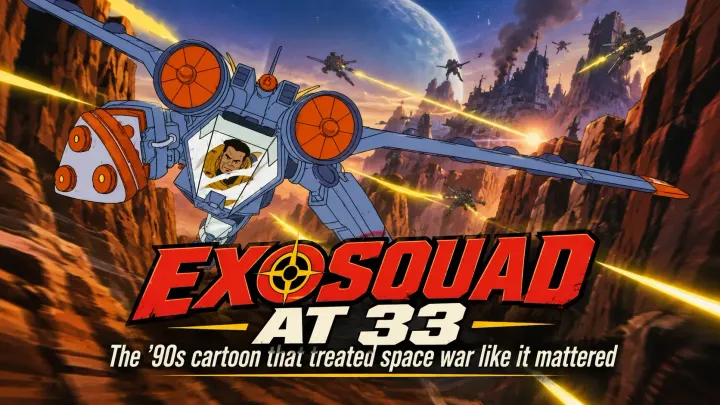
Exosquad at 33: The ’90s Cartoon That Treated Space War Like It Mattered
Thirty-three years after its premiere, Exosquad remains a remarkably ambitious animated war epic built on serialized storytelling, political consequence and unforgettable E-frames.