
The Year Was 1994: What America Watched, Played, Bought and Listened To
From Seinfeld and ER to Donkey Kong Country, Power Rangers and “The Sign,” 1994 was a year when American pop culture seemed to fire on every cylinder at once.
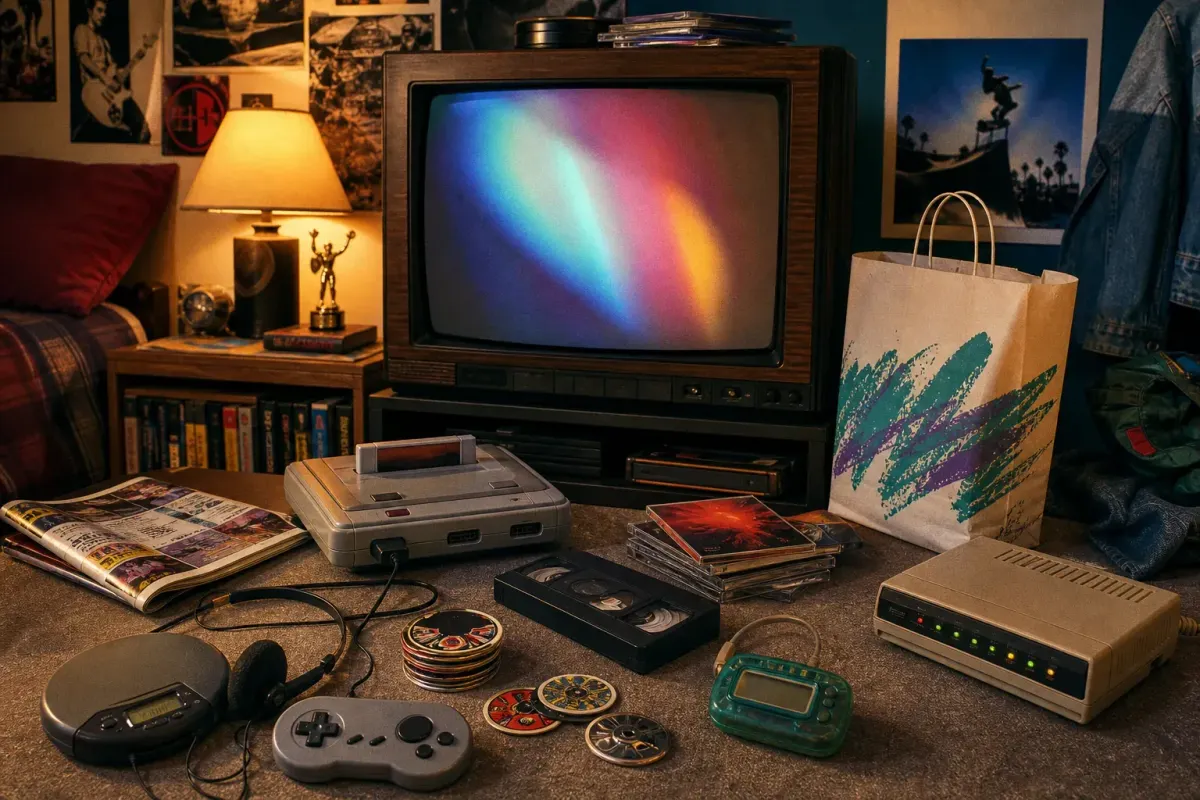
There are years that simply happen, and then there are years that seem to contain an entire era. 1994 was one of those years.
There was no Netflix, Spotify or YouTube. Amazon had only just been founded, most Americans had never heard of the World Wide Web, and carrying a computer in your pocket still sounded like science fiction. Entertainment was more communal because it had to be: millions watched the same shows at the same time, kids argued about Nintendo and Sega on playgrounds, and hearing a new album usually required a trip to the mall.
Thirty-plus years later, an extraordinary amount of what arrived in 1994 remains embedded in American culture. So rewind the VHS tape, blow into the game cartridge and grab the Discman. The year was 1994.
What America watched
Television was still a national gathering place
In 1994, television was not something you watched whenever you wanted; you watched when the network told you to, and tens of millions frequently watched with you. The 1994–95 season now reads like a greatest-hits collection: Seinfeld finished first in Nielsen’s primetime rankings, the brand-new medical drama ER placed second, and ABC’s Home Improvement came third.
Seinfeld
NBC · No. 1
ER
NBC · No. 2
Home Improvement
ABC · No. 3
Further down the list, a sitcom about six twenty-somethings in New York was beginning its run. Friends debuted in September and joined Seinfeld, Frasier and ER in NBC’s formidable Thursday-night lineup. At the same time, established favorites including Roseanne, Murder, She Wrote, Law & Order, The Nanny and Monday Night Football still attracted enormous audiences.
What television possessed then—and rarely possesses now—was a shared national audience. A major episode could become the next morning’s conversation at school or work because there was a good chance everyone had actually seen it.
Source note: Nielsen rankings for the 1994–95 television season.
At the movies
A box-office race decided by one million dollars
Movie theaters delivered one of the decade’s most durable years. Forrest Gump and The Lion King towered over the field, with only about $1 million separating their calendar-year grosses in the United States and Canada. Behind them came a slate that could only belong to 1994: True Lies, The Santa Clause, The Flintstones, Speed and The Mask.
1994’s biggest movies
Jim Carrey had an astonishing year all by himself. Within roughly ten months, audiences saw him headline Ace Ventura: Pet Detective, The Mask and Dumb and Dumber—a run that turned him from a rising comic actor into an unavoidable star. Meanwhile, Quentin Tarantino’s Pulp Fiction became a cultural phenomenon, and films such as The Shawshank Redemption built reputations that would grow long after their original theatrical runs.
Figures represent U.S./Canada box-office revenue earned during calendar year 1994.
What America played
Nintendo or Sega? Choose your side
For kids in 1994, hardware allegiance could feel like identity. The Super Nintendo and Sega Genesis fought for living-room supremacy while the Game Boy traveled everywhere. The year delivered Donkey Kong Country, Mortal Kombat II, Sonic the Hedgehog 3, Sonic & Knuckles, Super Metroid, Final Fantasy III—known today as Final Fantasy VI—and the console version of NBA Jam.
- Donkey Kong Country
- Mortal Kombat II
- Sonic 3
- Super Metroid
- Final Fantasy III
- NBA Jam
- Daytona USA
- Doom
Mortal Kombat was everywhere
Digitized fighters, secret characters and fatalities made the series perfect for the pre-Internet schoolyard. You could not Google a finishing move; you needed a strategy guide, a magazine, an older sibling or a friend who supposedly knew the code.
The “Doom Boom” spread
Released at the end of 1993, Doom exploded across PCs in 1994 through shareware. Its network-driven distribution offered an early preview of software spreading through computers rather than store shelves.
The striking thing was not simply the quality of the games. It was the speed of change. Arcade spectacle, home-console polish and networked PC culture were advancing at once, laying down several different futures for how Americans would play.
What America bought
The mall was the Internet
Walk into a mall in 1994 and you entered one of the central institutions of American life. Online shopping effectively did not exist for the average household. If you wanted something, you went somewhere and bought it—and the trip itself was part of the experience.
A social network with a food court
The mall was where teenagers met friends, discovered music, saw movie posters and watched trends move from television and magazines into real life. Starter jackets, oversized T-shirts, flannel, denim, Doc Martens and athletic sneakers all advertised which corner of 1990s culture you inhabited.
Then there were Pogs: tiny cardboard discs that became collectible, tradable and strangely irresistible. The game was simple, but collecting was the point. Sports, cartoons, movies and brands all found their way onto small circles that, for a brief period, functioned like playground currency.
What America listened to
Radio could hold almost everything
Few years demonstrate the musical range of the 1990s better than 1994. Pop ballads, R&B, alternative rock, hip-hop and dance music all competed for radio time and record-store shelf space. The song at the top of Billboard’s year-end Hot 100 came not from an American act, but from Sweden.
The biggest songs of 1994
Ace of Base placed “The Sign,” “All That She Wants” and “Don’t Turn Around” inside Billboard’s year-end Top 10—an extraordinary concentration of hits for one act in one year.
The compact disc was becoming king
Another shift was taking place inside American homes. Cassettes remained common, especially in cars and portable players, but the compact disc was becoming the prized format. CD binders replaced cassette cases, portable players became coveted electronics, and record-store walls filled with jewel cases. Buying music still meant owning something—often an entire album just to get one particular song.
Source note: Billboard Year-End Hot 100 for 1994.
Beyond pop culture
The stories America talked about
The year also carried major news events: the Northridge earthquake struck Southern California, the Winter Olympics unfolded in Lillehammer, the United States hosted the FIFA World Cup, and a baseball strike ultimately erased the World Series. Then, on June 17, millions watched a white Ford Bronco move slowly along Southern California highways as television networks followed the O.J. Simpson police pursuit live.
Northridge earthquake
A destructive earthquake strikes Southern California.
Winter Olympics
Lillehammer hosts the Games in Norway.
World Cup
The United States hosts soccer’s global tournament.
Baseball stops
A players’ strike ends the season and cancels the World Series.
The Bronco chase foreshadowed the wall-to-wall live-news culture that would become increasingly common. It was another sign that American media was changing even before the Internet became a daily habit.
The future was quietly arriving
A new world, still hiding in plain sight
Most homes were not online. Phones were attached to walls, newspapers dominated classified advertising, television networks controlled enormous audiences, record companies controlled music distribution and retail meant physical stores. Yet a former Wall Street executive named Jeff Bezos started an Internet company in 1994. Its eventual name was Amazon.
Elsewhere, Americans were beginning to hear strange phrases such as “email address,” “website,” “World Wide Web” and “information superhighway.” Within a decade, those technologies would begin transforming nearly every industry that defined life in 1994. But the future had not quite arrived.
If you were a kid in 1994
An afternoon without a second screen
You came home from school, dropped your backpack and turned on Nickelodeon, Fox Kids or Cartoon Network. Maybe it was Animaniacs, Batman: The Animated Series, X-Men, Mighty Morphin Power Rangers or Tiny Toon Adventures. Then came the Super Nintendo or Sega Genesis. Dinner happened. Homework happened—eventually.
Somewhere nearby was probably a pile of game cartridges, comic books, VHS tapes, Pogs, action figures, cassettes or CDs. There were no notifications and no endless social feed. If a friend discovered something interesting, they did not send you a link. They told you about it the next day.
Why 1994 still feels familiar
People still watch Friends and quote Seinfeld. Disney still returns to The Lion King. Nintendo still makes Donkey Kong games, Mortal Kombat remains active, and the films and musicians of the year are fixtures of American culture. The technology surrounding those things changed completely; the things themselves did not.
That is the central contradiction of 1994. It was one of the final years when pop culture operated almost entirely through television networks, movie theaters, radio stations, shopping malls and physical media. At the same time, the technology that would disrupt all of them was beginning to emerge. America simply did not know it yet.
The Internet age was coming. But for one more year, there were CDs in the Discman, cartridges in the Super Nintendo, Seinfeld on television and a Power Ranger somewhere on a kid’s Christmas list.
The year was 1994.Recommended
What Would Your Wizarding Career Be?
Answer 25 personality questions and discover whether you're destined to be an Auror, Healer, Professor, Curse-Breaker, Wandmaker or another wizarding professional.
10 of the Most Recognizable Careers in the Harry Potter Wizarding World
From Aurors and Healers to Hogwarts professors and Quidditch players, explore 10 of the most recognizable jobs in the Harry Potter Wizarding World.
Exosquad at 33: The ’90s Cartoon That Treated Space War Like It Mattered
Thirty-three years after its premiere, Exosquad remains a remarkably ambitious animated war epic built on serialized storytelling, political consequence and unforgettable E-frames.