The 20 Largest U.S. Public Companies by Number of Employees
Walmart and Amazon lead this ranking of U.S.-headquartered public companies by worldwide employees, based on annual SEC disclosures.

Walmart leads this ranking with approximately 2.1 million employees worldwide, followed by Amazon with 1.576 million.
A company’s workforce tells you something its stock price cannot: how much work it takes to keep the business running. Look down this ranking and you find stores to staff, packages to sort, hospitals to operate and customers to help. Walmart and Amazon occupy the top two spots, but the companies below them make the list more interesting than a simple contest between two retail giants.

This ranking covers publicly traded companies headquartered in the United States and uses their reported worldwide employee totals. These are global workforces, not counts of U.S. jobs; the reporting dates and company definitions are explained below.
The 20 Largest U.S.-Headquartered Public Companies by Employees
| Rank | Company | Global Employees | Industry | Reporting Date |
|---|---|---|---|---|
| 1 | Walmart | ~2,100,000 | Retail | Jan. 31, 2026 |
| 2 | Amazon | ~1,576,000 | E-commerce / Technology | Dec. 31, 2025 |
| 3 | FedEx | ~530,000 | Transportation / Logistics | May 31, 2026 |
| 4 | Home Depot | ~472,400 | Home Improvement Retail | FY2025 |
| 5 | UPS | ~460,000 | Transportation / Logistics | Dec. 31, 2025 |
| 6 | Concentrix | ~455,000* | Business Services | Nov. 30, 2025 |
| 7 | Target | ~415,000 | Retail | Jan. 31, 2026 |
| 8 | Kroger | 403,000+ | Grocery | Jan. 31, 2026 |
| 9 | UnitedHealth Group | 390,000+ | Healthcare | Dec. 31, 2025 |
| 10 | Berkshire Hathaway | ~387,800 | Conglomerate | Dec. 31, 2025 |
| 11 | Starbucks | ~381,000 | Restaurants / Retail | Sept. 28, 2025 |
| 12 | TJX Companies | ~377,000 | Retail | Jan. 31, 2026 |
| 13 | Cognizant | ~351,600 | Information Technology | Dec. 31, 2025 |
| 14 | Costco | ~341,000 | Warehouse Retail | Aug. 31, 2025 |
| 15 | HCA Healthcare | ~320,000 | Healthcare | Dec. 31, 2025 |
| 16 | JPMorganChase | 318,512 | Banking / Financial Services | Dec. 31, 2025 |
| 17 | PepsiCo | ~306,000 | Food & Beverage | Dec. 27, 2025 |
| 18 | CVS Health | 300,000+ | Healthcare / Retail | Dec. 31, 2025 |
| 19 | Albertsons | ~280,000 | Grocery | Feb. 28, 2026 |
| 20 | Aramark | 278,390 | Food & Facilities Services | Oct. 3, 2025 |
Company names link to the annual report or SEC filing supporting the figures. FY2025 refers to Home Depot’s fiscal 2025 year-end.
*Concentrix’s 2025 annual filing uses both “full-time game-changers” and “employees and staff” to describe its approximately 455,000-person workforce. Definitions differ across companies; see the methodology below.
Together, the reported workforces add up to more than 9 million people. The table brings together very different kinds of employers, from grocery chains and delivery networks to banks and businesses that work behind other companies’ brands.
Walmart and Amazon Are in a Different League
Even among these large employers, Walmart and Amazon stand apart. Their combined workforce of roughly 3.7 million is about seven times the size of third-place FedEx’s reported total.
Walmart’s roughly 2.1 million employees work across its namesake stores, Sam’s Club, distribution centers, fulfillment operations and offices. A shopper sees only a small part of that organization: the people staffing a particular store on a particular shift.
Amazon’s annual-report count includes approximately 1.576 million full- and part-time employees and excludes contractors and temporary personnel. That distinction matters when comparing its payroll with the wider network of people involved in getting an order to a customer.
For another measure of the gap, Amazon’s reported workforce exceeds the combined totals of the five companies ranked 16th through 20th. Those five include JPMorganChase, PepsiCo and CVS Health—hardly small operations.
Why Retailers Keep Appearing in the Top 20

Walk through a supermarket and the staffing question becomes easier to picture. Checkouts are only the beginning; there are deliveries to unload, shelves to replenish, fresh-food departments to run and customer questions to answer.
That helps explain the number of familiar retail names here: Walmart, Home Depot, Target, Kroger, Starbucks, TJX, Costco, CVS Health and Albertsons. Their businesses differ, but each has a substantial operation serving customers in physical locations.
A store’s headcount also has to cover different shifts and days, rather than just the employees a customer sees at once. Repeat those staffing needs across a chain, then add warehouses, distribution centers and office teams, and the payroll grows well beyond the shop floor.
For another view of retail scale, compare the retail companies with the most U.S. stores.
Company names can hide some of that reach. Albertsons’ total, for example, covers a collection of supermarket banners that includes Safeway, Jewel-Osco and ACME. Counting only stores with an Albertsons sign would miss much of the business.
Our ranking of America’s largest grocery store chains looks at how those parent companies and supermarket banners compare by number of locations.
Logistics Companies Employ Nearly One Million People
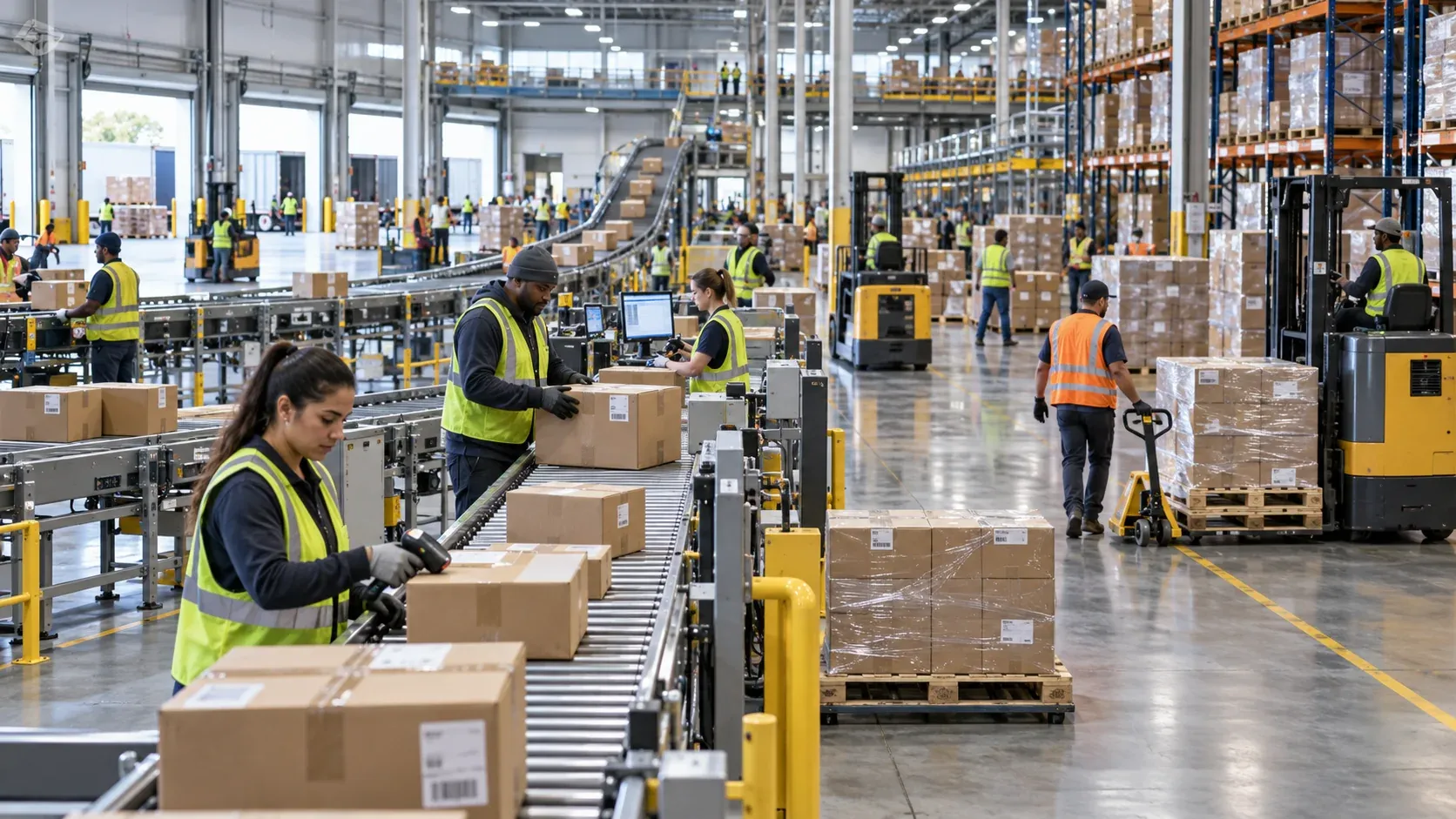
Before a product reaches a shelf or a doorstep, it has to move through a network of people and facilities. FedEx and UPS make that less visible work a major presence in this ranking.
Their reported totals add up to about 990,000 employees worldwide. FedEx’s figure combines permanent full-time and part-time employees; UPS excludes temporary seasonal employees from its count.
The driver at the door is the most recognizable part of the operation. Behind that delivery are package handlers, sorting-center crews, pilots, mechanics and teams keeping the network’s technology running. A single shipment passes through work the recipient never sees.
Amazon belongs in this discussion too. Its position near the top reflects a business that combines online retail and technology with fulfillment and delivery operations. Assigning it to a single industry column is useful for a table, but it leaves out part of the explanation.
Healthcare Employment Extends Beyond the Hospital

A hospital is an obvious place to find a large workforce. An insurer or a pharmacy chain may be less obvious, which makes the mix of healthcare businesses here worth a closer look.
UnitedHealth Group, HCA Healthcare and CVS Health all make the top 20, though their employees perform quite different kinds of work. UnitedHealth’s annual report says nearly 165,000 of its employees were clinical professionals at the end of 2025—a useful detail for readers who know it mainly as an insurance business.
UnitedHealth combines insurance with Optum’s healthcare services. HCA operates hospitals and other medical facilities, while CVS brings together pharmacies, insurance and healthcare services. Their headcounts therefore include much more than the staff treating patients in a hospital room.
For this part of the table, comparing totals is only the start. Understanding the businesses tells you whether those employees are staffing facilities, dispensing prescriptions, providing care or administering coverage.
The Large Employers Working Behind Other Brands
Concentrix is sixth on the list, ahead of Target and Kroger, yet its name is much less likely to appear on a storefront. Its customer-experience and business-services work happens on behalf of other companies, so the client’s brand may be the one a customer recognizes.
Cognizant makes the worldwide-versus-U.S. distinction particularly clear. Of its approximately 351,600 employees at the end of 2025, 256,900 were in India. A U.S. headquarters tells you where the company is based; it does not tell you where most of its employees work.
Aramark’s food and facilities employees work in settings such as universities, hospitals, businesses and sports venues. A customer may encounter their work at a dining hall or stadium without thinking of Aramark as the employer. Its former uniforms business became the separate company Vestis in 2023.
Berkshire Hathaway’s Total Covers Many Separate Businesses
Berkshire Hathaway’s place in the top 10 can be misleading if you imagine all those employees working for one centrally run business. Its total includes the people employed by a wide collection of subsidiaries.
GEICO, BNSF Railway and Berkshire Hathaway Energy help explain that breadth. Insurance, railroads and utilities have different staffing needs, and Berkshire’s manufacturing, retail and service businesses add more kinds of work to the mix.
Berkshire’s annual report describes a decentralized approach in which operating subsidiaries set their own personnel policies. The shared ownership brings their employees into one reported total, even though their working lives may have little in common.
JPMorganChase’s Workforce Goes Well Beyond Its Branches
JPMorganChase is the only traditional bank in this top 20. Its place among retailers and healthcare companies is a reminder of how much of a bank’s work happens away from the branch counter.
The workforce spans consumer banking, credit cards, commercial and investment banking, asset management, technology and corporate operations. Branch employees are the part many customers know, but supporting accounts, transactions and business clients requires a much wider organization.
What an Employee Ranking Can Tell Us
The most useful question this table raises is what makes a business need so many people. A supermarket, a delivery network and a hospital each have work tied to physical places and daily service. Outsourcing firms can accumulate similarly large workforces by doing work for many clients.
Headcount alone cannot tell us how well a company pays, how secure its jobs are or how productive its operations have become. It also misses people working for contractors and independent businesses. What it does reveal is the reach of a company’s own workforce: the people needed to open the doors, move the goods and keep its services running.
How We Ranked America’s Largest Corporate Employers
The ranking uses worldwide employee totals reported by publicly traded companies headquartered in the United States. Privately held employers are excluded. Company names in the table link to the supporting annual disclosures, with the relevant reporting period shown alongside each figure.
Worldwide totals are used because companies do not consistently disclose a separate U.S. headcount. That gives us a common geographic basis, but not perfectly identical definitions. For example, Target includes seasonal employees, while UPS excludes temporary seasonal employees. Amazon’s figure excludes contractors and temporary personnel.
A headcount is also different from a full-time-equivalent measure: a full-time employee and a part-time employee can each count as one person. Figures retain the companies’ approximations and lower-bound wording where applicable.
The dates matter. These totals are snapshots from different reporting periods, not a simultaneous count of employment today. FedEx’s May 31, 2026 total also predates its June 1 separation of FedEx Freight. The table should be read as a comparison of the listed annual disclosures, rather than a live payroll tracker.
Frequently Asked Questions
What U.S. company has the most employees?
Among the U.S.-headquartered public companies in this ranking, Walmart has the largest reported worldwide workforce, at approximately 2.1 million employees.
How many employees does Amazon have?
Amazon reported approximately 1.576 million full- and part-time employees as of December 31, 2025. Its count excludes contractors and temporary personnel.
Which industries have the largest corporate workforces?
Retail has a strong presence in this top 20, alongside transportation and logistics, healthcare, technology and business services, banking, food and facilities services.
Are these U.S. employee counts?
No. These are worldwide totals for companies headquartered in the United States. Employees working outside the U.S. are included.
Are private companies included?
No. The ranking covers publicly traded companies headquartered in the United States; privately held employers are excluded.
Data note: Figures reflect the annual disclosures and reporting periods linked in the table. They are approximate where the companies report approximate totals, and differences in workforce definitions limit direct comparisons.
Recommended