The Star Wars Toys Every Kid Wanted—and the Details We Still Remember
From the Falcon’s hidden compartment to the Tauntaun’s opening belly, the small features that made Kenner’s original Star Wars toys memorable.
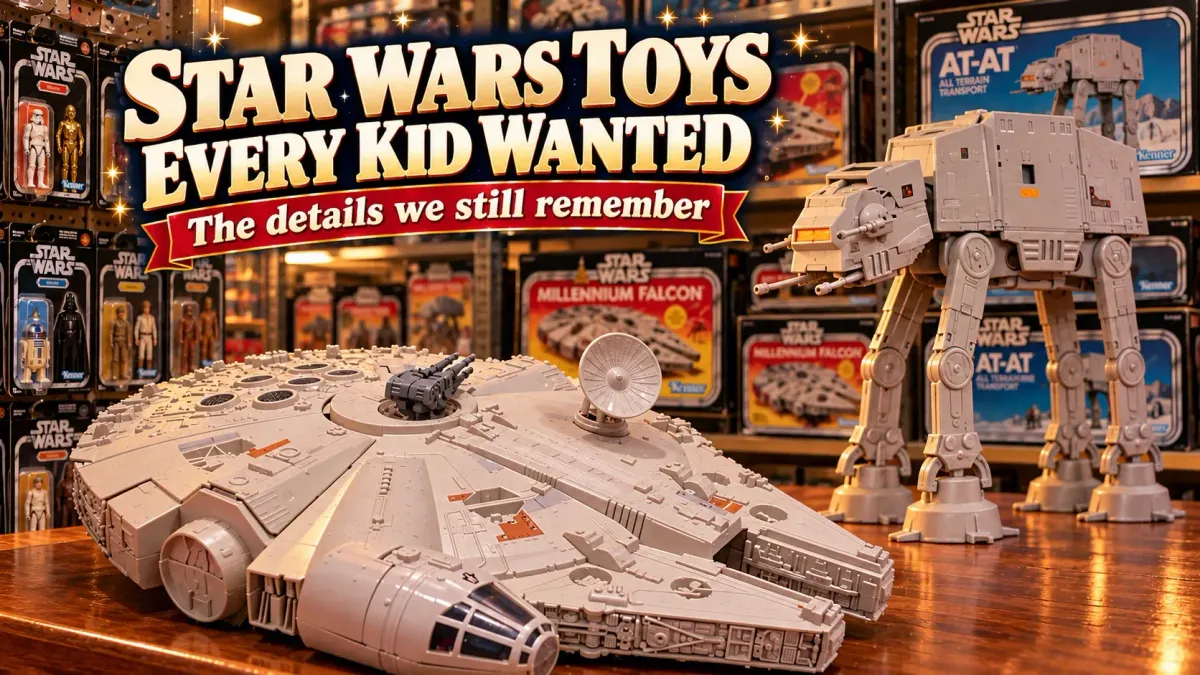
Ask someone about their old Star Wars toys and they may remember the hidden compartment in the Millennium Falcon before they remember the Christmas it arrived. Or they will reach for an imaginary button to show you how the TIE Fighter’s wings came off. The small details tend to survive: the click of R2-D2’s head, the string on the Snowspeeder, Luke’s yellow lightsaber sliding out of his arm.
Kenner gave children plenty of those details to discover. The toys were often simplified, occasionally strange interpretations of the films, but they let you put a character in the cockpit and carry on with the story. Between movies, that mattered. A few figures and a vehicle were enough to keep Star Wars occupying a large part of a bedroom.
These vintage Kenner Star Wars toys span 1978–1984, from the first small action figures to the Imperial Shuttle. The big ships still command attention. Some were the presents you hoped for; others belonged to a friend whose collection made yours look modest. But the smaller toys deserve their place here, too, especially when a simple bit of engineering made them unusually good company on the floor.
The original figures, yellow lightsaber and all
For some children, the first Star Wars present was a promise. Kenner did not have its action figures ready for Christmas 1977, so its Early Bird Certificate Package offered Luke Skywalker, Princess Leia, Chewbacca, and R2-D2 for later delivery. There were stickers and a display backdrop in the package, but the figures had to be claimed by mail.
When they arrived in 1978, the small size was a considerable part of the appeal. You could bring several characters along in one hand, and they could fit inside the vehicles that followed. Owning Luke did not require finding somewhere to keep a doll-sized Luke.
The original figures also had quirks that remain easy to recognize. Farmboy Luke’s lightsaber was yellow, despite the blue blade in the film, and it retracted into his right arm. Vader had a removable vinyl cape. R2-D2’s head clicked when turned, while much of the detail on his body came from a sticker.
Next to later figures, they look plain and rather stiff. Yet the old R2’s click is a detail a photograph cannot quite convey. You have to turn the dome.
Inside the Millennium Falcon
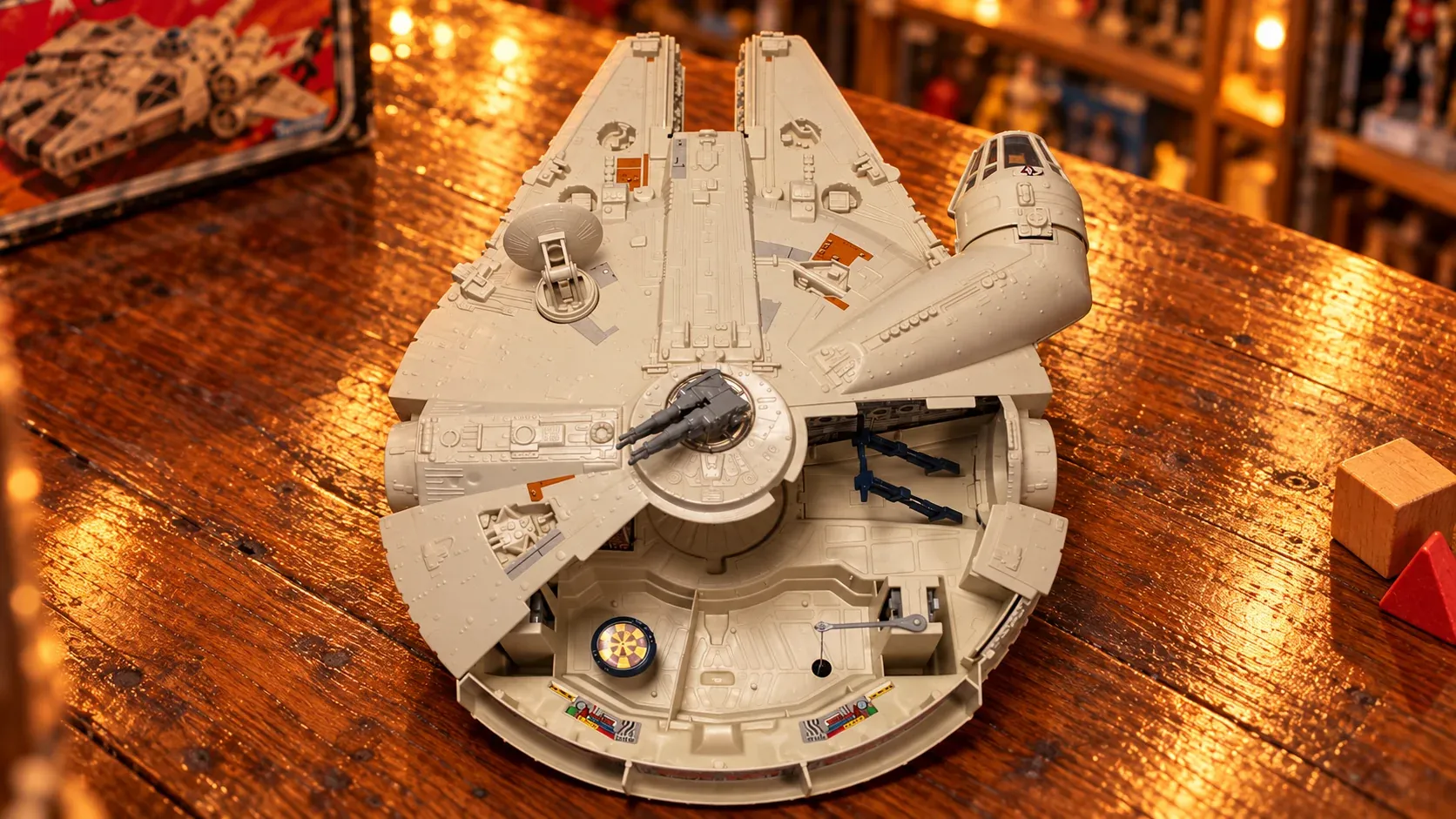
Released in 1979, the Millennium Falcon was the ship to linger over. Its removable rear deck exposed enough of an interior to make arranging the passengers almost as interesting as flying them somewhere.
There was the game table from the film, a swiveling gunner’s seat, and a little training ball for Luke. The ramp folded down, the cockpit opened, and the landing gear tucked away. Under a floor panel was the compartment where figures could hide, just as Han and his passengers had hidden aboard the Death Star.
That compartment was an especially good touch because discovering it involved opening the ship twice: first the large cover, then the small panel inside. Once you knew it was there, it was hard to leave it alone.
The Falcon also made a battery-powered battle-alert sound, but it did not need the electronics to justify taking up so much space. Han and Chewbacca could remain aboard while other figures moved between the cockpit, gun, and main cabin. On a toy-store shelf, it was a large gray spacecraft. At home, there was plenty to investigate beneath the lid.
X-wings, TIE Fighters, and wings that came off
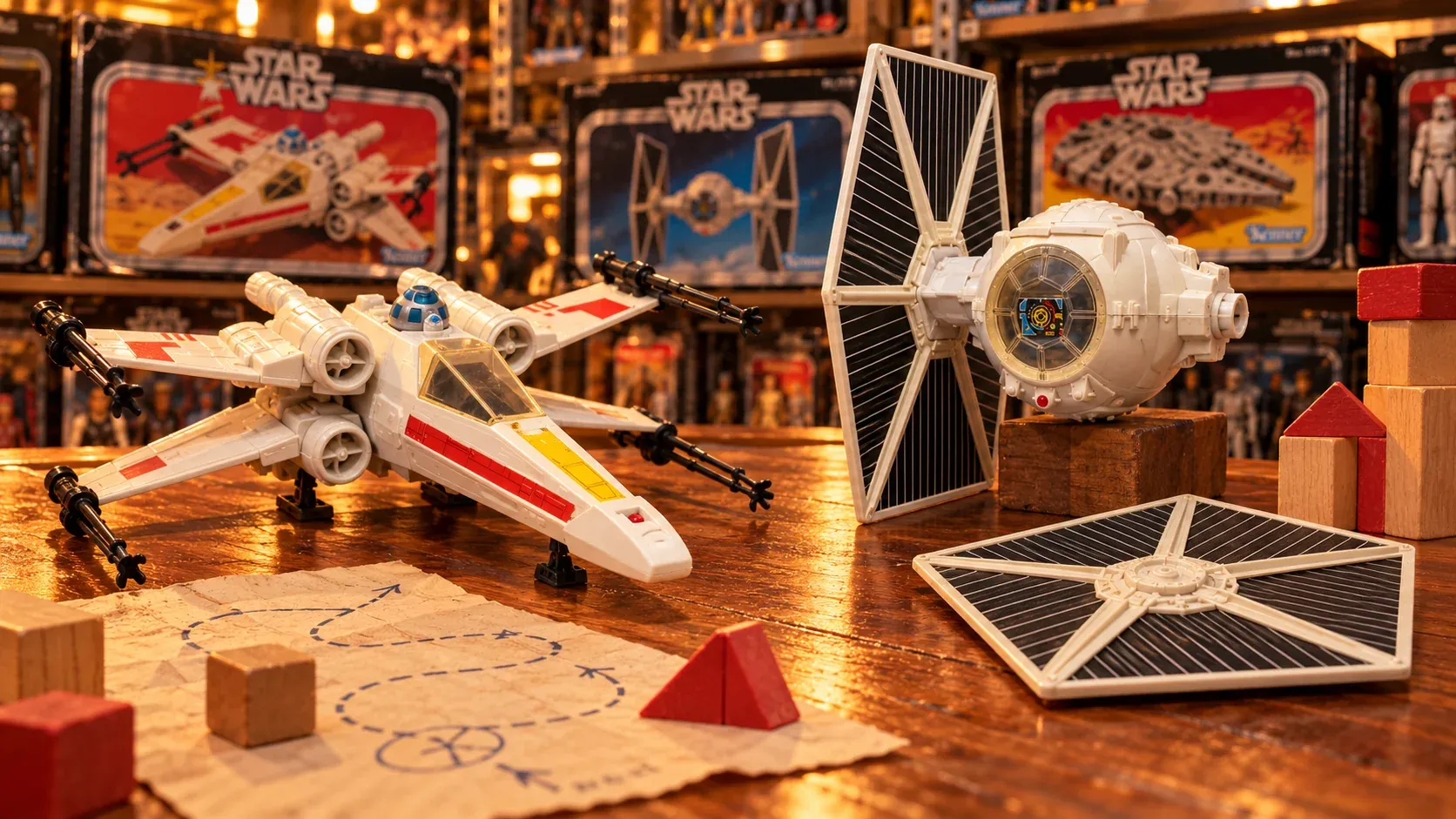
The 1978 X-wing had a control that was difficult to forget. Press down on the simulated R2-D2 behind the cockpit and its wings opened into their attack position; a second button closed them again.
R2 was permanently part of the vehicle, so this was not the place to put your separate droid figure. But using his head to operate the wings made sense to a child holding the ship. The button was exactly where your fingers could reach it.
The original Imperial TIE Fighter, also released in 1978, offered the other half of the battle. Its white body was a conspicuous departure from the screen, and its electronic light and sound were straightforward toy effects. The feature to demonstrate was the wing release. After a hit, the panels could come away from the cockpit, leaving you to retrieve them and rebuild the ship.
Kenner returned to that idea with Darth Vader’s TIE Fighter in 1979. Its curved wings and gray finish made it a tempting addition even if you already owned the standard fighter. The TIE Interceptor followed in 1984 with large, pointed panels and the same opportunity to send them flying.
Of the three, the Interceptor has the most menacing outline. Vader’s ship has a more personal attraction: there was never much doubt about who should be piloting it.
Boba Fett needed Slave I
The mail-away Boba Fett came with a complication that has followed the toy ever since. Kenner’s 1979 promotion advertised a firing rocket, then removed the mechanism before the consumer figure was released for safety reasons.
The figure children received had a fixed rocket. Vintage working prototypes exist, but an original Fett with a launcher was not something ordinarily sold in a shop or delivered through the promotion. A recollection of seeing the advertisement can easily become a recollection of owning the promised feature.
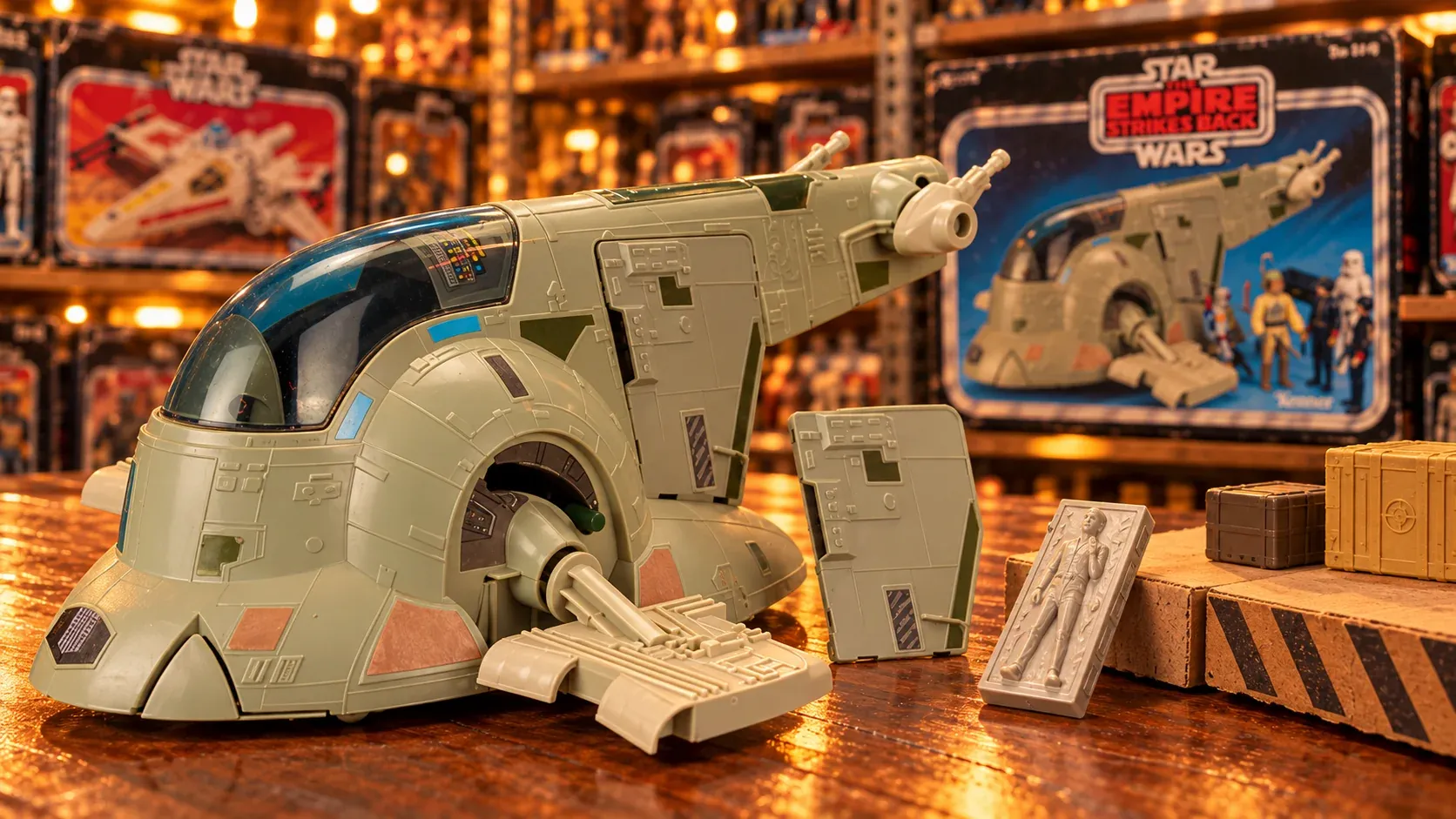
By 1981, Fett had a ship with enough working parts of its own. Sold by Kenner as Boba Fett’s Spaceship, Slave I had gravity-operated wings and a cockpit that changed orientation, rotating weapons, a removable access panel, and a cargo ramp.
The accessory worth looking for was the included Han Solo frozen in carbonite. It gave the ship something specific to carry and made the trip from Cloud City to Jabba a story you could play through while waiting for the next film.
There was also an obvious temptation to release Han much earlier than the movies allowed. Nothing required the child with the ship to honor Fett’s delivery schedule.
The AT-AT and Snowspeeder brought Hoth home
The AT-AT looked expensive because it was. Sears listed Kenner’s walker at $47.99 in its 1981 Wish Book, well beyond the price of adding another figure to the collection.
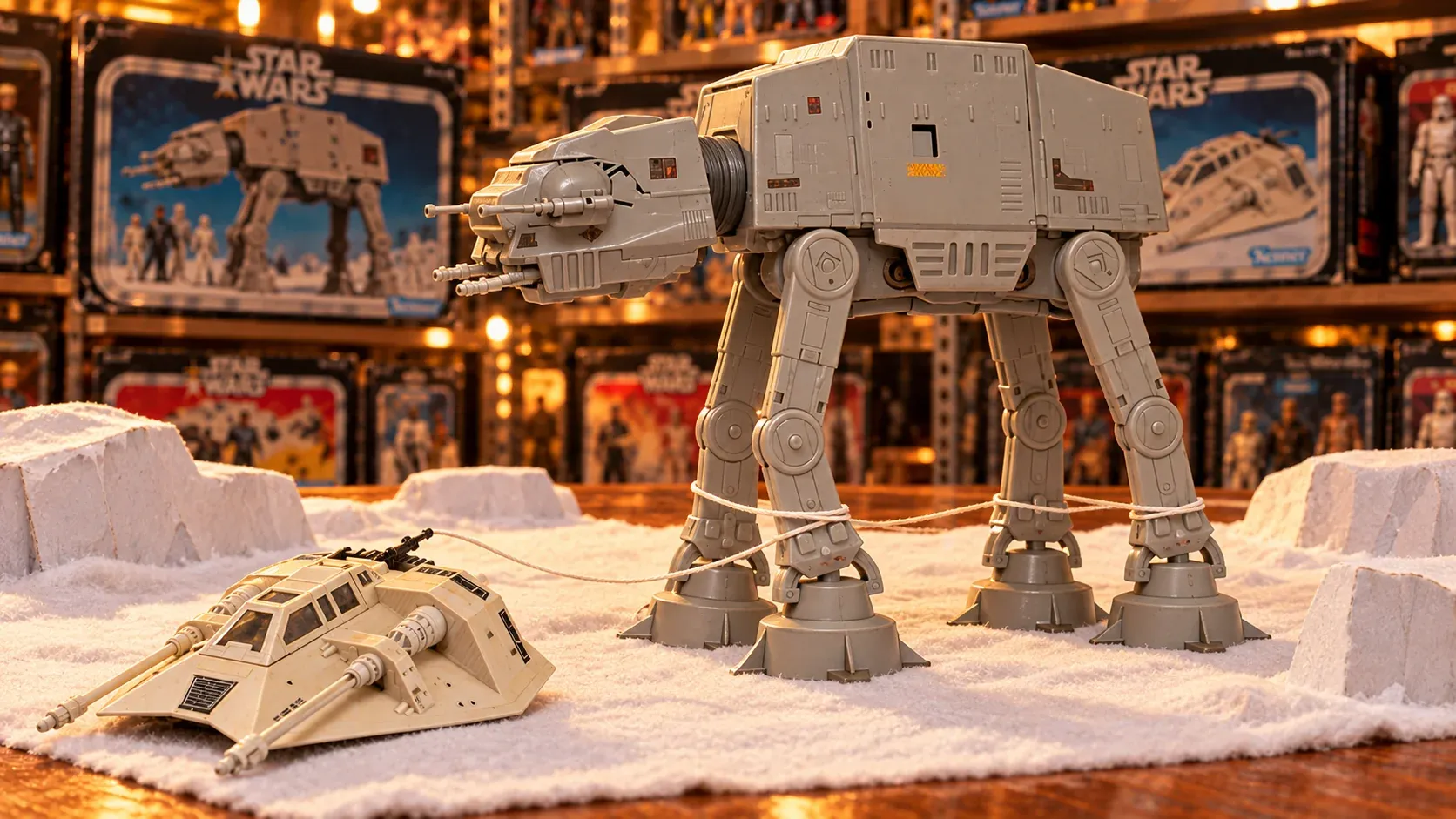
It had room inside for troops and space for two figures in the cockpit. The head moved through an internal lever, and the clear chin guns lit up and pumped back and forth. The legs bent at several joints, although moving them was your job: the original AT-AT did not walk under its own power.
There was a little work involved in getting it to stand the way you wanted. Once positioned, its height made the other toys around it look vulnerable, which was an excellent quality in a toy based on the Battle of Hoth.
Kenner’s Rebel Armored Snowspeeder had arrived a year earlier, in 1980. Its front guns lit up, but the rear harpoon was the reason to put it beside the walker. A two-foot string let you wrap the cable around the AT-AT’s legs.
Flying the smaller ship while arranging the string required some coordination. The walker could fall, the cable could slip, and the whole operation could be attempted again. That was much closer to playing out the scene than simply pointing two toys at each other and announcing who had won.
The Death Star, complete with garbage
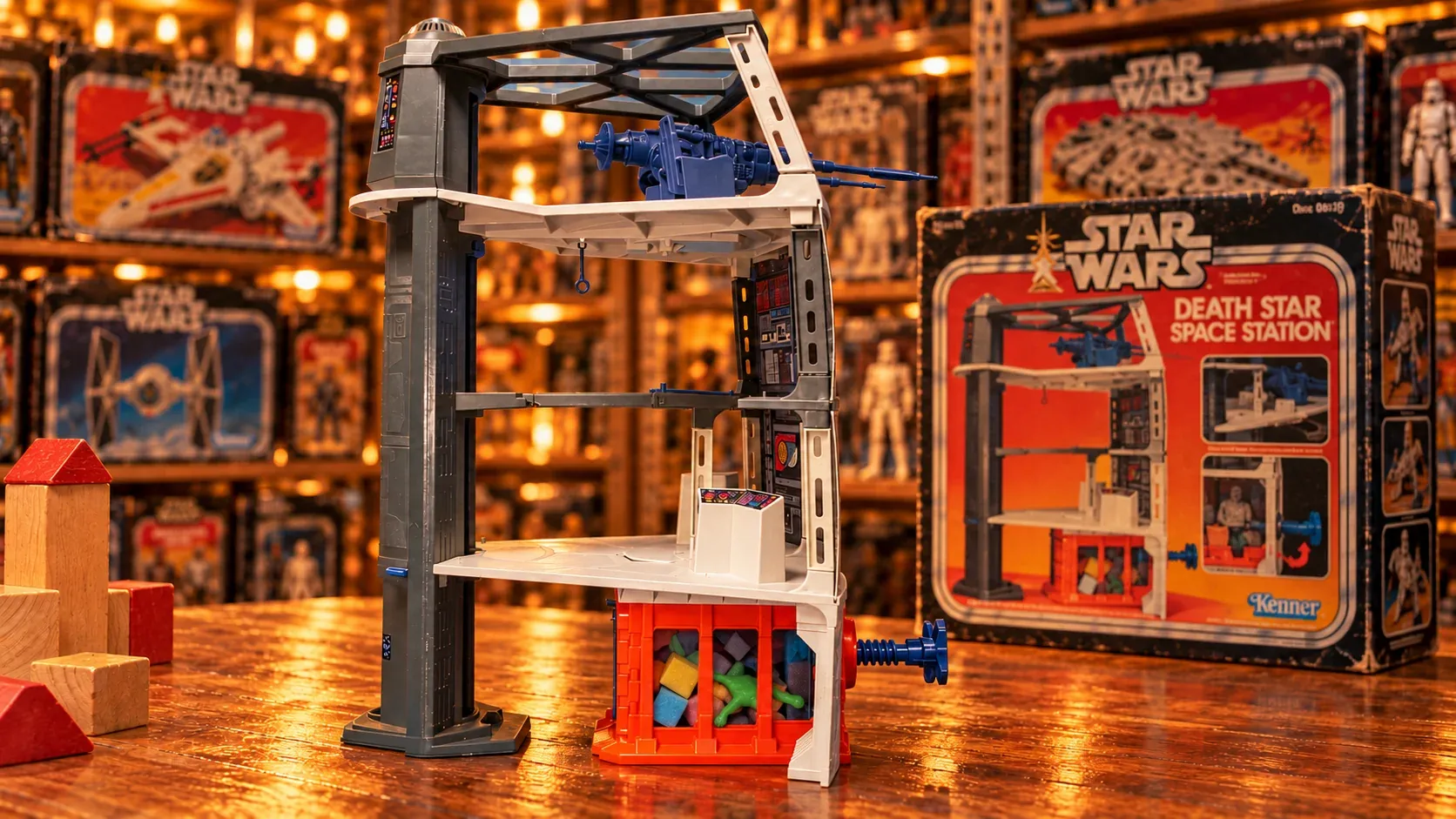
Kenner’s 1978 Death Star Space Station was a tall, open playset rather than a ball. The exterior resemblance was limited, but the arrangement let a child reach several scenes without having to dismantle the whole thing.
An elevator moved the figures between floors. There were places for escapes and confrontations above, and a trash compactor below, with foam garbage and a green Dianoga monster.
The compactor is the part that gives this set so much personality. Children could put the heroes in the rubbish and operate the room around them, rather than stand them against a picture of the scene. Even the small, somewhat odd-looking monster helped: it gave the threat in the garbage a body you could hold.
The upper floors made the set useful for more than that one sequence, though the temptation was always there to send everyone downstairs again. A working elevator was a perfectly good toy feature. A room that could trap Luke, Han, and Leia was harder to pass up.
Darth Vader’s Star Destroyer and its glowing chamber
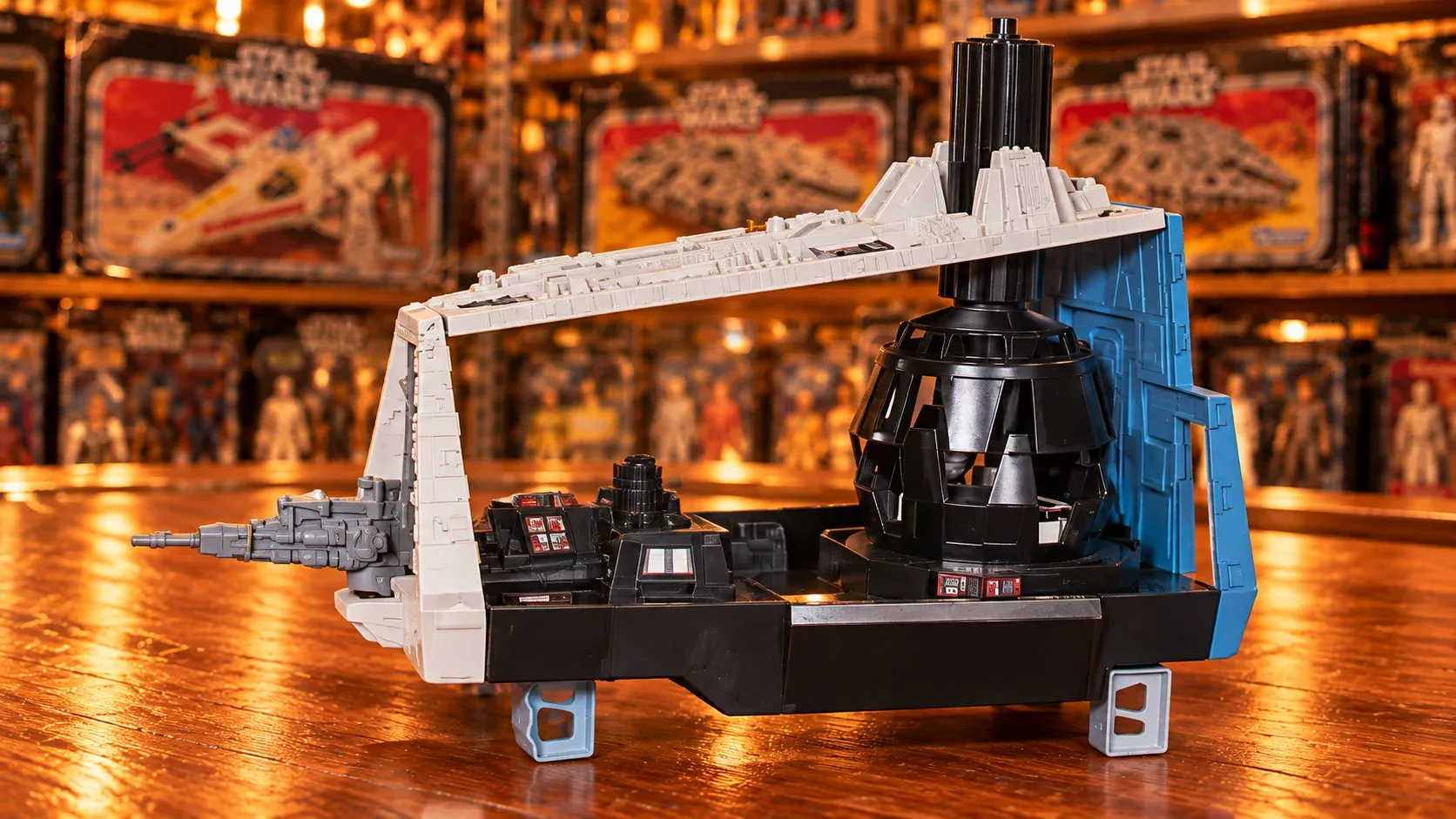
Kenner’s 1980 Darth Vader’s Star Destroyer put the Empire’s business out where you could reach it. Beneath a narrow gray upper deck sat an open floor, a command platform, and Vader’s black meditation chamber. It had the outline of a ship, but most of the fun happened while it stayed on the floor.
The chamber was the part to demonstrate first. It opened and closed around Vader, and a battery-powered light gave the interior a red glow. A simulated hologram offered someone for him to report to. Even without moving the whole playset, there was a small scene to arrange around that black enclosure.
On the swiveling command platform, Vader could turn to address a line of bounty hunters. The movable laser cannon and push-button escape hatch supplied less orderly possibilities. A captured Rebel could be kept aboard only until the child running the escape decided it was time to press the button.
Then there were the detention pegs overhead, which held figures upside down. It was a peculiar feature to put beside a command bridge, and an easy one to remember. Once the briefing was over, someone could end up hanging from the ceiling while the next figure tried the hatch.
The Tauntaun you could put Luke inside
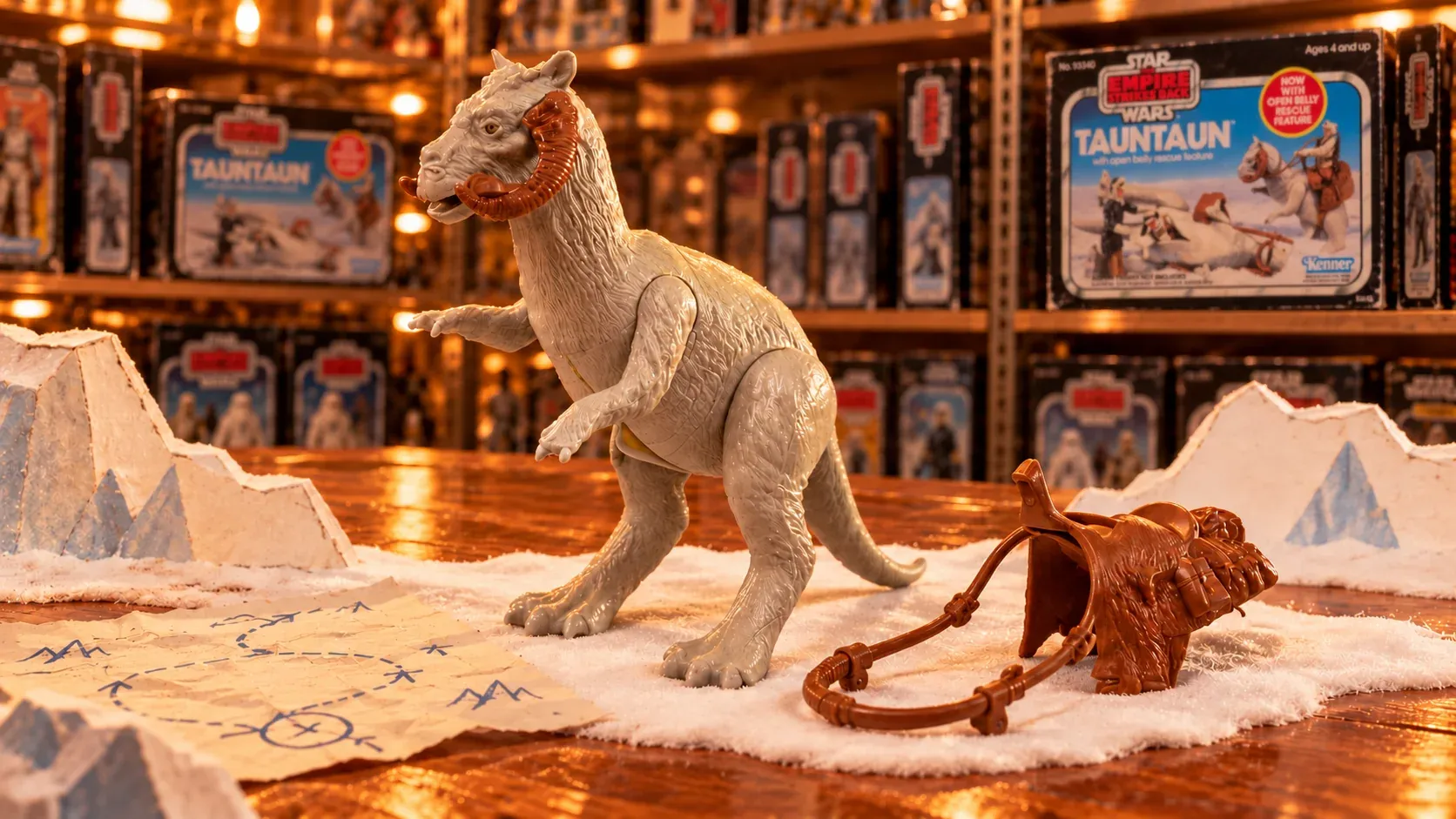
The first Kenner Tauntaun, released in 1980, had a solid belly. In 1982, Kenner added the Open Belly Rescue Feature, using flexible rubber panels that allowed an action figure to be tucked inside.
It is still a peculiar thing to see demonstrated. A child could seat Han on the creature, take him off, and then push Luke into its abdomen, following one of the grimmest passages in The Empire Strikes Back.
The toy did not include the mess of the movie scene. The panels made it a neat, repeatable operation, while the removable saddle and reins let the Tauntaun return to carrying a rider afterward.
If you remember owning one, the version matters. Putting Luke in the belly was a later feature, not something the original 1980 toy could do.
Luke’s Landspeeder and its hidden wheels
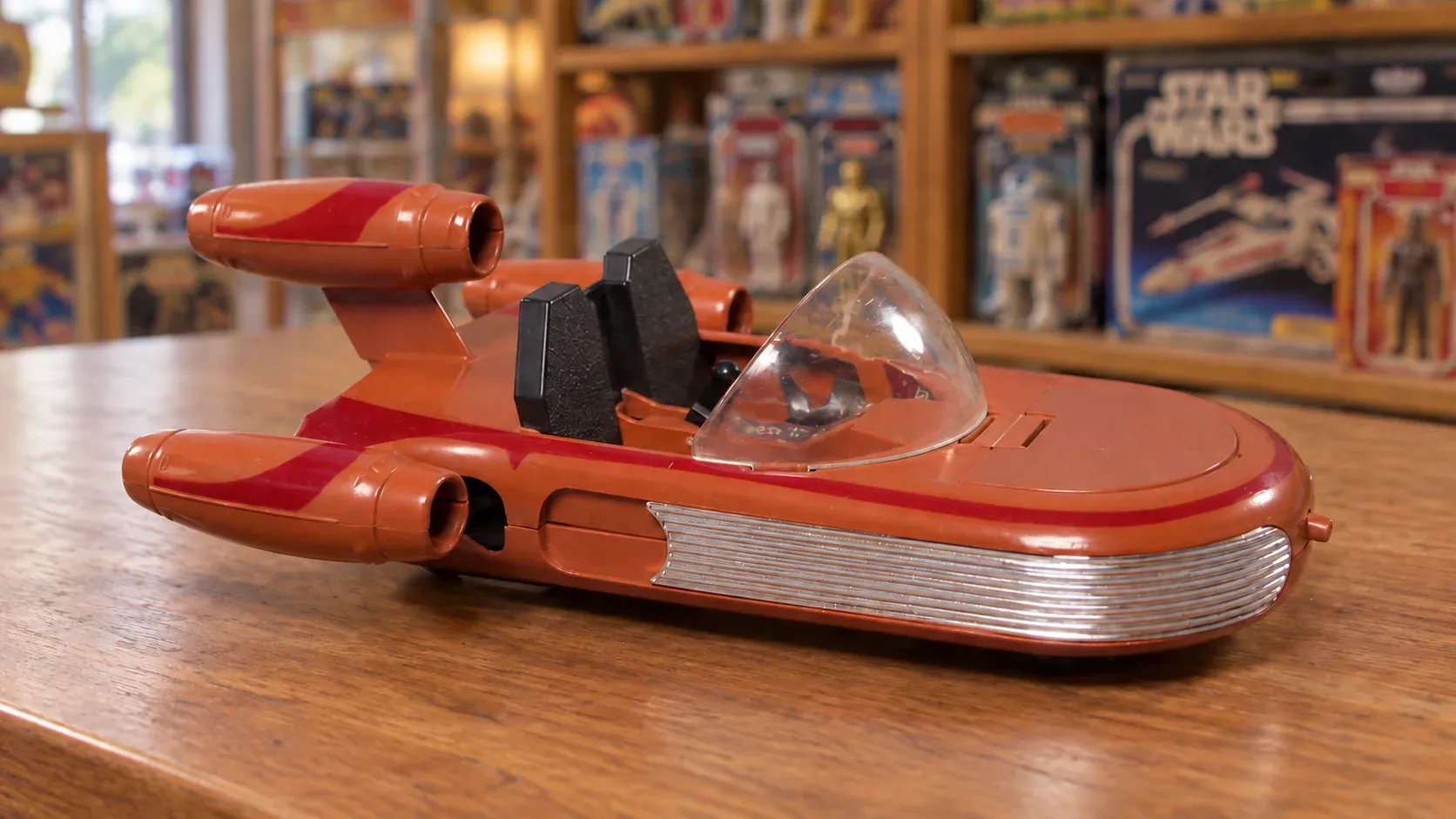
The Landspeeder was less elaborate than the larger ships, but its spring-loaded wheels created a convincing enough impression of floating when viewed from the right angle.
Released in 1978, it could carry two figures in the cockpit, with spaces for others at the rear. Luke and Ben could sit up front while the droids came along behind. On the U.S. Kenner toy, the hood popped open to reveal the engine area; some overseas versions had a fixed hood.
It was a useful early vehicle because it immediately accommodated a recognizable group of characters. You could set out with the people from the film rather than decide which one got the only available seat. The open passenger area also made it easy to put them in and take them out, without wrestling with a cockpit canopy every time Luke needed to get somewhere.
The Speeder Bike’s crashes and the AT-ST’s walking legs
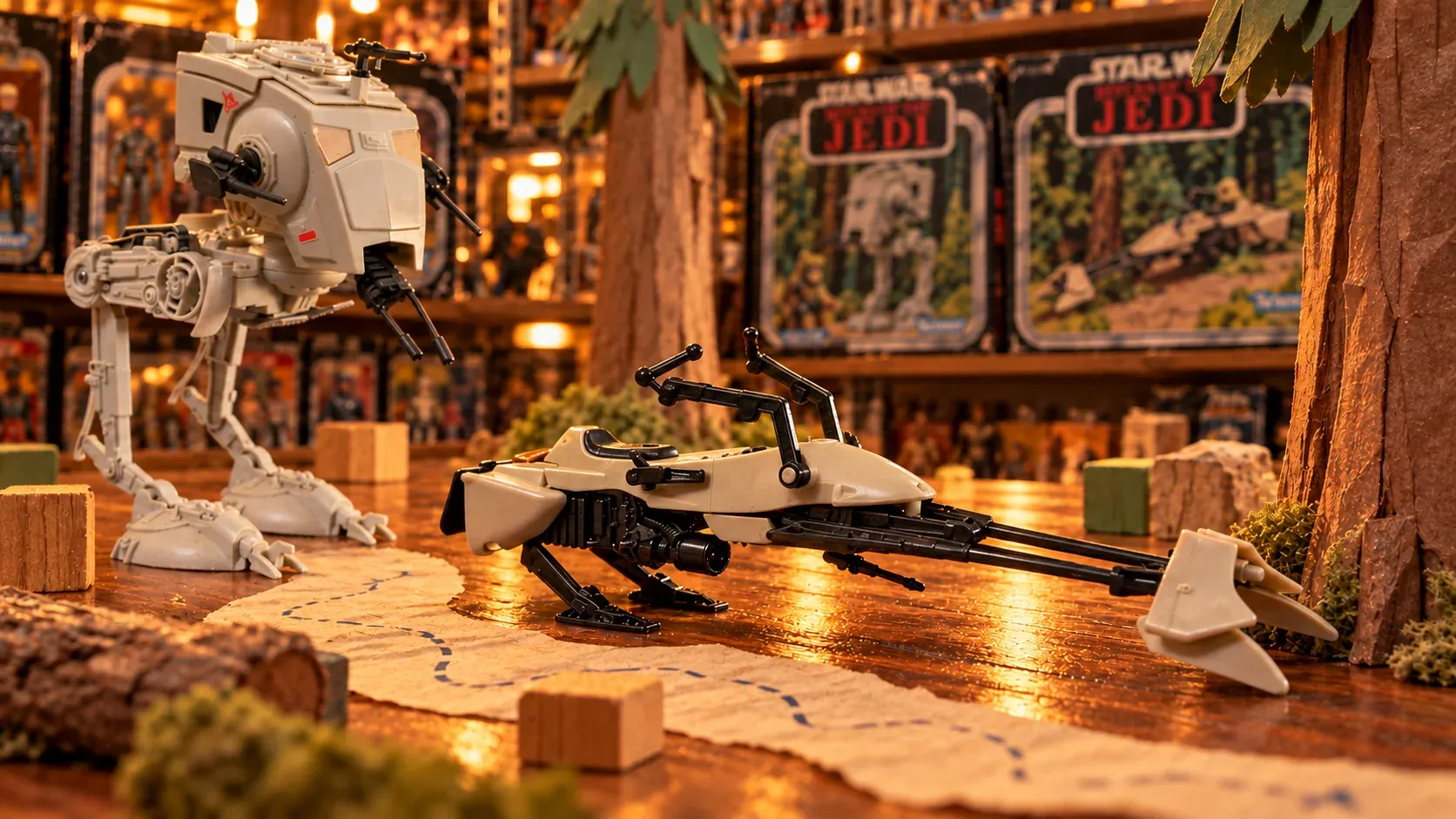
The Speeder Bike chase in Return of the Jedi offered an unusually clear instruction for playing with the 1983 toy: pick it up and move it quickly past things.
Kenner gave the bike movable handlebars and rear brake flaps, but the crash mechanism was its best feature. Pressing the button at the back flipped the upper portion forward to simulate the vehicle breaking apart. A Biker Scout figure could be sent off with it, which made the end of a chase rather more eventful than laying the bike on its side.
The Scout Walker, or AT-ST, supplied a larger opponent for Endor games. Kenner had released it in 1982 under The Empire Strikes Back branding, before its much more prominent appearance in Jedi.
A button behind the head moved the legs, and they could also be set for standing. The resulting steps were not graceful, but watching the legs respond to the button was part of the appeal. Next to the Speeder Bike, it made a useful obstruction: something to weave around before the inevitable crash.
The Y-wing dropped bombs; the B-wing kept its pilot upright
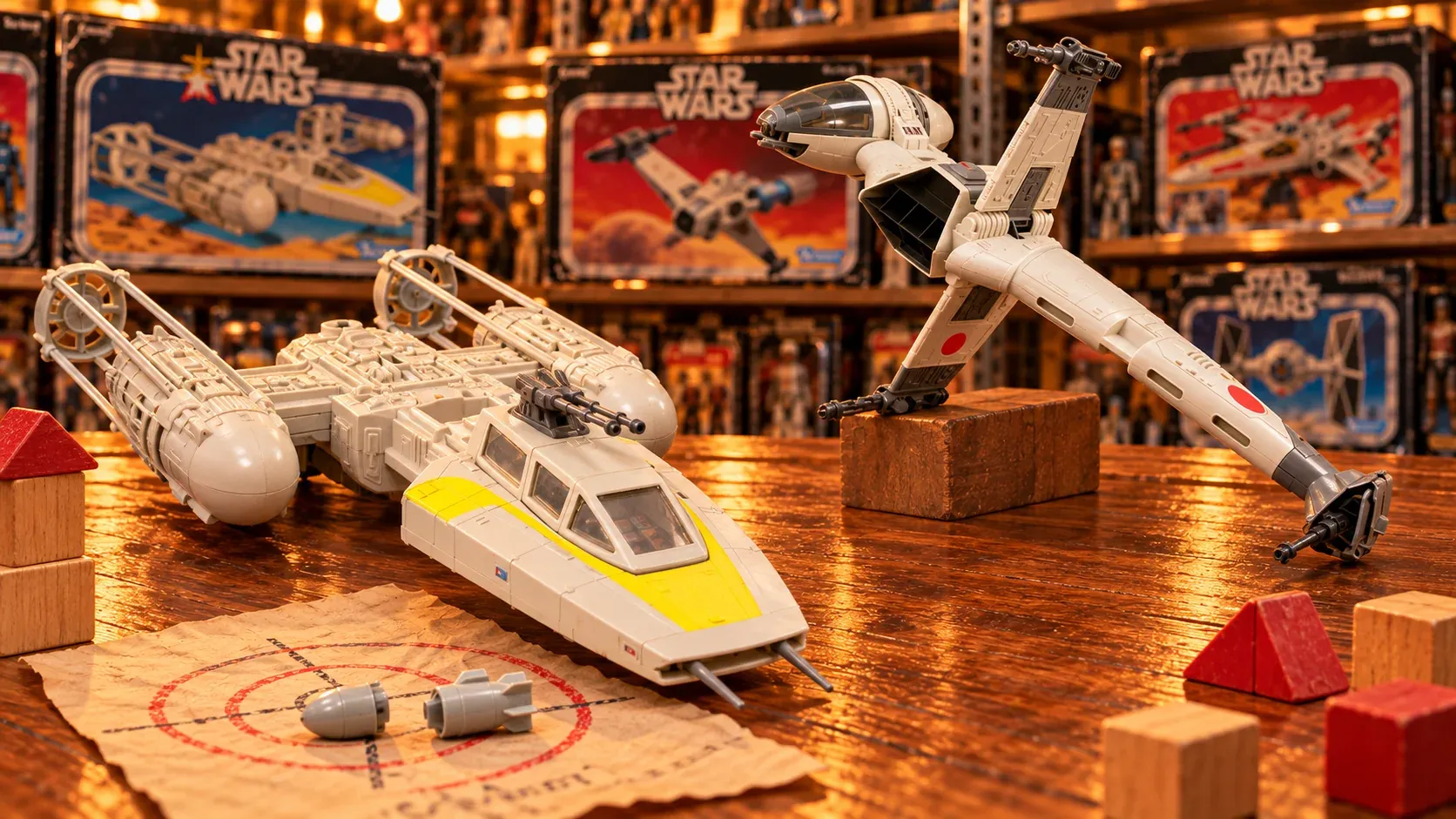
Kenner took until 1983 to release an action-figure-sized Y-wing, although a smaller die-cast version had appeared earlier.
The larger fighter came with a rotating electronic cannon, a place for an R2-D2 figure, and a two-piece bomb released by a button. That last feature gave the ship a good reason to fly over something on the floor. A target could be chosen, the bomb dropped, and the pieces collected afterward.
The B-wing, released in 1984, had a more unusual mechanism. Its cockpit used gravity to remain upright as the rest of the ship rotated. Roll the craft in your hand and the pilot could stay the right way up.
It is one of the features most worth demonstrating today because a still photograph misses what makes it clever. The ship also had electronic battle sounds, and turning a rear engine pod operated the side wings.
Both fighters made attractive additions to the Rebel side, but the B-wing is the one to pick up if someone asks what was so interesting about the old toy. Rotate it slowly and watch the cockpit.
The Imperial Shuttle’s slowly lowering wings
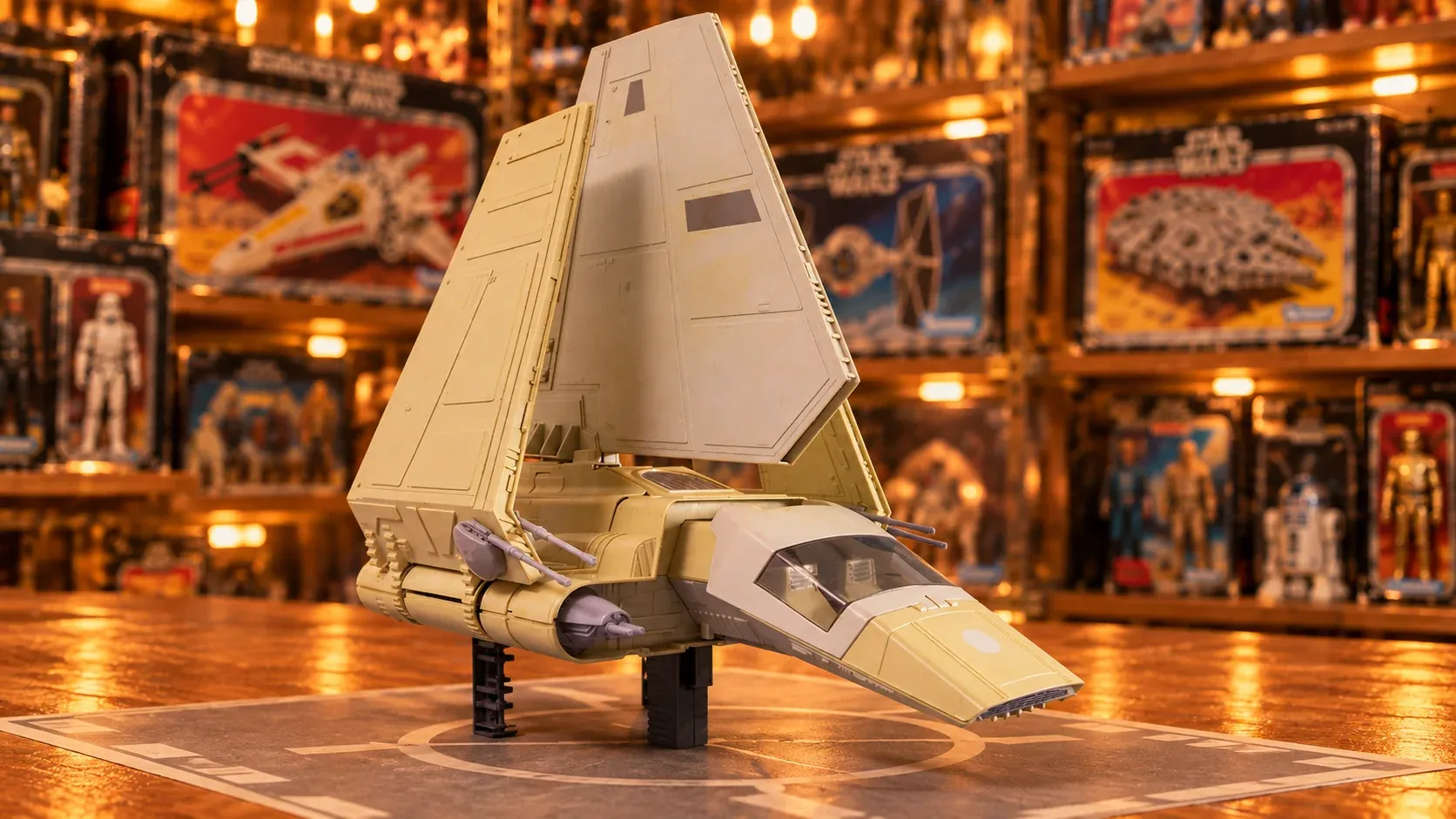
The Imperial Shuttle did not reach Kenner’s line until 1984, the year after Return of the Jedi opened.
It was an imposing vehicle, and the wing mechanism gave you an excuse to handle it carefully. A trigger on the underside let the two side wings lower slowly into flight position. The movement looked particularly good because it took a moment; there was time to watch the toy change shape before carrying it away.
Opening side panels and electronic laser sounds added features, although the Shuttle’s appeal rested heavily on its size and silhouette. With the wings lowered, it was an impressive thing to have in the collection.
The Shuttle suited the more ceremonial moments in a game: bringing an important passenger down, opening the vehicle, and arranging the figures nearby. Vader and the Emperor had plenty of fighters available in Kenner’s line, but this was the transport that looked appropriate when they were expected somewhere.
The Jawa Sandcrawler moved under its own power
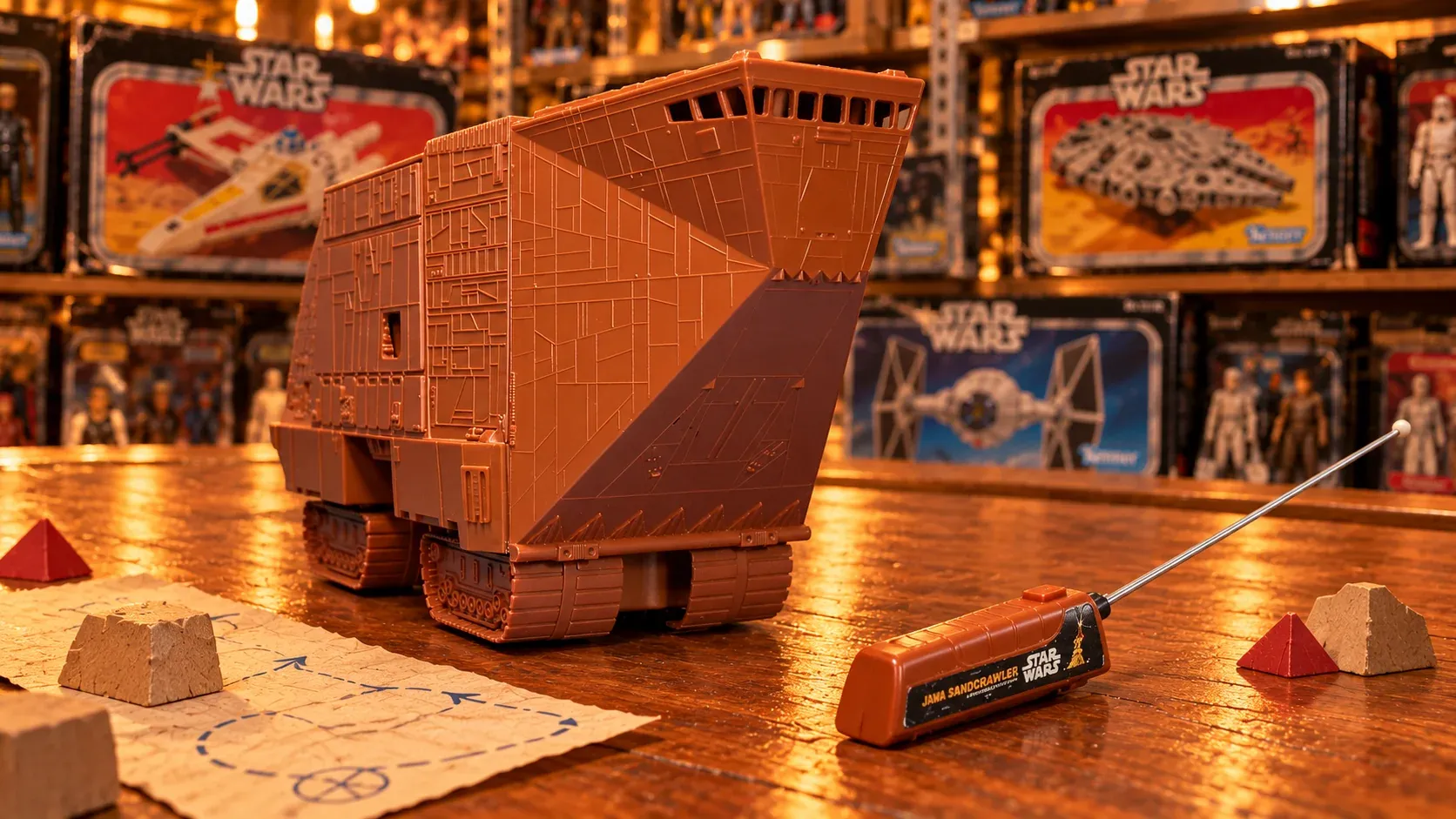
Kenner’s 1979 Radio Controlled Jawa Sandcrawler gave you a different job during play. You could put the big brown vehicle down, take the handheld controller, and send it across the floor. After flying an X-wing by carrying it around the room, making a vehicle move without touching it was a substantial new trick.
Steering took a little planning. The Sandcrawler moved forward and reversed in an arc to change direction, so a chair leg or a cardboard building could turn a short journey into a maneuvering exercise. There was room for a whole Tatooine trading expedition between the sofa and the next clear stretch of floor.
When it arrived, the roof hatch and opening side panel let you get to the figures inside. An elevator and loading steps gave the Jawas something to do besides stand beside their transport. R2-D2 could be collected, unloaded, and offered for sale again, with the next buyer waiting wherever the Sandcrawler stopped.
With an original retail price of $29.99, this was an ambitious present to ask for in 1979. The brown hull and treads made it recognizable, but the controller was what set the toy apart. A small droid caravan could move through the room while you stood a few feet away, deciding where the Jawas would conduct business next.
That is why these old toys are worth revisiting before asking what they might sell for. Pick one up and the remembered detail is often immediate: the button behind the walker’s head, the removable Falcon floor panel, the resistance of Luke’s sliding saber. For a moment, you are looking for the same thing your hands looked for years ago.
Star Wars had plenty of competition on Christmas lists. Our look at the biggest Christmas toys of the 1980s follows the decade through He-Man, Transformers, and Nintendo. The Christmas toys of the 1990s take the story into the next decade.
Recommended