When AOL Instant Messenger Was How America Talked Online
How AIM made Buddy Lists, screen names and away messages part of everyday life, from the family computer to its later mobile years.
Before texting became constant, before Facebook Messenger and group chats followed us everywhere, there was AOL Instant Messenger.
AIM, as everyone called it, became one of the defining technologies of the late 1990s and early 2000s because it turned the family computer into a social hub. For millions of people, especially teenagers and young adults, it was where friendships continued after school, where crushes became complicated, where arguments stretched late into the night, and where entire evenings disappeared one message at a time.
For many early users, AIM belonged to the family computer: you sat down, connected to the internet and deliberately signed on. That desktop-centered routine made conversation feel like something you entered. It was not AIM’s whole history, though. VoiceStream introduced mobile AIM in May 2001, years before smartphones made mobile messaging commonplace.
Before everyone carried the internet in their pocket, millions of people came home, turned on a computer and checked one simple thing first:
Who was online?
The Buddy List Was Waiting for You
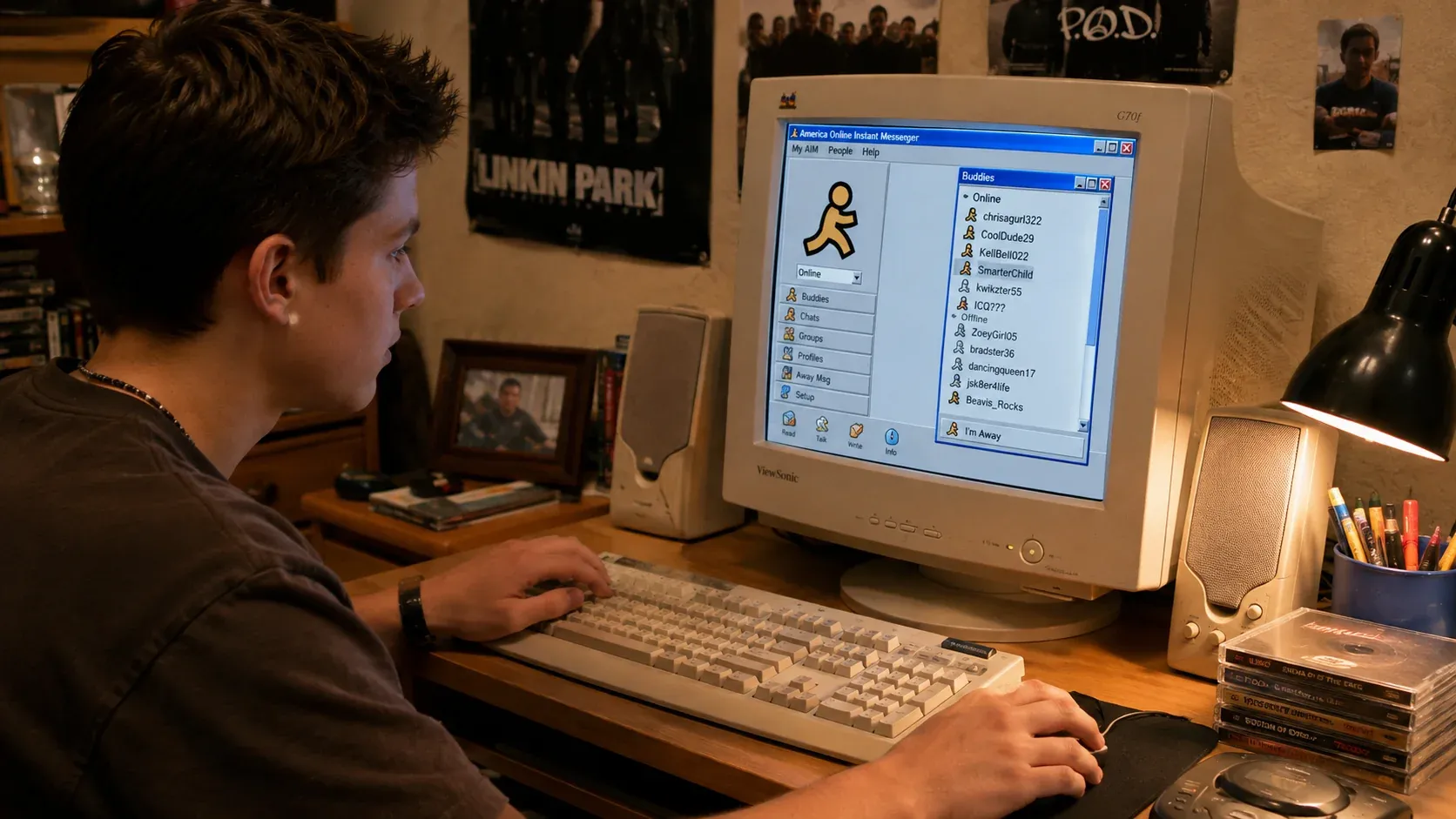
AOL Instant Messenger launched in 1997 and quickly grew beyond its connection to America Online. Because AIM could be downloaded and used separately from the full AOL service, it became an easy way for people to communicate online without needing to remain inside AOL's larger ecosystem.
By the early 2000s, checking AIM had become part of the daily routine for millions of users.
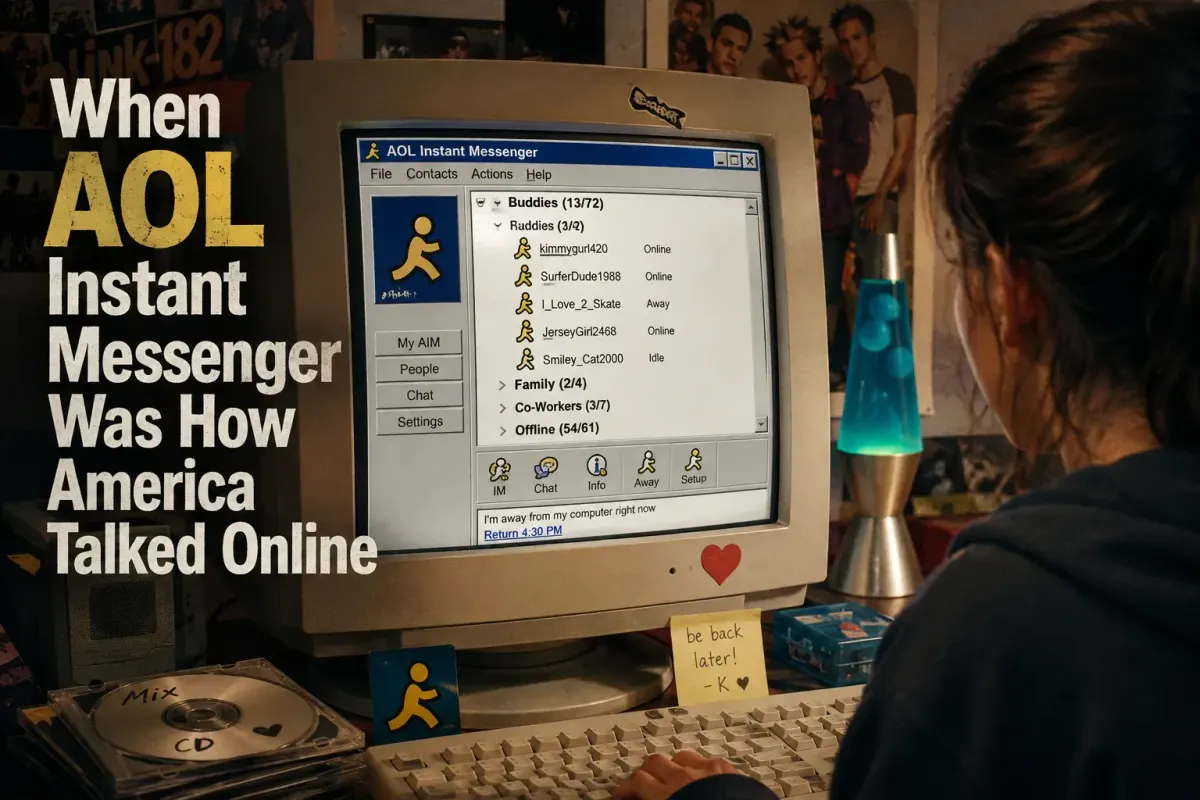
You came home from school or work, turned on the computer, signed in and immediately looked at the Buddy List to see who else was there. Maybe your best friend was already online. Maybe someone you had been hoping to talk to had just signed on. Maybe the person you wanted to avoid was suddenly active.
Friends could be sorted into Buddy List folders by school, neighborhood or team. The list made availability visible: you noticed when someone was online for hours, went idle or signed off in the middle of a conversation.
Today, most people are assumed to be reachable at nearly any moment. AIM worked differently because being online was a visible state. Someone could appear, disappear, go idle or sign off entirely, and those small changes often carried more meaning than they probably should have.
When someone came online, it felt as though they had walked into the room.
Your Screen Name Became Part of Who You Were
Long before social-media profiles turned online identity into something carefully managed, AIM gave millions of people one of their first chances to decide how they wanted to appear on the internet.
That started with the screen name.
Some people used variations of their real names, while others mixed together sports teams, favorite bands, birth years, nicknames and inside jokes. Numbers were everywhere. Capital letters appeared in strange places. Words were intentionally misspelled because the normal spelling had already been taken.
Some screen names were created in middle school and somehow survived all the way into college.
At the time, nobody thought of this as "personal branding." It was simply the name that appeared when you messaged someone. Yet for many people, it became one of their first online identities and an early lesson in the fact that the internet allowed you to present yourself differently from the way you did in person.
Away Messages Were Early Status Updates
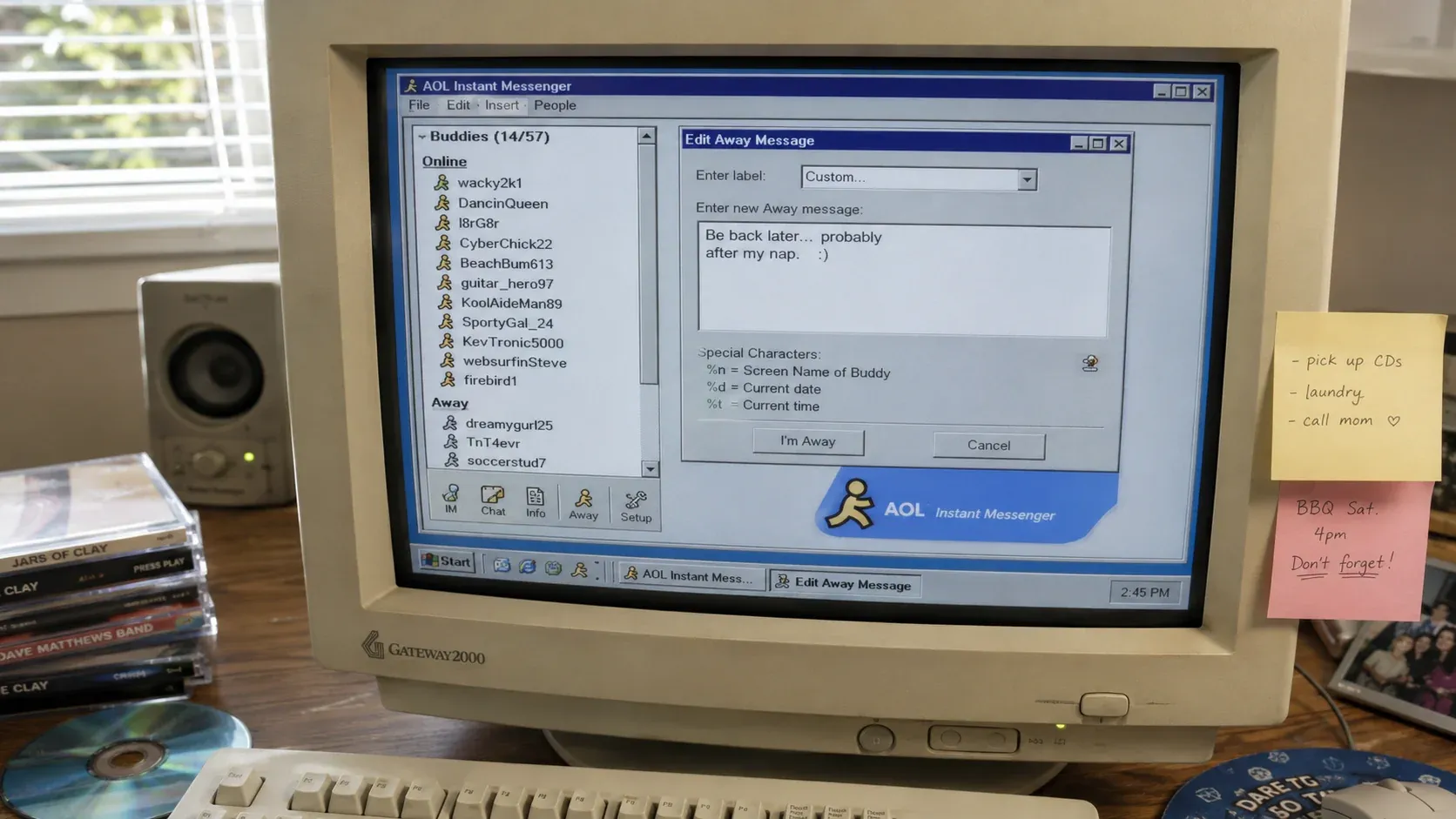
The away message was originally designed for a simple purpose. If you stepped away from the computer, you could leave a short note telling people where you had gone or when you might return.
Users quickly turned the feature into something much more interesting.
Away messages became miniature status updates years before social media made that behavior normal. People posted song lyrics, quotes, inside jokes, plans for the evening and deliberately vague comments about relationships or friendships.
A message might say something as simple as:
"Funny how people change."
Everyone on the Buddy List could see it, but only a few people might understand what it actually meant.
That ambiguity was part of the appeal. Away messages were public enough to attract attention but indirect enough to avoid saying exactly what was wrong. In many ways, they were an early version of the cryptic social-media post designed for one particular person while pretending to address everyone.
AIM Profiles Were Tiny Personal Websites
AIM profiles gave users another place to express themselves.
Compared with modern social-media pages, the profiles were extremely basic, but people still found ways to fill them with personality. They included favorite quotes, song lyrics, friend shout-outs, inside jokes, links to personal websites, initials that only certain people understood and occasionally elaborate pieces of ASCII art.
Some people updated their profiles constantly, while others left the same quote or lyric there for months.
For teenagers growing up just as the internet was becoming part of everyday life, these profiles became an early exercise in building an online persona. Years before Instagram bios and TikTok profiles, people were already trying to decide which song lyric best represented their current mood.
Conversations Felt Different When You Had to Sit at a Computer
One of the biggest differences between AIM and modern messaging was that online communication still had clear boundaries.
You could spend hours talking with friends, but eventually someone had to leave the computer. Dinner was ready. A parent needed the phone line. A sibling wanted to use the machine. Homework still had to get done.
For someone using the shared desktop computer, leaving the room could still mean leaving the conversation.
Today, a group chat or text conversation can continue all day in small bursts while people move between work, school, errands and everything else. AIM conversations were often more concentrated. People sat down specifically to talk, sometimes for hours at a time.
For a few hours after school or late at night, everyone was in front of a keyboard together.
AIM Helped Create the Language of Online Conversation
AIM also helped popularize a style of communication that would eventually spread into texting and social media.
Abbreviations such as "LOL," "BRB," "TTYL," "OMG" and "JK" became part of everyday online conversation because they were quick to type and easy to understand.
There were also countless smaller habits that anyone who used AIM during its peak would remember.
People changed fonts and text colors constantly. Some messages arrived in enormous type for dramatic effect. Friends sometimes sent one word at a time instead of typing an entire sentence. If someone was not answering, their name might be typed repeatedly until they finally responded.
The technology was simple by today's standards, but people found plenty of ways to make it expressive.
Late-Night AIM Had Its Own Atmosphere

AIM became especially memorable late at night.
The house was quieter, the room was darker and the computer screen often provided most of the light. As the night went on, the Buddy List slowly became shorter as people signed off one by one.
Those were often the hours when casual conversations turned into serious ones.
Friends talked about school, relationships, college, parents, music and whatever embarrassing thing had happened earlier that day. People sometimes found it easier to type something personal than to say it face-to-face, and AIM gave them a place to do that.
For many teenagers, some of their most memorable conversations happened while sitting alone in a bedroom or family room, staring at a blinking cursor and waiting for the next response.
AIM Changed Dating Before Dating Apps Existed
Romance became especially complicated on AIM.
Should you send the first message? How quickly should you reply? Why did someone suddenly go idle? Why were they online but not answering? Was that song lyric in their away message aimed at you?
AIM introduced an entire generation to the anxiety of interpreting small digital signals.
Seeing a crush sign on could completely change the mood of the evening. A simple "hey" could create excitement, while a one-word reply could lead to an hour of overthinking.
Modern dating apps may have introduced swiping and read receipts, but AIM had already demonstrated how much meaning people were willing to attach to tiny pieces of online behavior.
The Family Computer Made Everything More Complicated
AIM also belonged to a period when many households still had only one main computer.
That computer might have been in the living room, den, family room or a small home office, and everyone in the house had to share it. Privacy was limited, especially when a parent or sibling could walk past the screen at any moment.
A conversation that felt deeply personal could suddenly become very public if someone stood behind you at the wrong time.
Dial-up internet made things even more complicated because going online could tie up the household telephone line. Someone might demand that you disconnect because they were waiting for a call, turning the end of a conversation into a technical necessity rather than a social choice.
Broadband eventually removed that problem, but the shared family computer remained part of the AIM experience for years.
When AIM Stopped Being the Center of Online Life
By the time AOL closed AIM on December 15, 2017, texting, Facebook Messenger, iMessage and WhatsApp had made instant conversation part of everyday phone use. AIM itself had supported mobile messaging for years, but the familiar ritual of signing in at a shared computer belonged to an earlier period.
For users who knew AIM that way, a Buddy List could mark the beginning and end of an evening. You sat down to talk, then signed off when it was time to leave the computer.
Recommended