The 20 Retail Companies With the Most Stores in America in 2026
Which retailers have the most stores in America? See the 20 largest U.S. retail chains by store count in 2026, led by Dollar General and 7-Eleven.
Dollar General has the most stores in America, with roughly 21,100 U.S. locations in this ranking. The next-largest network, 7-Eleven, Speedway and Stripes, has about 12,100 across the United States and its territories. Walmart and Sam's Club sit much further down the list, despite Walmart's lead in retail sales.
Store count gives a different view of American retail from a sales ranking. It brings neighborhood businesses into focus: dollar stores, convenience stores, pharmacies and auto-parts shops. Ace Hardware even edges ahead of Walmart and Sam's Club combined. The table compares companies and branded networks, including independent and franchised stores, using the latest publicly available figures as of September 2026.
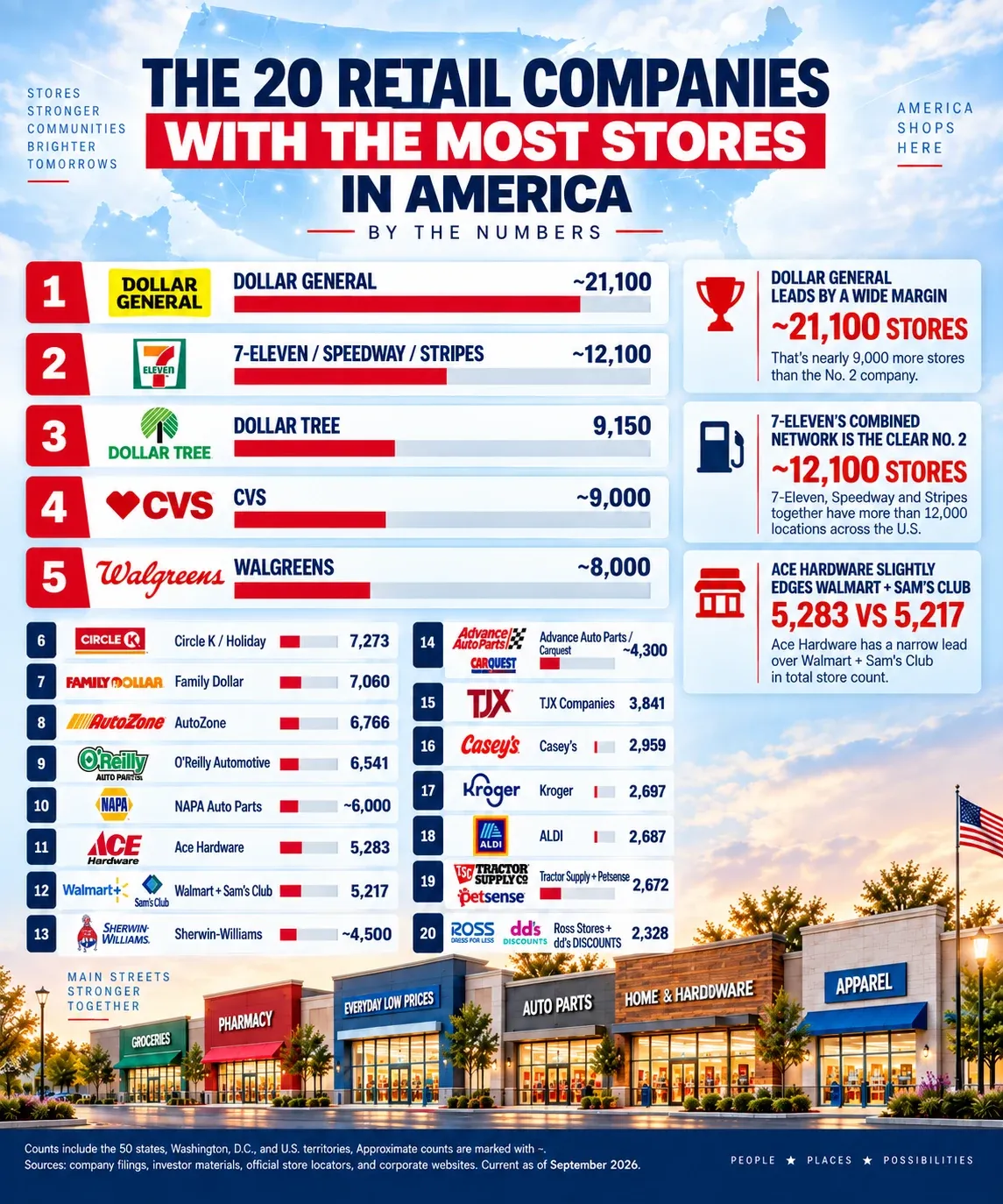
The 20 Largest Retail Chains in America by Store Count
The table below ranks major retail companies and branded retail networks by the number of physical locations they operate in the United States and U.S. territories. Counts use the latest publicly available company data as of September 2026 whenever possible.
| Rank | Retail Company or Network | U.S. Stores |
|---|---|---|
| 1 | Dollar General | ~21,100 |
| 2 | 7-Eleven / Speedway / Stripes | ~12,100 |
| 3 | Dollar Tree | 9,150 |
| 4 | CVS | ~9,000 |
| 5 | Walgreens | ~8,000 |
| 6 | Circle K / Holiday | 7,273 |
| 7 | Family Dollar | 7,060 |
| 8 | AutoZone | 6,766 |
| 9 | O'Reilly Automotive | 6,541 |
| 10 | NAPA Auto Parts | ~6,000 |
| 11 | Ace Hardware | 5,283 |
| 12 | Walmart + Sam's Club | 5,217 |
| 13 | Sherwin-Williams | ~4,500 |
| 14 | Advance Auto Parts / Carquest | ~4,300 |
| 15 | TJX Companies | 3,841 |
| 16 | Casey's | 2,959 |
| 17 | Kroger | 2,697 |
| 18 | ALDI | 2,687 |
| 19 | Tractor Supply + Petsense | 2,672 |
| 20 | Ross Stores + dd's DISCOUNTS | 2,328 |
About the data: Store counts are based on the latest publicly available company reports, SEC filings, investor materials and official store-location data available as of September 2026. A tilde (~) indicates an approximate count, typically because a company reports a rounded figure or does not provide a perfectly separated current U.S.-only total. Counts include the 50 states, Washington, D.C., and U.S. territories where applicable.
Walmart counting note: The company reported 5,217 U.S. retail units as of July 31, 2026: 4,594 Supercenters, discount stores and Neighborhood Markets, 602 Sam’s Clubs, and 21 small-format units. The grocery-chain ranking excludes those 21 small-format units and lists Sam’s Club separately.
Dollar General Has the Largest Retail Footprint in America
Dollar General's roughly 21,100 locations put it about 9,000 stores ahead of the next network on this list. That lead reflects a format built for repetition: a relatively small store carrying everyday essentials, rather than a supercenter with departments spread across a much larger building.
The format gives Dollar General room to operate in small towns and rural communities where a much larger retailer may be harder to sustain. For shoppers in those places, proximity can matter more than the range of products available at a distant big-box store.
7-Eleven Is Much Larger Than It May Seem
The name on the sign matters when counting convenience stores. This total includes Speedway and Stripes alongside 7-Eleven, bringing the combined U.S. and territory network to roughly 12,100 locations. Looking only for the familiar 7-Eleven logo would miss part of the business being measured.
Convenience stores compete on being close at hand. A quick stop for a drink or a few groceries serves a different purpose from a weekly supermarket trip, which helps explain why the format supports so many individual locations.
Circle K and Holiday add another 7,273 U.S. stores to the ranking. Casey's, with 2,959, also makes the Top 20 despite its primarily Midwestern footprint; a chain does not need to be equally visible everywhere to build a large network.
Dollar Stores Occupy Three of the Top Seven Positions
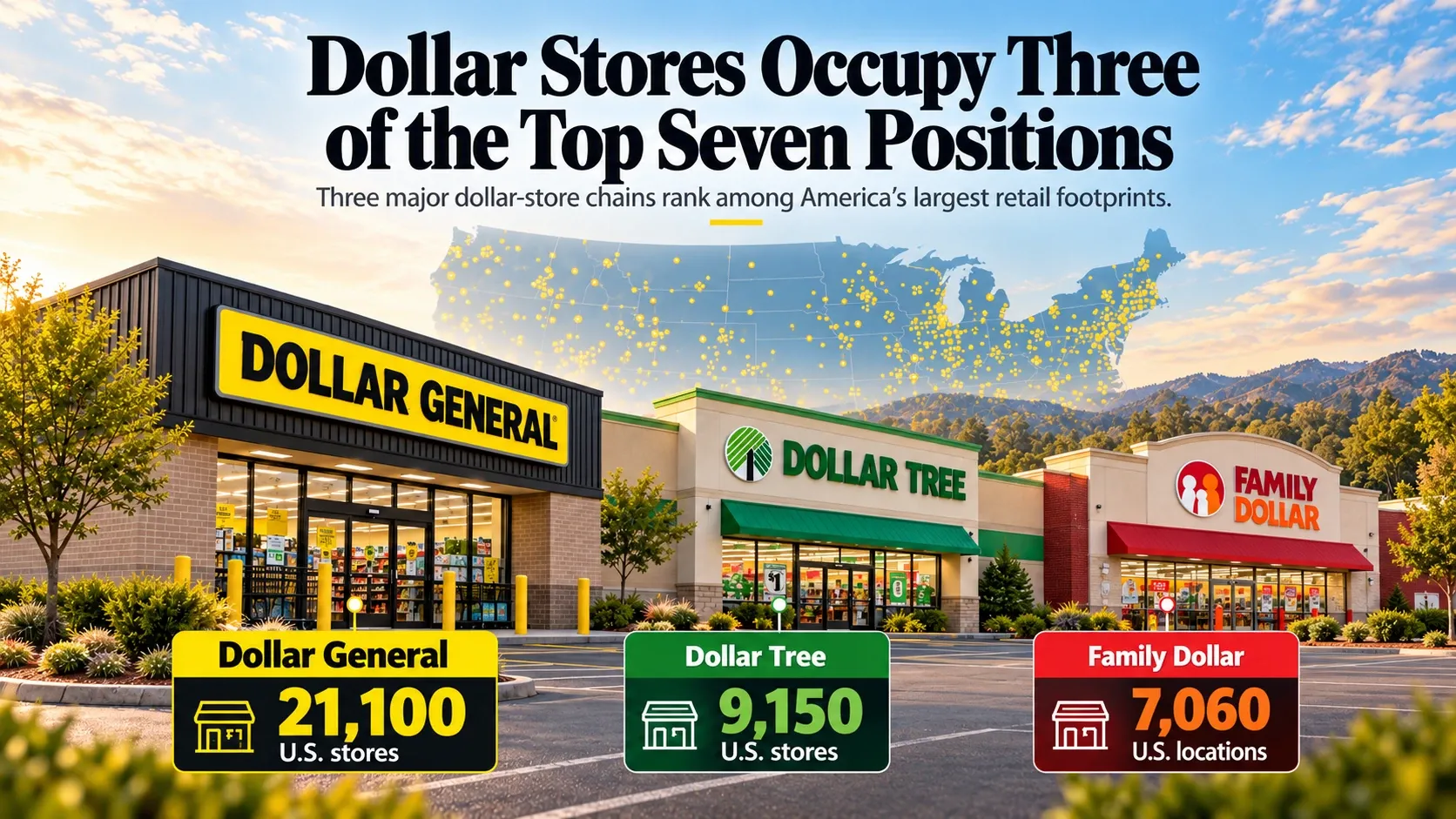
Dollar stores claim three of the first seven places: Dollar General, Dollar Tree with 9,150 U.S. stores, and Family Dollar with 7,060. Their presence near the top makes this one of the defining formats in the ranking.
Family Dollar is counted separately following its sale by Dollar Tree. That distinction matters: combining them would put a former corporate relationship ahead of the ownership structure used for this list.
The stores share a practical advantage even though their merchandise and pricing differ. They can fit into smaller buildings and serve markets that would be harder to reach with a large-format store. Across suburban neighborhoods and rural towns, that opens up many possible sites.
CVS and Walgreens Still Have Enormous National Networks
CVS and Walgreens remain near the top even after years of closures. Their positions capture the scale of the networks that still exist, rather than suggesting that either chain is continuing to expand at its former pace.
The figures used here put CVS at approximately 9,000 retail locations and Walgreens at roughly 8,000 across the United States and Puerto Rico. Because closures can change those totals, the reporting date deserves particular attention when comparing drugstore chains.
A prescription counter also brings customers into a store selling toiletries, beauty products and household goods. That mix gives these locations a place in a retail ranking, even though many customers visit primarily for the pharmacy.
Auto Parts Retailers Are Quietly Everywhere
Four places in the Top 20 belong to auto-parts networks. These stores tend to draw less attention than supermarkets or department stores, but their combined presence is hard to miss in a count of physical locations.
AutoZone operates 6,766 U.S. stores, while O'Reilly Automotive has 6,541 locations across 48 states and Puerto Rico. NAPA Auto Parts adds approximately 6,000 branded stores of its own, and Advance Auto Parts and Carquest contribute another roughly 4,300 locations.
For a driver needing a replacement part, or a repair shop waiting to finish a job, distance matters. A network of local stores puts inventory closer to both. That gives auto-parts retail a reason to spread across thousands of locations beyond simply opening more places for customers to browse.
Ace Hardware Has More Stores Than Walmart and Sam's Club Combined
Ace's 5,283 domestic stores exceed Walmart and Sam's Club's combined 5,217 by just 66 locations. It is a narrow lead, and one that depends on counting independently owned branded stores alongside corporate-owned locations.
Many Ace stores are locally owned businesses operating under a shared national brand. The count brings those individual retailers together as one network, rather than treating each owner as an unrelated company.
The same principle applies to franchised and independently owned locations elsewhere on the list, including 7-Eleven and NAPA. It keeps the comparison focused on the stores a customer can visit under each network's brands.
Walmart Shows Why Store Count Does Not Equal Retail Size
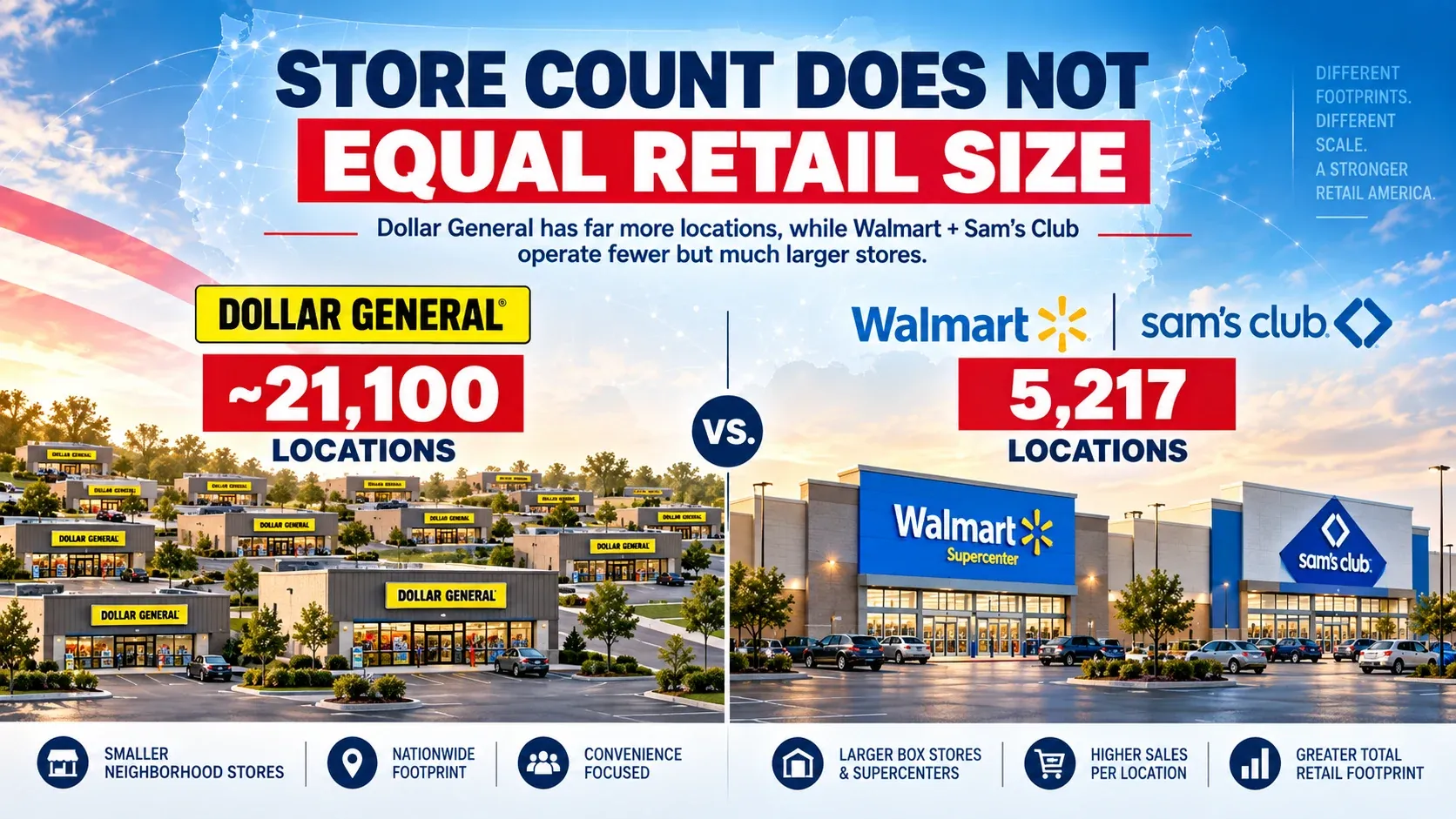
Walmart and Sam's Club place 12th with 5,217 U.S. retail units. That position says something about the limits of this ranking: a single location counts as one store whether it is a neighborhood shop or a supercenter.
A Walmart Supercenter can exceed 150,000 square feet, bringing groceries and multiple merchandise departments into one building. Several smaller retailers might divide those shopping trips among separate locations. Counting the doors alone leaves out that difference in what each store contains.
Revenue, selling space and customer reach would produce different comparisons. Store count answers a narrower question, which is why Walmart's position here should be read alongside its much larger role in U.S. retail sales.
For another measure of corporate scale, compare the largest U.S. public companies by worldwide employees.
Discount and Value Retailers Continue to Build Large Networks
Discount shopping appears here in several forms. TJX's brands, ALDI's supermarkets and Ross's stores belong to different retail categories, even though value is central to their appeal.
TJX Companies operates 3,841 U.S. locations across TJ Maxx, Marshalls, HomeGoods, Sierra and Homesense. ALDI has expanded to approximately 2,687 stores, while Ross Stores and dd's DISCOUNTS combine for another 2,328 locations.
Five Below, which recently moved above 2,000 stores, now sits just outside this Top 20.
A single corporate total can also conceal several familiar names. TJ Maxx, Marshalls and HomeGoods are counted together under TJX, while dd's DISCOUNTS is included with Ross. Recognizing those combinations makes the totals easier to connect to the stores people actually use.
Grocery Chains Are Large, but Not as Large as You Might Expect
Kroger operates 2,697 supermarkets across dozens of banners, including Kroger, Ralphs, Fry's, Harris Teeter, King Soopers and others.
Kroger's 17th-place total includes supermarkets carrying different local names. A shopper at Ralphs or Harris Teeter is visiting part of the network counted here, even if the Kroger name never appears on the storefront.
ALDI sits immediately behind Kroger, with approximately 2,687 stores compared with 2,697. The ten-store gap is worth noticing, but the counts come from different reporting dates. It should not be treated as a precise, same-day lead.
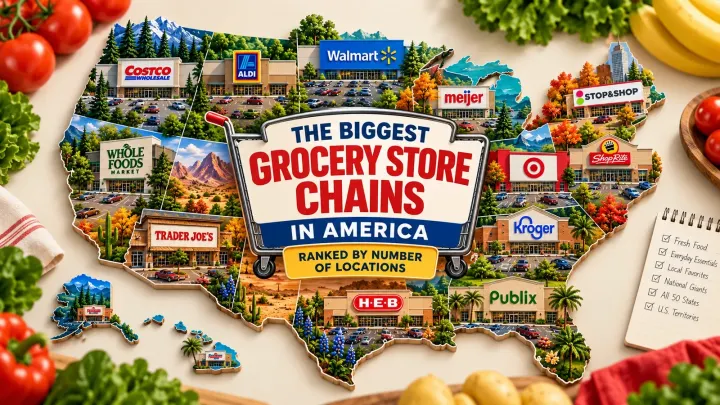
Our ranking of America’s largest grocery chains by number of locations compares individual store banners, separating familiar names that share a parent company.
Why Some Familiar Retailers Aren't in the Top 20
Ross and dd's DISCOUNTS set the cutoff at 2,328 locations. A familiar national name can therefore have thousands of stores and still fall outside this Top 20.
Albertsons operates roughly 2,200 stores under banners including Albertsons, Safeway, Jewel-Osco, Acme and Shaw's. Home Depot has slightly more than 2,000 U.S. stores, while Five Below has also crossed the 2,000-store mark. Target reported 2,019 stores as of August 1, 2026.
Bath & Body Works, Lowe's and several other familiar national chains also have large footprints but fall below the cutoff needed to make the current Top 20.
Do it Best raises a different counting question. It serves independent hardware and lumber retailers, many of which trade primarily under their own local names. Including every member would broaden the definition beyond the clearly branded retail networks used here, so those member locations are excluded.
Restaurants are outside the scope of this retail comparison. Bringing in Subway, McDonald's or Starbucks would produce a different list, rather than simply adding a few missing retailers.
What America's Largest Retail Networks Have in Common
The common thread is proximity. Many of the highest-ranked networks sell things people need nearby: everyday essentials, prescriptions, convenience items and replacement parts. Their locations can fit into places where a larger store would be harder to sustain, giving them more opportunities to repeat the format.
Methodology and Sources
This ranking uses the latest publicly available store counts available as of September 2026. The United States is defined to include the 50 states, Washington, D.C., and U.S. territories such as Puerto Rico, Guam and the U.S. Virgin Islands. Canadian, Mexican and other international locations are excluded whenever company reporting allows them to be separated.
The ranking counts physical consumer-facing retail stores operating under each company's brands or retail network. Company-owned, franchised, licensed and independently owned branded stores are included. Restaurants, banks and non-retail facilities are excluded. Service-only locations are generally excluded; Walmart is an exception because its company-reported U.S. retail-unit total retains 21 small-format units, a mixed category that includes fuel stations and other pharmacy formats. The Walmart counting note above explains this difference.
Because companies use different fiscal calendars, individual store counts do not all represent the same reporting date. Figures marked with a tilde (~) are approximate because the retailer either reports a rounded figure or does not provide a perfectly separated current U.S.-only count.
Sources: Company annual reports, quarterly reports and filings with the U.S. Securities and Exchange Commission; company investor-relations materials; official company store-location databases; and official corporate websites. Third-party location data was used where an exact current company-reported U.S. count was not publicly available.
Frequently Asked Questions
Which retail company has the most stores in America?
Dollar General has the largest physical retail network in the United States, with approximately 21,100 locations based on the latest available 2026 company data.
How many 7-Eleven stores are there in the United States?
The combined 7-Eleven, Speedway and Stripes network is estimated at roughly 12,100 U.S. and U.S. territory locations. That makes it one of the largest retail networks in America.
Does Walmart have the most stores in the United States?
No. Walmart and Sam's Club operate approximately 5,217 U.S. retail units. Several companies, including Dollar General, 7-Eleven, Dollar Tree, CVS and Walgreens, operate more individual locations. Walmart's stores are generally much larger, however, so store count should not be confused with sales or overall company size.
Why is Ace Hardware ranked ahead of Walmart?
Ace Hardware operates more individual retail locations because most Ace stores are smaller, independently owned neighborhood hardware stores. Walmart operates fewer but dramatically larger stores. Ace therefore has more locations even though Walmart is a much larger company by revenue.
Are franchise stores included in the ranking?
Yes. The ranking measures consumer-facing stores operating under a retail company's brands or network, so franchised, licensed and independently owned branded locations are included alongside company-owned stores.
Recommended