
The Cell Phones Everyone Wanted Before the iPhone
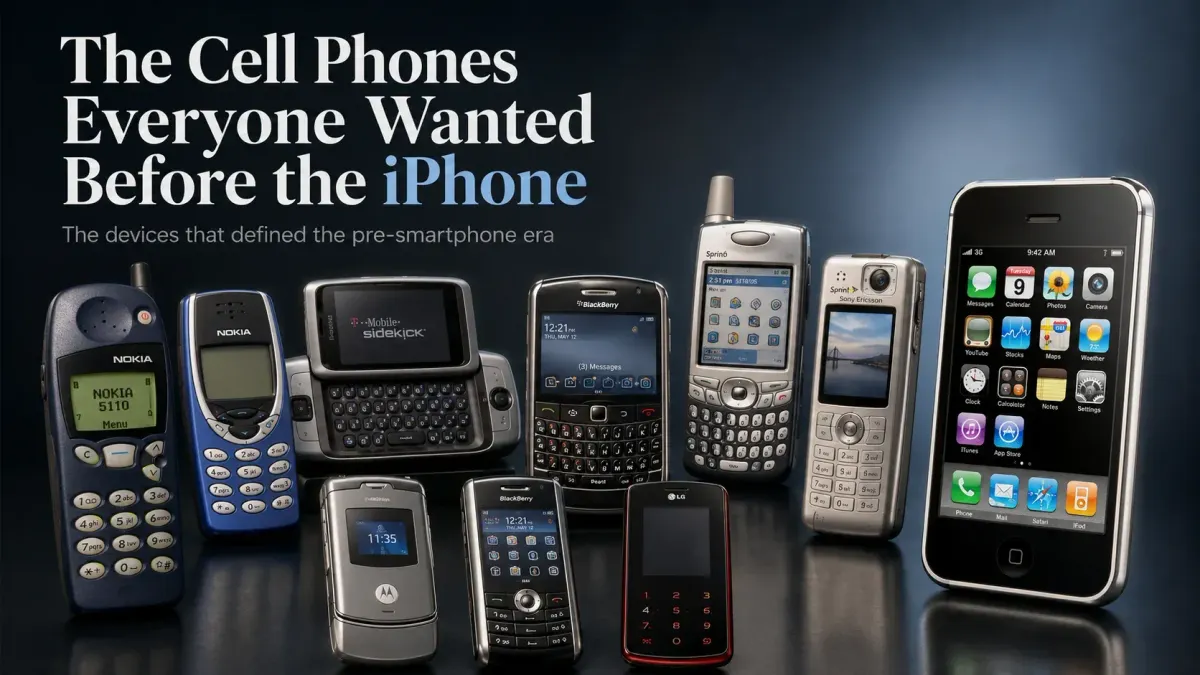
Before every phone became a large glass rectangle, cell phones had personality.
There were tiny candy-bar phones, flip phones that snapped shut with authority, BlackBerrys covered in tiny keys, and strange new devices that swiveled, slid, folded, and tried to squeeze the internet into screens barely larger than a postage stamp. During the late 1990s and early 2000s, manufacturers seemed to have a completely different idea every year about what the future of the cell phone should look like.
Then, in 2007, the iPhone arrived and changed the direction of the industry.
The iPhone did not appear out of nowhere, however. Many of the things that would eventually define the smartphone—mobile email, web browsing, cameras, music, messaging, calendars, and constant connectivity—had already begun appearing on the phones that came before it.
Looking back at the most desirable phones of the era reveals just how quickly that transformation happened.
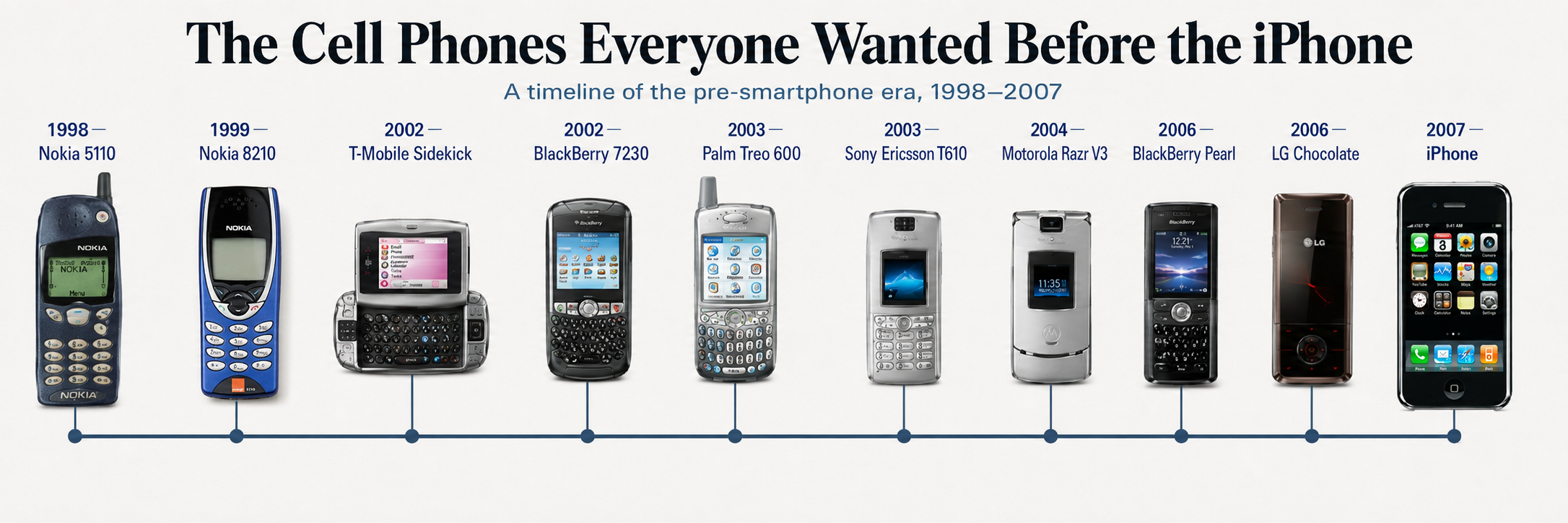
1998 — Nokia 5110
For millions of people, the Nokia 5110 represented the moment when carrying a cell phone started to feel normal rather than extravagant.
Its chunky candy-bar shape looks unmistakably late-1990s today, but at the time it was relatively compact, easy to use, and remarkably customizable. Interchangeable faceplates allowed owners to change the color and appearance of their phone, turning what had once been a purely functional device into something considerably more personal.
The 5110 also helped introduce millions of users to Snake, the simple game that became practically synonymous with Nokia phones. Long before app stores and streaming services, having a game built into your telephone felt surprisingly entertaining.
A great phone in 1998 was still primarily judged by call quality, battery life, portability, and durability. Everything else was a bonus.
1999 — Nokia 8210
Only a year later, the race had shifted toward making phones dramatically smaller.
The Nokia 8210 became one of the clearest symbols of that trend. Weighing roughly 79 grams, it was remarkably light for the period and small enough to almost disappear into a pocket.
Its curved design and colorful interchangeable covers also made it feel more stylish than many of the utilitarian phones that had come before it. While modern smartphone companies compete over larger screens, the bragging rights around 1999 could come from having a phone that seemed impossibly tiny.
The 8210 showed that a cell phone was becoming something people wanted not only because they needed one, but because they liked the way it looked.
2002 — T-Mobile Sidekick
The Sidekick represented a much bigger change.
Instead of focusing primarily on phone calls, it was designed around communication in all its emerging forms. Its distinctive screen swiveled out of the way to reveal a full physical keyboard underneath, making instant messaging and email far easier than typing with a traditional numeric keypad.
For teenagers and young adults in particular, the Sidekick could feel like carrying part of the internet in your pocket. Instant messaging, email, web browsing, and constant conversations suddenly traveled with you.
Its unusual design also helped make it a pop-culture object. Celebrities carried them, musicians were photographed with them, and the satisfying swivel of the screen became instantly recognizable.
The Sidekick offered an early preview of something that would eventually define smartphones: the idea that your phone should keep you connected all day, even when you weren't actually making a call.
2003 — BlackBerry 7230
While the Sidekick was becoming associated with messaging and youth culture, BlackBerry was transforming the business world.
The BlackBerry 7230 combined mobile email, web browsing, messaging, a color display, and the company's famous physical keyboard in one compact device. For professionals who had previously needed to return to a computer to check their inbox, the ability to send and receive email almost anywhere was revolutionary.
BlackBerry devices soon became symbols of corporate importance. Seeing someone furiously typing on one often suggested that they were busy, connected, and probably answering an email that couldn't wait.
The devices became so difficult for some users to put down that the nickname “CrackBerry” entered popular culture.
BlackBerry had discovered something incredibly important: once people became accustomed to having their digital lives available everywhere, they rarely wanted to give that access up.
2003 — Palm Treo 600
The Palm Treo 600 pushed the concept even closer to what we now recognize as a smartphone.
It combined a mobile phone with many of the features people already loved about Palm's personal digital assistants. Users could manage contacts and calendars, send email, browse the web, install software, take pictures, and type using a physical keyboard.
Today, that collection of features sounds completely ordinary. In 2003, putting them together in one pocket-sized device felt ambitious.
The Treo demonstrated the growing belief that people would eventually stop carrying separate electronic devices for different tasks. A phone might replace the PDA, organizer, email device, and perhaps even the camera.
That idea of technological convergence was rapidly becoming the industry's biggest goal.
2003 — Sony Ericsson T610
The Sony Ericsson T610 showed another important piece of the future arriving: the camera phone.
With its stylish silver design, color display, Bluetooth connectivity, and integrated camera, the T610 looked considerably more sophisticated than phones from only a few years earlier.
Its camera would be laughably primitive compared with even an inexpensive smartphone today, but image quality was not really the point. What mattered was that people could suddenly take a picture with something they were already carrying.
You didn't need to remember your camera.
You didn't need film.
You simply pulled out your phone.
That convenience would eventually transform photography itself, but in 2003 it still felt like an exciting novelty.
2004 — Motorola Razr V3
Then came one of the most desirable phones of the entire pre-iPhone era.
Motorola introduced the Razr V3 in 2004, and it immediately stood apart from the bulky flip phones surrounding it. Its ultra-thin profile, metallic construction, distinctive flat keypad, and sharply styled hinge made it look more like a piece of futuristic design than a traditional telephone.
The Razr also benefited enormously from its cultural visibility. Celebrities carried them, advertisements treated them like fashion accessories, and wireless stores displayed them as premium products.
For a few years, owning a Razr was a status symbol.
Its success reinforced an increasingly important lesson for the mobile industry: specifications mattered, but design mattered too. People were beginning to care just as much about how their phone looked when they pulled it out of their pocket as they did about what it could do.
2006 — BlackBerry Pearl
By 2006, BlackBerry was no longer interested in serving only executives and corporate users.
The BlackBerry Pearl was smaller, sleeker, and considerably more consumer-friendly than many earlier BlackBerry models. It combined email and messaging with a camera, multimedia functions, web access, and a compact keyboard system that allowed the device to remain relatively narrow.
It also featured the tiny trackball that gave the Pearl its name.
For many consumers, it offered an appealing compromise. You could have the always-connected email and messaging capabilities of a BlackBerry without carrying something that looked quite so much like equipment issued by your company's IT department.
The line between a business phone and a personal phone was rapidly disappearing.
2006 — LG Chocolate
The LG Chocolate represented another major shift taking place just before the iPhone: phones were becoming entertainment devices.
Its glossy exterior, sliding design, glowing touch-sensitive controls, and music-oriented marketing made it one of the most distinctive phones of 2006.
That emphasis on music was especially important. Apple's iPod had become a cultural phenomenon, and millions of people were still carrying an MP3 player alongside their cell phone.
Phone manufacturers understood that this probably wouldn't last forever.
Consumers increasingly wanted one device that could handle phone calls, photos, music, messaging, email, calendars, and the internet. The pieces of the modern smartphone were rapidly coming together.
What nobody had completely figured out was how those pieces should be controlled.
Most companies continued adding more buttons, keyboards, sliders, navigation pads, and specialized hardware.
Then Apple offered a radically different answer.
2007 — The iPhone Changes the Formula
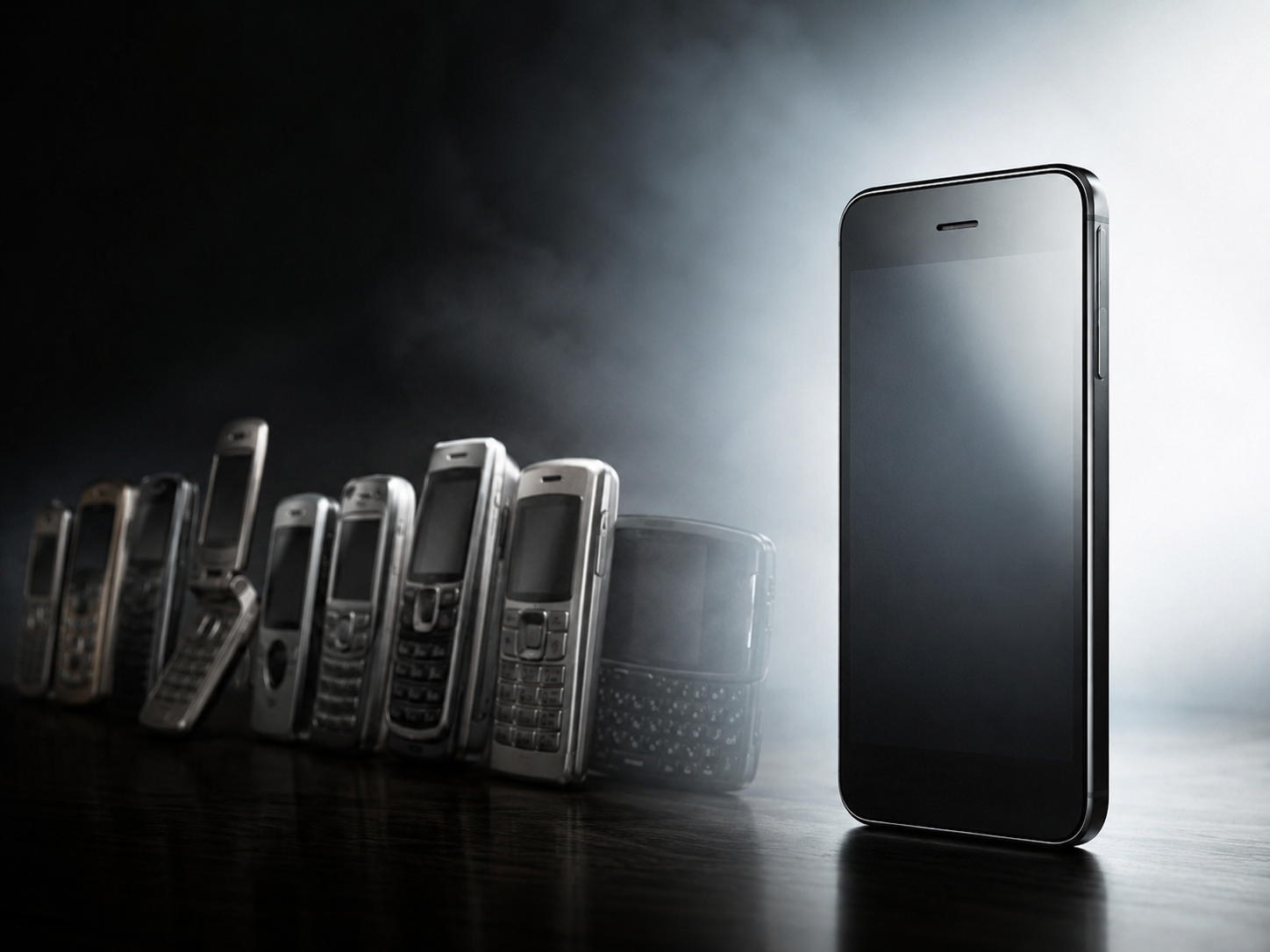
On January 9, 2007, Steve Jobs walked onto the stage at Macworld and introduced the iPhone.
Apple presented it as three products combined into one: a widescreen iPod, a mobile phone, and an internet communications device.
Yet one of the most revolutionary things about the iPhone was not what Apple added. It was what Apple removed.
There was no full physical keyboard, no flip mechanism, no sliding keypad, and no trackball. Instead, almost the entire front of the device became a touchscreen that could change depending on what the user was doing.
At the time, that was far from an obvious decision. Physical buttons had defined cell phones for decades, and devices like the BlackBerry had demonstrated how effective real keyboards could be.
Plenty of people questioned whether consumers would actually want to type directly on a screen.
They did.
The first iPhone did not invent every feature associated with smartphones. Other devices already offered email, web browsing, cameras, music, messaging, calendars, and downloadable software.
What Apple changed was the way those capabilities were brought together and, more importantly, how people interacted with them.
The phone itself became less important than what could appear on its screen.
When Every Phone Looked Different
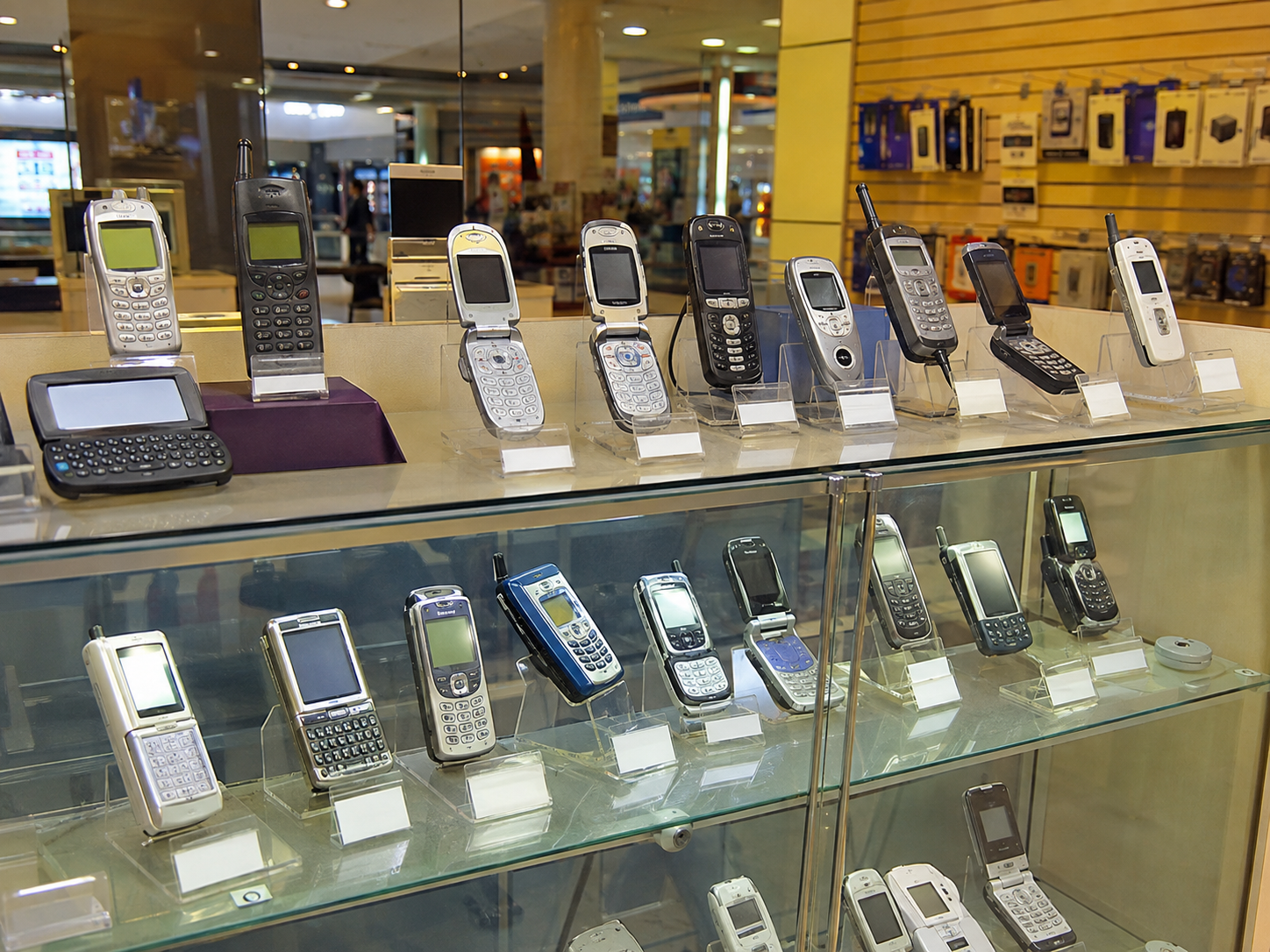
Within only a few years, most major manufacturers began moving toward the same fundamental design the iPhone had popularized: a large touchscreen occupying almost the entire front of the device.
Flip phones faded. Sliding keyboards disappeared. Interchangeable faceplates became unusual, and the tiny physical keyboards, navigation pads, trackballs, and elaborate hinges that had defined the early 2000s gradually vanished.
Modern smartphones are vastly more capable than anything available during that era, but the pre-iPhone years were arguably much more visually interesting.
You could identify many phones from across a room. A Sidekick looked nothing like a Razr. A Razr looked nothing like a BlackBerry. A BlackBerry looked nothing like an LG Chocolate, and none of them looked much like the tiny Nokia phones that had dominated only a few years earlier.
Every manufacturer seemed to be experimenting with a different vision of the future.
By the time the iPhone appeared in 2007, most of the ingredients of the modern smartphone had already arrived. The Nokia era had made mobile phones personal and ubiquitous. The Sidekick turned messaging into a lifestyle. BlackBerry put email in everyone's pocket. Palm demonstrated that one device could replace several others. Camera phones changed photography, the Razr made phones fashionable, and the LG Chocolate pushed music deeper into the mobile experience.
The iPhone's breakthrough was bringing those ideas together behind one large touchscreen.
And almost overnight, the cell phones everyone had wanted before it began to look like they belonged to another era.
Recommended

What Would Your Wizarding Career Be?
Answer 25 personality questions and discover whether you're destined to be an Auror, Healer, Professor, Curse-Breaker, Wandmaker or another wizarding professional.

10 of the Most Recognizable Careers in the Harry Potter Wizarding World
From Aurors and Healers to Hogwarts professors and Quidditch players, explore 10 of the most recognizable jobs in the Harry Potter Wizarding World.
Exosquad at 33: The ’90s Cartoon That Treated Space War Like It Mattered
Thirty-three years after its premiere, Exosquad remains a remarkably ambitious animated war epic built on serialized storytelling, political consequence and unforgettable E-frames.