
The Rise and Fall of Saturday Morning Cartoons
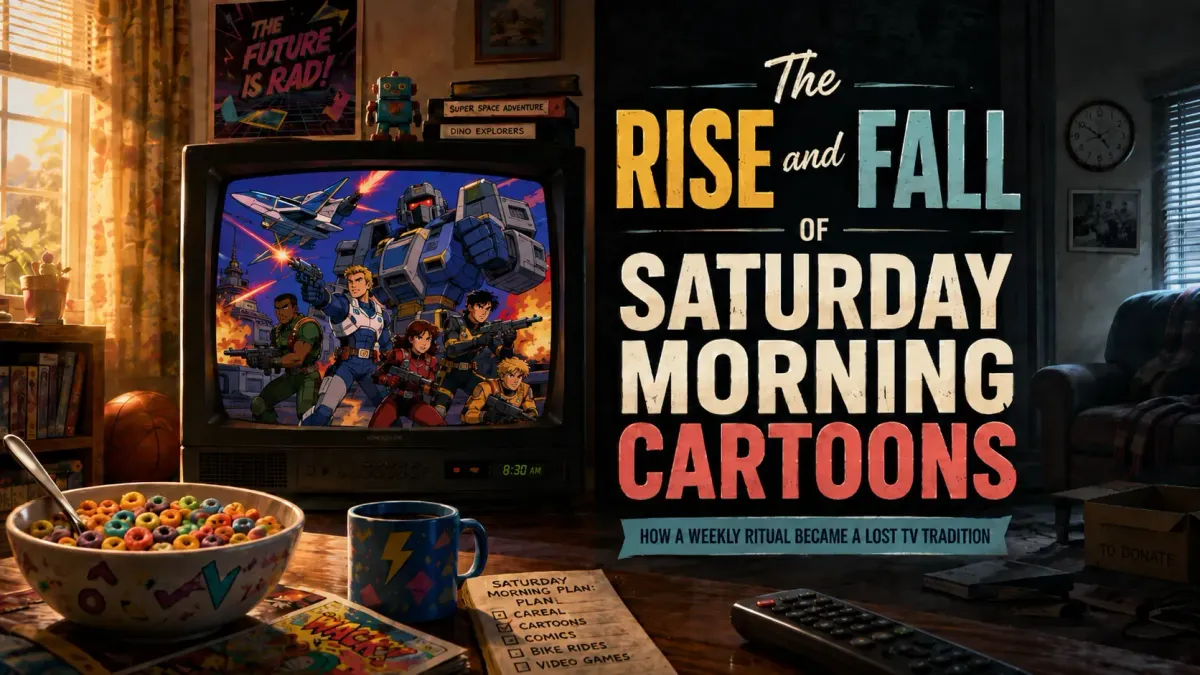
For generations of American kids, Saturday morning had a routine all its own: wake up before your parents, grab a bowl of cereal, claim a spot in front of the television and disappear into several hours of cartoons.
There was no streaming service and no endless library waiting whenever you wanted it. If you wanted Scooby-Doo, Super Friends, The Smurfs or whatever else was on the schedule, you watched when the network told you to watch.
For decades, that meant Saturday morning.
How Saturday Morning Became Cartoon Morning
Cartoons weren’t always primarily children’s television. Many of the classic animated shorts Americans watched on early TV had originally been produced for movie theaters, while shows such as The Flintstones and The Jetsons initially aired in prime time. That began changing rapidly during the 1960s, when television studios found more economical ways to produce animation. Saturday morning offered networks something especially valuable: millions of children were home from school and available to watch at the same time.
By 1966, ABC, CBS and NBC were all airing Saturday-morning animation blocks, helping establish a television tradition that would last for decades. PBS’s history of television animation describes just how extensive the programming became. By the 1960s, children could find nearly three hours of animated programming on each of the three major networks every Saturday morning, and advertisers knew exactly who was watching.
Cartoons, Cereal and a Captive Audience
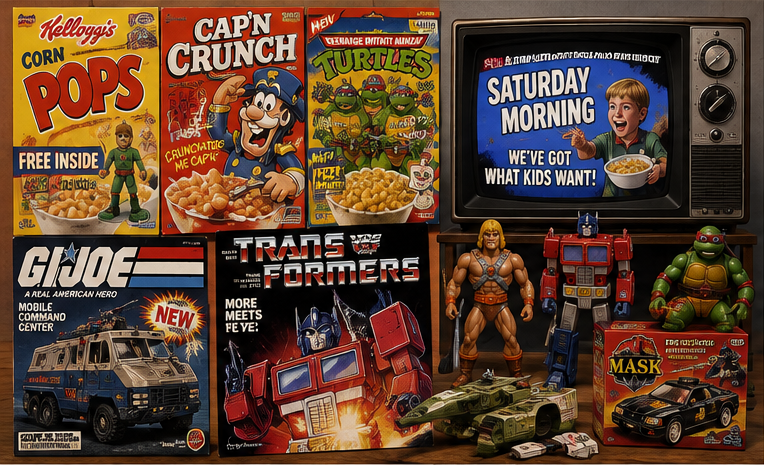
Saturday morning wasn’t simply a convenient place to put cartoons; it became an extraordinarily effective way to reach children. Toy makers, cereal companies, candy manufacturers and other advertisers could reach a large audience of kids during a predictable block of programming. Advertising soon became inseparable from the experience, with cartoons interrupted by commercials for brightly colored cereal, action figures, dolls and toys—many featuring animated mascots of their own.
Research illustrates just how much advertising children were seeing. One study examining 25.5 hours of weekend children’s programming in 1975 counted 614 advertisements, while another examining 12 hours of Saturday-morning programming in 1987 counted 225 ads. By the late 1980s, researchers reported that Saturday-morning programming averaged nearly 11 minutes of product commercials per hour.
Saturday morning wasn’t just television
It was a marketplace.
The Golden Age
By the 1970s and 1980s, the Saturday-morning cartoon had become an American institution. Hanna-Barbera emerged as one of the era’s giants, producing shows including Scooby-Doo, Super Friends, Captain Caveman and countless others. Other studios joined the competition, filling network schedules with superheroes, mysteries, comedies and, eventually, programs closely connected to toys.
That relationship grew even stronger during the 1980s. Shows including He-Man and the Masters of the Universe, Transformers, G.I. Joe and My Little Pony demonstrated just how closely television and merchandising could work together. For children, however, none of that business strategy mattered. Saturday morning meant hours when the television effectively belonged to them, and because millions of kids watched many of the same shows at approximately the same time, those cartoons became a shared cultural experience.
Then the Television World Changed
Saturday morning cartoons didn't disappear because children suddenly stopped liking cartoons. Instead, the reason for their existence began disappearing.
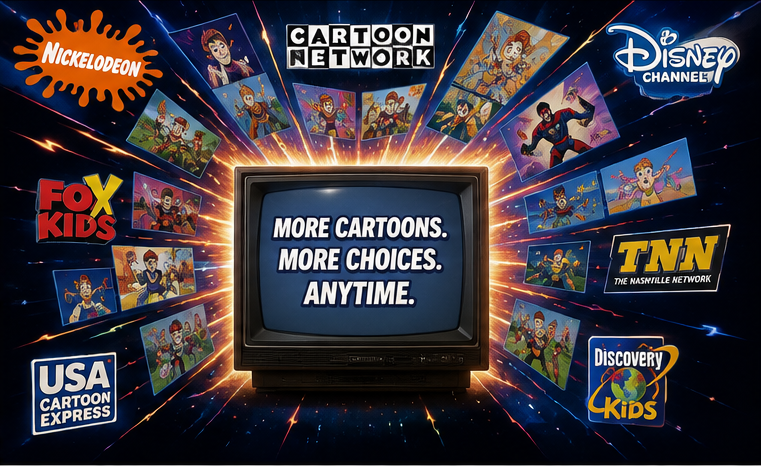
One of the biggest changes was cable television. Nickelodeon gave children programming throughout the day. The Disney Channel expanded. And in 1992, Cartoon Network launched an entire channel built around animation. Suddenly there was nothing particularly special about finding cartoons on Saturday morning. Kids could watch them Tuesday afternoon, Thursday evening, or practically anytime.
Broadcast television tried to compete. Fox Kids arrived in 1990, while Kids' WB followed later in the decade. ABC launched its memorable One Saturday Morning block in 1997. For a while, Saturday mornings remained competitive.
But the audience was fragmenting across more channels and more forms of entertainment.
New Rules Changed Saturday Morning Too
There was another major change happening behind the scenes.
Congress passed the Children's Television Act of 1990, designed in part to increase educational programming for children and place limits on advertising during children's shows.
The Federal Communications Commission strengthened implementation of those requirements in 1996. The FCC established a guideline of approximately three hours per week of regularly scheduled educational and informational children's programming for broadcasters.
For local television stations, Saturday morning was increasingly valuable real estate. Instead of carrying large blocks of entertainment cartoons, stations could use portions of that schedule for programming that helped satisfy educational requirements—or for news and other programming attractive to advertisers.
Cartoons were no longer the obvious choice they once had been.
The Beginning of the End
One of the clearest signals arrived in 1992. NBC abandoned traditional Saturday-morning cartoons and shifted toward live-action teen programming under its TNBC banner, fueled in part by the success of Saved by the Bell. Other networks gradually reduced their reliance on cartoons as well. Meanwhile, children's viewing habits continued changing.
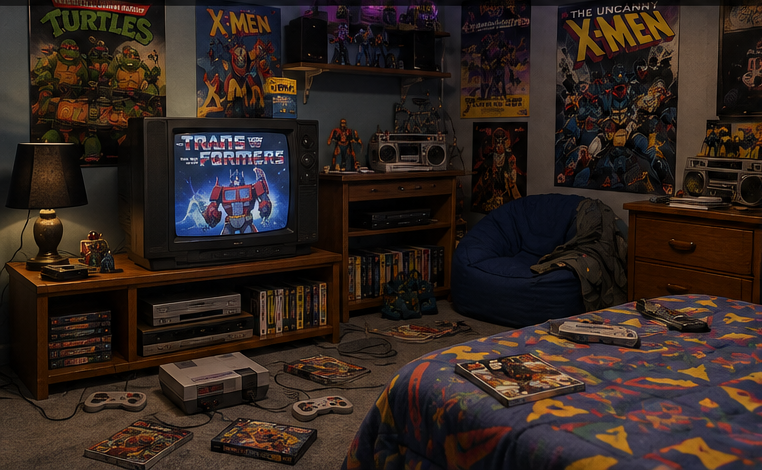
Cable television offered cartoons every day. VHS tapes allowed favorite programs to be watched repeatedly. Video games competed for children's attention. DVDs followed. Then came digital television, on-demand programming, YouTube and streaming.
The defining feature of Saturday morning television—you had to be there when it aired—was disappearing.
The Last Saturday Morning
Saturday morning cartoons didn't end with one dramatic cancellation. They slowly faded away. But there is a symbolic ending. On September 27, 2014, The CW aired the final edition of its Vortexx programming block. The five-hour Saturday-morning block had featured animated programming alongside some live-action shows.
The following week it was replaced by One Magnificent Morning, a live-action educational programming block. After nearly half a century, the traditional Saturday-morning cartoon block on the major American broadcast networks was effectively over.
What We Gained—and What We Lost
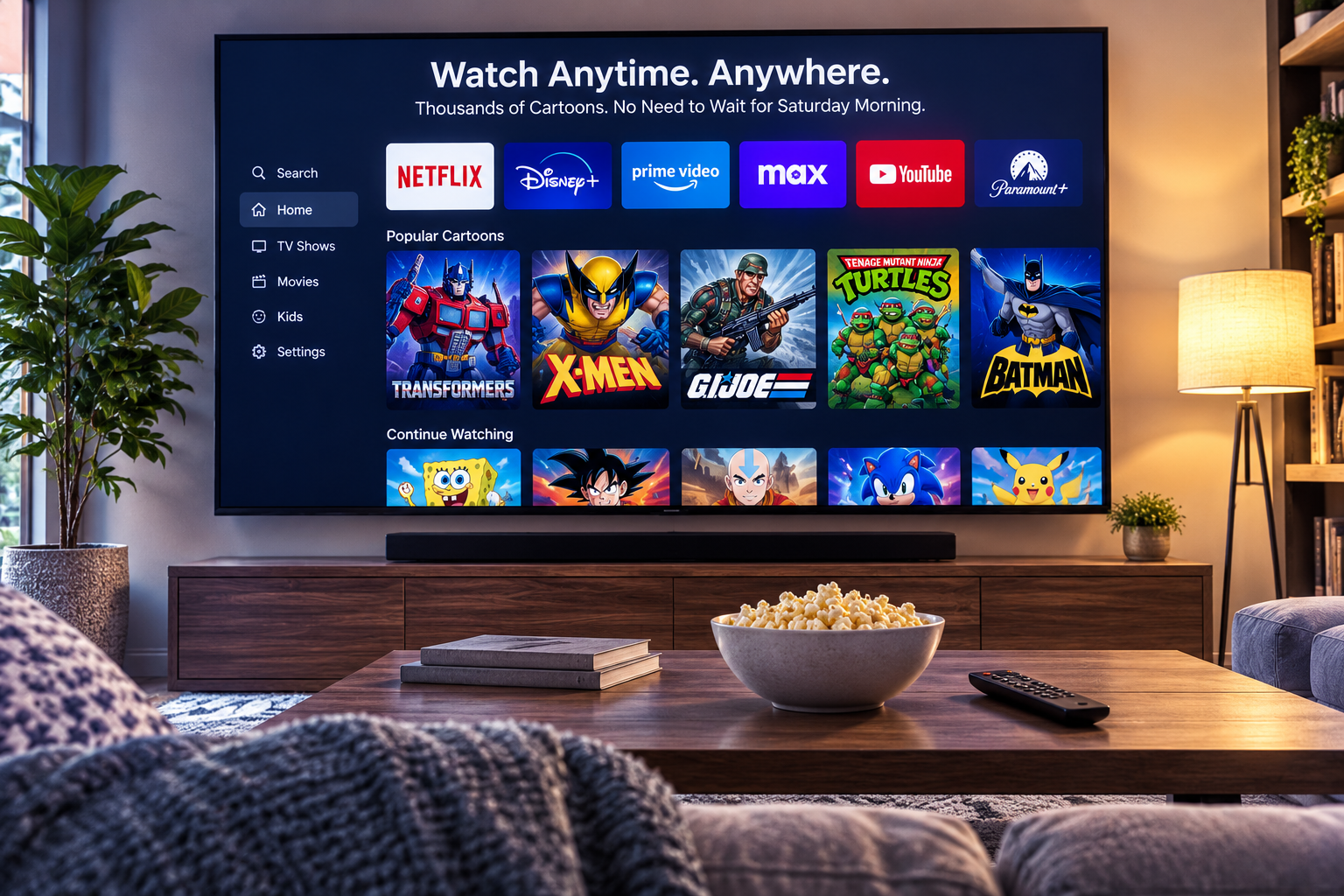
Kids today have access to something a child in 1985 could barely have imagined. Thousands upon thousands of episodes of animation are available almost instantly. A favorite cartoon doesn't have to be watched at 9:30 Saturday morning. It can be watched whenever someone wants it. That's unquestionably convenient. But something disappeared along the way.
Saturday morning cartoons weren't memorable simply because of the cartoons themselves. They were memorable because of the ritual. Millions of kids woke up on the same morning, watched many of the same programs and saw many of the same commercials.
You couldn't pause it.
You couldn't choose the next episode.
And if you slept too late, you missed it.
Today we have more cartoons than ever.
What we don't have is Saturday morning.
Recommended
What Would Your Wizarding Career Be?
Answer 25 personality questions and discover whether you're destined to be an Auror, Healer, Professor, Curse-Breaker, Wandmaker or another wizarding professional.
10 of the Most Recognizable Careers in the Harry Potter Wizarding World
From Aurors and Healers to Hogwarts professors and Quidditch players, explore 10 of the most recognizable jobs in the Harry Potter Wizarding World.

Exosquad at 33: The ’90s Cartoon That Treated Space War Like It Mattered
Thirty-three years after its premiere, Exosquad remains a remarkably ambitious animated war epic built on serialized storytelling, political consequence and unforgettable E-frames.