
The TV Networks That Ruled the 1990s
NBC had Friends, ABC had Home Improvement, CBS had 60 Minutes and Fox had Bart Simpson and the NFL. Here is who truly ruled 1990s television.
NBC had Friends. ABC had Home Improvement. CBS had 60 Minutes. Fox had Bart Simpson and the NFL. But which network truly owned the decade?
Before streaming queues, YouTube and hundreds of on-demand choices, television in the 1990s still revolved around a remarkably small number of networks. For millions of Americans, the nightly question was not which app to open. It was whether to watch NBC, ABC, CBS or Fox. NBC has the strongest claim as the television network that ruled the 1990s, particularly during the decade’s second half. ABC and CBS each led portions of the decade, while Fox transformed the traditional Big Three into the Big Four
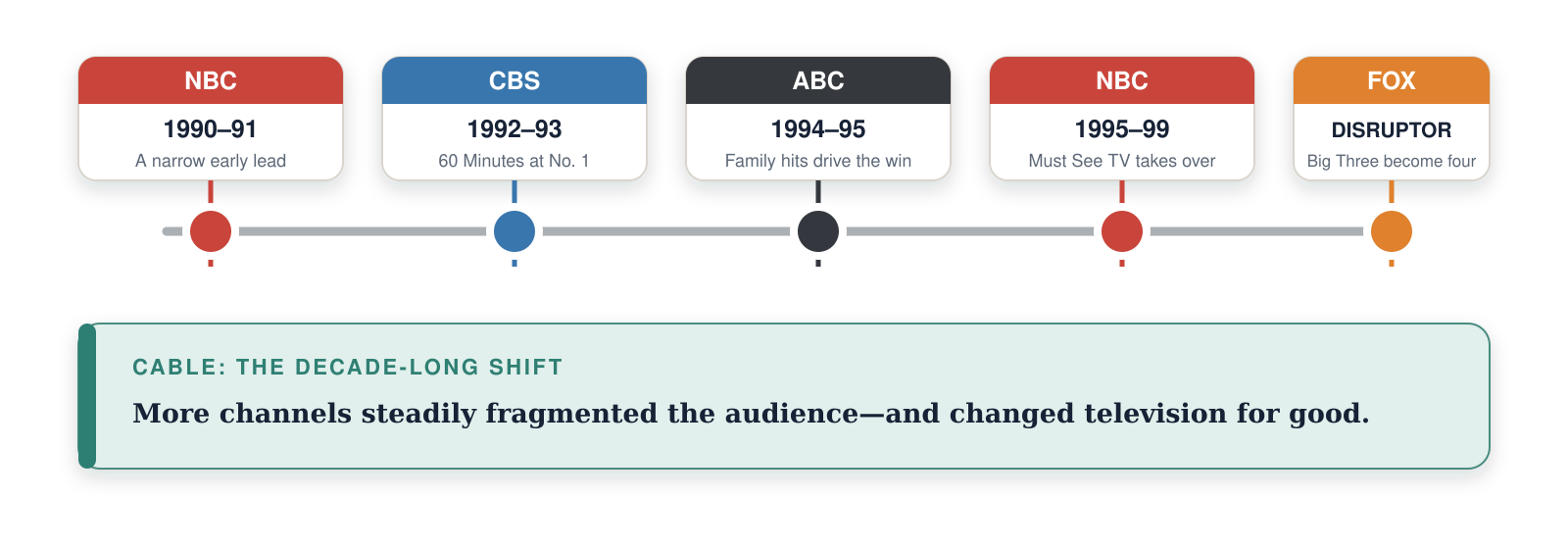
The decade began with the traditional Big Three still dominating American television. By the end of the 1990s, Fox had firmly established itself as a fourth major broadcast network, cable television had become a serious competitor and audiences were beginning to fragment in ways that would eventually reshape television entirely. So which network ruled the 1990s? The answer depends on when during the decade you were watching.
NBC: The network that ultimately won the ’90s

If one network has the strongest claim to being television’s king of the 1990s, it is NBC. The network entered the decade already on top. During the 1990–91 television season, NBC finished first among the three major networks with a 12.7 Nielsen rating, narrowly ahead of ABC at 12.5 and CBS at 12.3. It was NBC’s sixth consecutive season victory.
Must See TV
Thursday night became one of the most valuable pieces of television real estate in America. NBC assembled a run of programs that included Seinfeld, Friends, Frasier, ER, Mad About You, Wings, Caroline in the City and 3rd Rock from the Sun.
NBC’s 1990s identity: Big comedies, prestigious dramas and Thursday-night dominance.
ABC: The family television powerhouse

NBC may be most associated with sophisticated Thursday-night sitcoms, but ABC arguably defined mainstream family television during the first half of the 1990s. Its lineup included Roseanne, Home Improvement, Full House, Family Matters, Step by Step, Coach, The Wonder Years, America’s Funniest Home Videos, NYPD Blue and Monday Night Football.
TGIF
For children and families growing up during the decade, the letters TGIF became nearly synonymous with Friday night. Programs such as Full House, Family Matters, Step by Step and Boy Meets World turned the end of the school week into a recurring television ritual.
ABC’s 1990s identity: Family sitcoms, broad mainstream programming and sports.
CBS: The network that refused to disappear

CBS entered the decade with something of an image problem. Its audience skewed older than some advertisers preferred while competitors increasingly targeted younger viewers. But dismissing CBS would have been a mistake. The network had enormous programs including 60 Minutes, Murphy Brown, Murder, She Wrote, Northern Exposure, Walker, Texas Ranger, The Nanny, Touched by an Angel and Everybody Loves Raymond.
During the 1992–93 season, CBS’s 60 Minutes was the No. 1-rated program in America, ahead of ABC’s Roseanne and Home Improvement.
CBS’s 1990s identity: Established hits, news magazines and an older but extremely loyal audience.
Fox: The network that changed everything

At the beginning of the decade, calling Fox an equal competitor to NBC, ABC and CBS would have been generous. By the end of the decade, nobody questioned it. Fox targeted younger audiences with programs the established networks often would not have aired, including The Simpsons, Married… with Children, Beverly Hills, 90210, Melrose Place, The X-Files, In Living Color, Cops and America’s Most Wanted.
Then came sports. Fox’s push into major professional sports dramatically increased its national relevance and affiliate strength. The television industry no longer talked only about the Big Three. It increasingly talked about the Big Four.
Fox’s 1990s identity: Younger audiences, edgy programming, pop culture and sports.
Then cable started stealing everyone’s audience
There was another winner in the 1990s that did not fit neatly into the network ratings race: cable television. MTV, Nickelodeon, ESPN, CNN, Discovery and TNT were not one network but an entire collection of competitors slowly taking viewers away from broadcast television.
During the 1994–95 season, ABC, NBC and CBS together captured only about 57 percent of the television audience. The fragmentation of television had begun.
Who actually ruled the 1990s?
| Era | Strongest claim | Why |
|---|---|---|
| Early 1990s | NBC / ABC | NBC began as ratings champion while ABC’s family sitcom empire surged. |
| 1992–1995 | ABC / CBS | CBS won 1992–93 while ABC captured 1994–95. |
| 1995–1999 | NBC | ER, Seinfeld, Friends and the Must See TV machine. |
| Biggest disruptor | Fox | Turned the Big Three into the Big Four. |
| Biggest long-term threat | Cable | Slowly pulled audiences away from every broadcast network. |
There was no single network that dominated every year. Viewed across the entire decade, however, NBC has the strongest overall claim to the crown. Its programming defined prime-time television during the second half of the 1990s, and few lineups in history can match the cultural impact of Friends, Seinfeld, Frasier and ER running during overlapping years.
ABC deserves a close second for its enormous early-’90s sitcom empire. CBS remained a ratings powerhouse throughout much of the period. Fox deserves perhaps the most important distinction of all: it permanently changed the structure of American television.
The last great network television era
Perhaps the most interesting thing about the 1990s is not which network finished first. It is how much power television networks still had. Viewers organized their schedules around television: Thursday meant NBC, Friday meant ABC, Sunday meant CBS and 60 Minutes, and Fox offered something different.
There were more choices than ever before, but still few enough that tens of millions of Americans routinely watched the same shows at the same time. Cable accelerated the fragmentation. The internet accelerated it again. Streaming would eventually rewrite the rules completely.
The 1990s became the decade when America’s great broadcast networks were still powerful enough to dominate popular culture—but no longer powerful enough to dominate television forever.
Recommended

What Would Your Wizarding Career Be?
Answer 25 personality questions and discover whether you're destined to be an Auror, Healer, Professor, Curse-Breaker, Wandmaker or another wizarding professional.

10 of the Most Recognizable Careers in the Harry Potter Wizarding World
From Aurors and Healers to Hogwarts professors and Quidditch players, explore 10 of the most recognizable jobs in the Harry Potter Wizarding World.

Exosquad at 33: The ’90s Cartoon That Treated Space War Like It Mattered
Thirty-three years after its premiere, Exosquad remains a remarkably ambitious animated war epic built on serialized storytelling, political consequence and unforgettable E-frames.