
America Has Less Cropland Than at Any Time Since 1945
America still produces enormous amounts of crops, but it is doing so with less land classified as cropland than at any point since 1945.
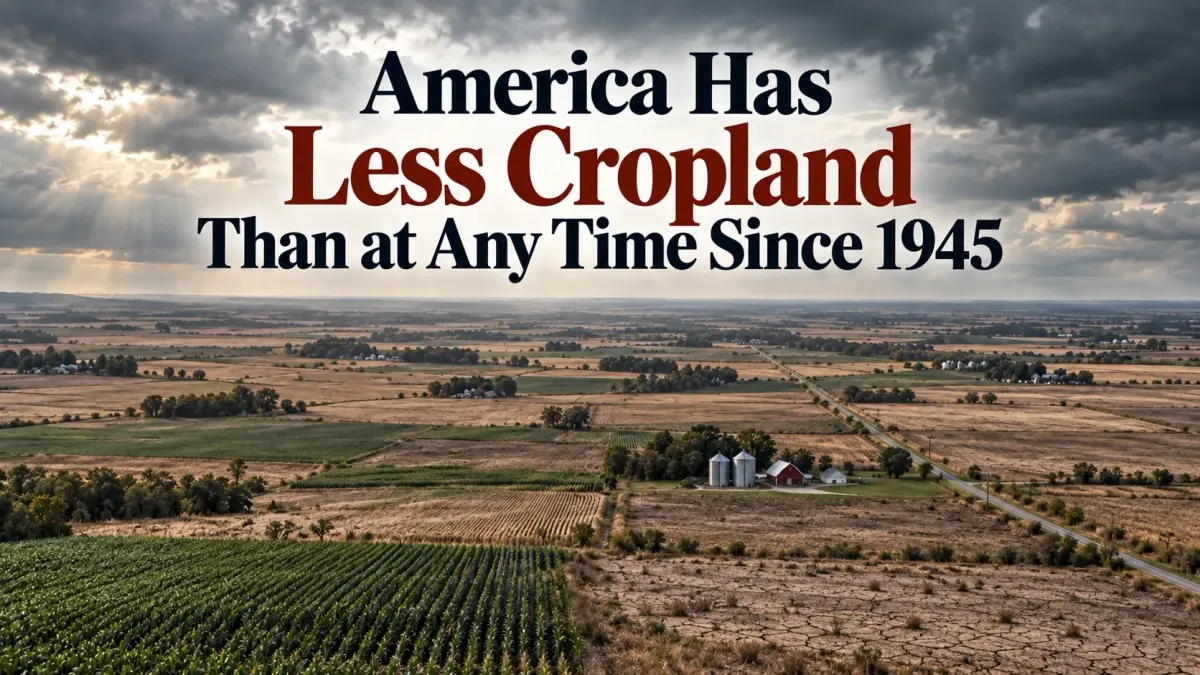
The United States still grows an extraordinary amount of food, feed and fuel, even as the amount of land officially classified as cropland has fallen to a modern low.
Drive through Iowa, Illinois, Nebraska or Kansas in summer and America's farmland can seem endless: cornfields stretch beyond the horizon, soybean fields are divided only by rural roads, and wheat farms can cover thousands of acres. Yet USDA data reveal a counterintuitive trend—America has less cropland than it once did.
According to the latest data from the U.S. Department of Agriculture's Economic Research Service, the United States had approximately 377 million acres of cropland in 2022.
377 million acres — America's total cropland in 2022
That was 13 million acres fewer than in 2017, when the total stood at 390 million, and it represents the lowest level recorded in USDA's Major Land Uses series, which dates to 1945.
The decline does not mean American farming is disappearing. In important ways, rising productivity tells the opposite story.
Cropland Has Been Gradually Shrinking for Decades
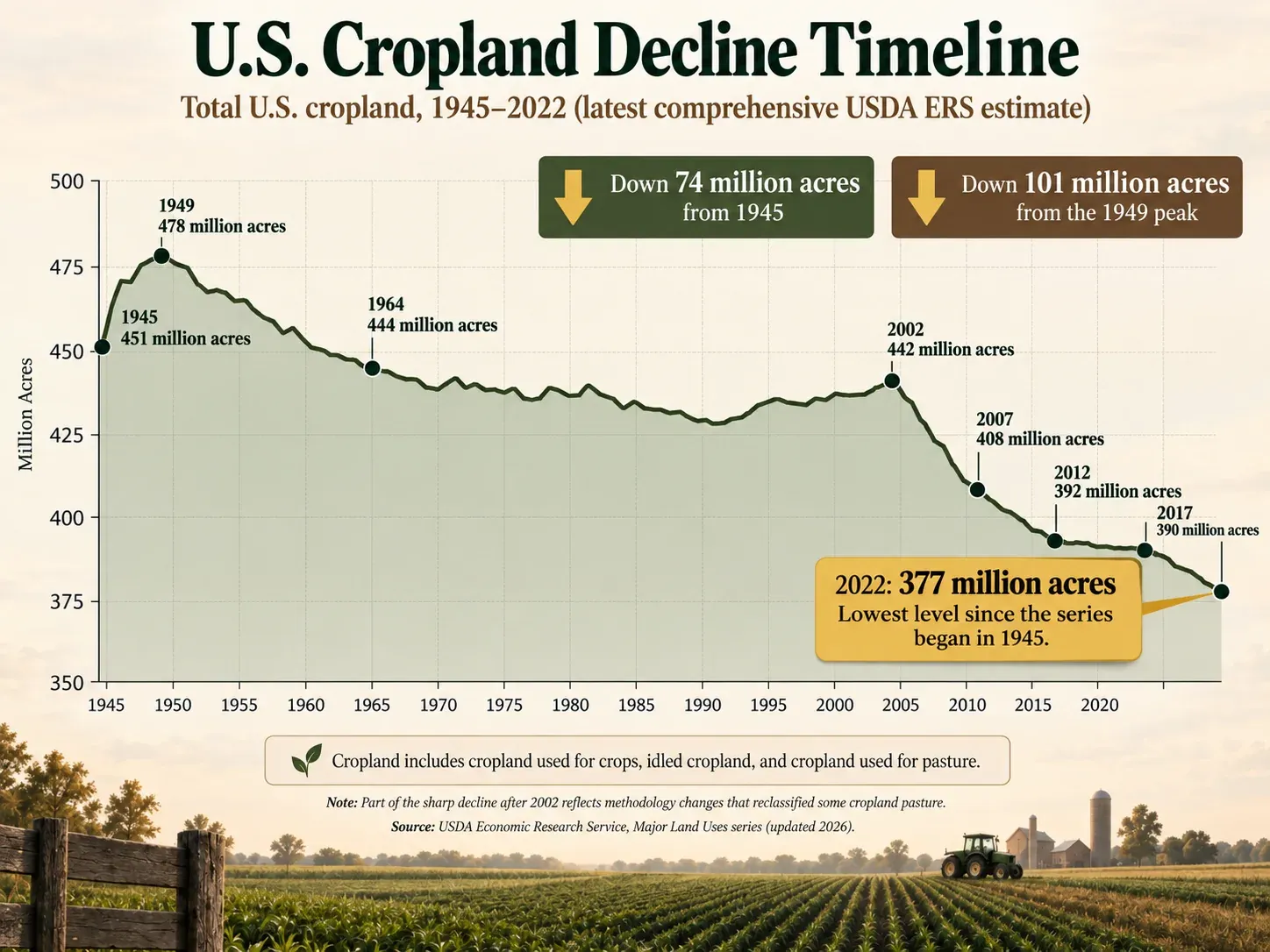
In 1959, the United States had considerably more land classified as cropland than it does today. By 2022, total cropland acreage had fallen approximately 18% from its 1959 level.
This was not a sudden drop. USDA reported that cropland had already reached a record low of 390 million acres in 2017, then the lowest total since the Major Land Uses series began.
Five years later, the total fell another 13 million acres, making 2022 the newest low point in a decline that has unfolded over generations.
Cropland Doesn't Just Mean Fields Being Harvested
USDA's definition of cropland is broader than the fields producing corn, soybeans or other crops in a given year. The category combines cropland used for crops, idled cropland, and cropland used for pasture.
Cropland used for crops includes harvested acreage as well as crop failures and cultivated summer fallow. The country's 377 million acres therefore represent more than the fields that produced a crop in 2022; the figure measures the broader agricultural land base capable of—or historically associated with—crop production.
Less Cropland Doesn't Necessarily Mean Less Food
The more revealing part of America's agricultural story is that cropland has declined while productivity has risen dramatically. Improved crop varieties, mechanization, fertilizer, irrigation, better pest and disease control, precision agriculture and other technologies allow farmers to produce far more from individual acres than they could in the middle of the 20th century.
USDA says these technological changes have increased productivity enough that more agricultural production can be obtained from the same cropland base. (USDA Land Use, Land Value and Tenure)
For much of human history, producing substantially more food required putting substantially more land into production. Modern agriculture has changed that relationship, allowing output to grow without acreage expanding at the same rate.
Where Did the Cropland Go?
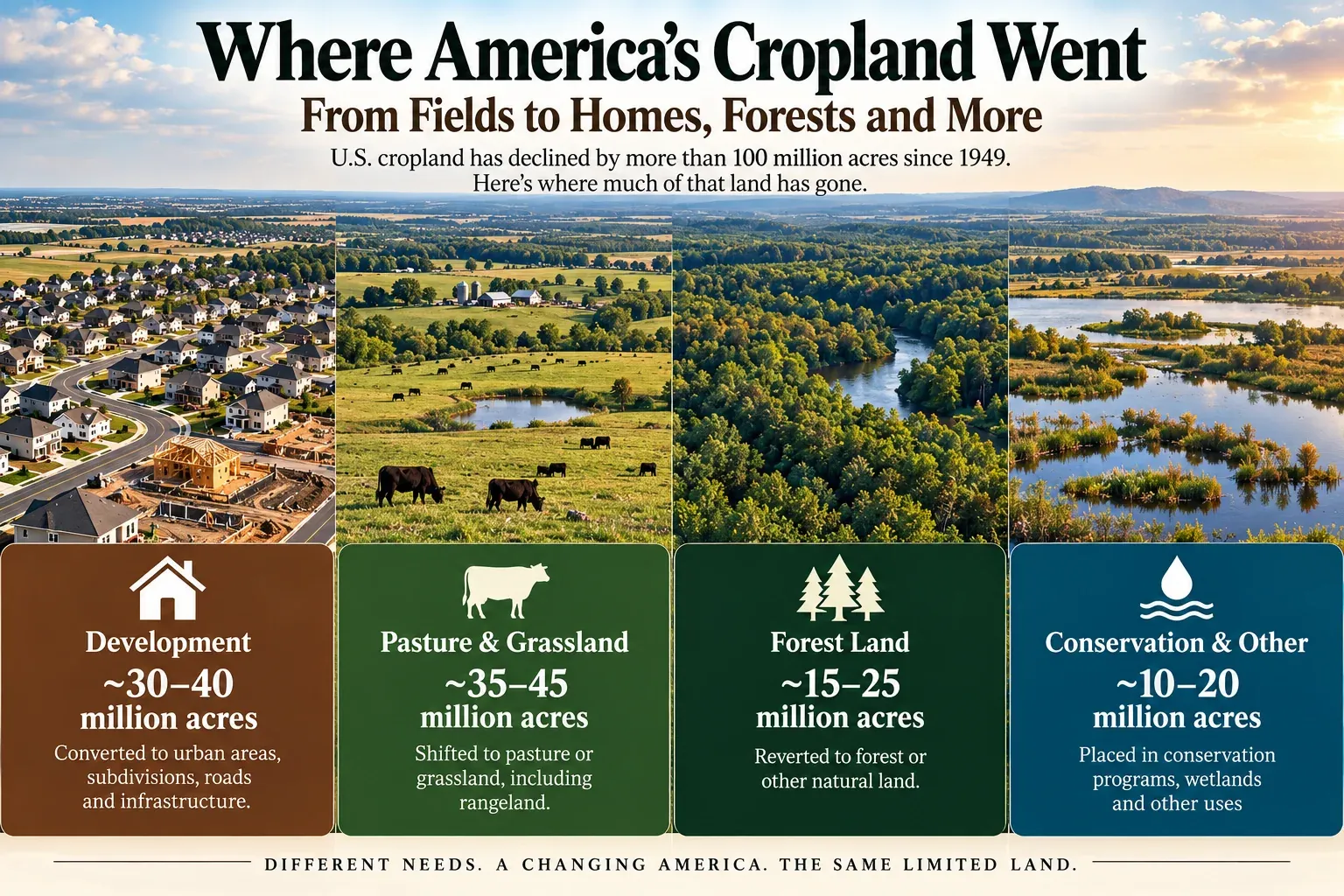
No single factor explains the decline. Land moves from one use to another in response to economics, public policy, development and environmental conditions. USDA points to commodity and timber prices, agricultural and conservation policies, urban pressure and drought among the forces that shape those decisions.
The pattern also varies sharply by region. USDA has identified clearer long-term cropland declines in parts of the Northeast and Southeast, where development pressure and the economics of farming can make other uses more valuable. Elsewhere, acreage may shift into pasture, forest, conservation programs or other categories.
Some land can move back and forth among crops, grazing and forest, but urban development is much harder to reverse. USDA notes that conversions to urban use are typically irreversible. (USDA Major Land Uses) Once a subdivision, highway or shopping center replaces farmland, that acreage rarely returns to crop production.
America's Crops Have Changed Too
The amount of cropland is not the only thing that has changed; what farmers plant has shifted considerably as well. USDA reports that wheat acreage fell about 50% from its early-1980s peak, influenced by international competition, conservation programs and improvements that allowed corn and soybeans to expand into regions where wheat had once been more dominant.
Soybean acreage, by contrast, more than tripled from the 1960s through 2017 as international demand grew, while corn acreage also benefited from demand associated with biofuels. America's agricultural map, in other words, does not simply shrink or grow—it continually rearranges itself.
377 Million Acres Is Still an Enormous Amount of Land
Calling America's cropland a historic low can make the decline sound more dramatic than it is. 377 million acres remains an immense agricultural landscape, larger than many countries and still one of the largest components of the American land base.
The direction of the trend nevertheless matters. In 1959, agricultural uses accounted for approximately 59% of the U.S. land base; by 2022, that share had fallen to about 51%. Cropland is one part of that long transition.
America remains a farming powerhouse, but it now produces on fewer acres of cropland than at any point since USDA began tracking the figure more than three-quarters of a century ago.
Source
USDA Economic Research Service's Major Land Uses dataset, updated in August 2026. The series includes national, regional and state estimates dating to 1945, while USDA's annual cropland-used-for-crops series extends back to 1910.
Continue Reading
Recommended
What Would Your Wizarding Career Be?
Answer 25 personality questions and discover whether you're destined to be an Auror, Healer, Professor, Curse-Breaker, Wandmaker or another wizarding professional.

10 of the Most Recognizable Careers in the Harry Potter Wizarding World
From Aurors and Healers to Hogwarts professors and Quidditch players, explore 10 of the most recognizable jobs in the Harry Potter Wizarding World.

Exosquad at 33: The ’90s Cartoon That Treated Space War Like It Mattered
Thirty-three years after its premiere, Exosquad remains a remarkably ambitious animated war epic built on serialized storytelling, political consequence and unforgettable E-frames.